Beondegi
 Beondegi in a cup, with toothpicks as utensils | |
| Course | Street food |
|---|---|
| Associated cuisine | Korean cuisine |
| Main ingredients | Silkworm pupae |
| Similar dishes | Nhộng tằm |
| Korean name | |
| Hangul | 번데기 |
| RR | beondegi |
| MR | pŏndegi |
| IPA | pʌn.de.ɡi |
Beondegi (Korean: 번데기), literally "pupa", is a Korean insect-based street food made with silkworm pupae.[1]
The boiled or steamed snack food is served in paper cups with toothpick skewers.[2][3] Its aroma has been described as "nutty, shrimp-like, and a bit like canned corn" and the canned-type smells very much "like tire rubber", while the texture is firm and chewy.[4]
Beondegi is also served in soup form as beondegi-tang. This soup is flavoured with soy sauce, chili, garlic, green onions and red pepper powder. It is typically served as an anju (food consumed with alcohol) at pubs.[4]
Canned beondegi and beondegi-tang can also be found in supermarkets and convenience stores.[3][4]
History
Although sericulture in Korea dates back 4,000 years, consumption of silkworm pupae—a byproduct of extracting the raw silk fiber from the cocoon—had been an endemic practice in silk farming areas. Widespread consumption in South Korea began after the Korean War, during a period of economic reconstruction when the government heavily promoted raw silk production as an export industry with low technological or capital barriers to entry.
By the 1970s, the overflow of the byproduct provided a cheap source of protein before economic growth allowed broader access to meat supply.[4][5][6] Through the end of the 20th century, beondegi was frequently available from street food vendors, and especially near schools, which made it a popular snack children and students could afford.
The relative ubiquity of beondegi stalls in daily Korean life ended by the early 2000s due to several economic factors: street stalls faced crackdowns as part of governmental regulation efforts against the informal economy, and economic development in South Korea meant more snack options were available for children. Despite the decline, demand holds steady as canned beondegi made home consumption possible and is widely available in stores.
Nutritional content
Silkworm pupae are a nutrient-dense food, containing approximately 55–60% protein by dry weight, along with significant levels of unsaturated fatty acids, iron, zinc, and B vitamins. They provide a high-quality protein source comparable to beef or fish, making them a valuable dietary component in contexts of food insecurity.[7]
Gallery
-
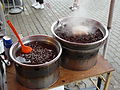 Beondegi sold by a street vendor
 -
 Canned beondegi


References
- ^ Pettid, Michael J. (2008). Korean Cuisine: An Illustrated History. London: Reaktion Books. p. 173. ISBN 978-1-86189-348-2.
- ^ Kraig, Bruce; Sen, Colleen Taylor, eds. (2013). Street Food around the World: An Encyclopedia of Food and Culture. Santa Barbara, CA: ABC-CLIO. p. 320. ISBN 978-1-59884-954-7.
- ^ a b "Beondegi | Traditional Insect Dish From South Korea | TasteAtlas". www.tasteatlas.com. Retrieved 2022-08-24.
- ^ a b c d "Salty Silkworm Pupae Are the One Street Food You Shouldn't Miss in South Korea". Matador Network. Retrieved 2022-08-24.
- ^ 김미혜. 번데기. Encyclopedia of Korean Culture (in Korean). Academy of Korean Studies. Retrieved 17 April 2025.
- ^ Kurovski, Jillian; Sexton, Nicole R.; Pannier, Angela K.; Hebets, Eileen A. (2026-02-02). "Arthropods as Models for Transdisciplinary Bio-Inspired Research and Discovery". Insects. 17 (2): 165. doi:10.3390/insects17020165. ISSN 2075-4450. PMC 12940437. PMID 41752567.
- ^ Olenici, Nicolai; Duduman, Mihai-Leonard; Popa, Ionel; Isaia, Gabriela; Paraschiv, Marius (2022-07-12). "Geographical Distribution of Three Forest Invasive Beetle Species in Romania". Insects. 13 (7): 621. doi:10.3390/insects13070621. ISSN 2075-4450. PMC 9316972. PMID 35886797.
External links


 | This Korean cuisine–related article is a stub. You can help Wikipedia by adding missing information. |
Content Disclaimer
Informasi ini disarikan dari Wikipedia dan disajikan kembali untuk tujuan edukasi. Konten tersedia di bawah lisensi CC BY-SA 3.0. Kami tidak bertanggung jawab atas ketidakakuratan data yang bersumber dari kontribusi publik tersebut.
- The information displayed on this website is sourced in part or in whole from Wikipedia and has been adapted for the purpose of restating it. We strive to provide accurate and relevant information, however:
- There is no guarantee of absolute accuracy. Wikipedia is an open, collaborative project that can be edited by anyone, so information is subject to change.
- It is not intended to constitute professional advice. The content displayed is for informational and educational purposes only. For important decisions (e.g., medical, legal, or financial), please consult a professional.
- Content copyright. Wikipedia is licensed under the Creative Commons Attribution-ShareAlike License (CC BY-SA). This means that content may be reused with appropriate attribution and shared under a similar license.
- Responsible use. Any risk arising from the use of information from this website is entirely the responsibility of the user.