Konchoida


Konchoida – typ krzywej płaskiej o specjalnej konstrukcji.
Konstrukcja krzywej
Niech będą dane punkt krzywa i liczba niezerowa


Dowolny punkt krzywej wyznacza na prostej punkt oddalony od o odległość w stronę punktu lub w stronę przeciwną zależności od znaku liczby formalnie


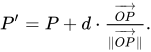
Zbiór wszystkich punktów tworzy konchoidę.
Rodzaje
W zależności od typu krzywej wyróżnia się konchoidy[1]:
- prostej – konchoidę Nikomedesa
- okręgu – ślimak Pascala
Zobacz też
Przypisy
- ↑ konchoida, [w:] Encyklopedia PWN [online], Wydawnictwo Naukowe PWN [dostęp 2021-09-29].
Linki zewnętrzne
- Eric W. Weisstein, Conchoid, [w:] MathWorld, Wolfram Research (ang.). [dostęp 2026-01-19].
 Conchoid (ang.), Encyclopedia of Mathematics, encyclopediaofmath.org [dostęp 2025-04-23].
- Conchoid (ang.), MacTutor History of Mathematics archive – University of St Andrews, mathshistory.st-andrews.ac.uk [dostęp 2026-01-18].


Content Disclaimer
Informasi ini disarikan dari Wikipedia dan disajikan kembali untuk tujuan edukasi. Konten tersedia di bawah lisensi CC BY-SA 3.0. Kami tidak bertanggung jawab atas ketidakakuratan data yang bersumber dari kontribusi publik tersebut.
- The information displayed on this website is sourced in part or in whole from Wikipedia and has been adapted for the purpose of restating it. We strive to provide accurate and relevant information, however:
- There is no guarantee of absolute accuracy. Wikipedia is an open, collaborative project that can be edited by anyone, so information is subject to change.
- It is not intended to constitute professional advice. The content displayed is for informational and educational purposes only. For important decisions (e.g., medical, legal, or financial), please consult a professional.
- Content copyright. Wikipedia is licensed under the Creative Commons Attribution-ShareAlike License (CC BY-SA). This means that content may be reused with appropriate attribution and shared under a similar license.
- Responsible use. Any risk arising from the use of information from this website is entirely the responsibility of the user.