Self-adjoint element
In mathematics, an element of a *-algebra is called self-adjoint if it is the same as its adjoint (i.e. ).

Definition
Let be a *-algebra. An element is called self-adjoint if .[1]


The set of self-adjoint elements is referred to as .

A subset that is closed under the involution *, i.e. , is called self-adjoint.[2]


A special case of particular importance is the case where is a complete normed *-algebra, that satisfies the C*-identity (), which is called a C*-algebra.

Especially in the older literature on *-algebras and C*-algebras, such elements are often called hermitian.[1] Because of that the notations , or for the set of self-adjoint elements are also sometimes used, even in the more recent literature.


Examples
- Each positive element of a C*-algebra is self-adjoint.[3]
- For each element of a *-algebra, the elements and are self-adjoint, since * is an involutive antiautomorphism.[4]
- For each element of a *-algebra, the real and imaginary parts and are self-adjoint, where denotes the imaginary unit.[1]
- If is a normal element of a C*-algebra , then for every real-valued function , which is continuous on the spectrum of , the continuous functional calculus defines a self-adjoint element .[5]






Criteria
Let be a *-algebra. Then:
- Let , then is self-adjoint, since . A similarly calculation yields that is also self-adjoint.[6]
- Let be the product of two self-adjoint elements . Then is self-adjoint if and commutate, since always holds.[1]
- If is a C*-algebra, then a normal element is self-adjoint if and only if its spectrum is real, i.e. .[5]





Properties
In *-algebras
Let be a *-algebra. Then:
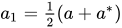
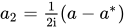
- Each element can be uniquely decomposed into real and imaginary parts, i.e. there are uniquely determined elements , so that holds. Where and .[1]
- The set of self-adjoint elements is a real linear subspace of . From the previous property, it follows that is the direct sum of two real linear subspaces, i.e. .[7]
- If is self-adjoint, then is normal.[1]
- The *-algebra is called a hermitian *-algebra if every self-adjoint element has a real spectrum .[8]



In C*-algebras
Let be a C*-algebra and . Then:
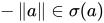
- For the spectrum or holds, since is real and holds for the spectral radius, because is normal.[9]
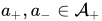
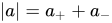
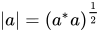
- According to the continuous functional calculus, there exist uniquely determined positive elements , such that with . For the norm, holds.[10] The elements and are also referred to as the positive and negative parts. In addition, holds for the absolute value defined for every element .[11]
- For every and odd , there exists a uniquely determined that satisfies , i.e. a unique -th root, as can be shown with the continuous functional calculus.[12]










See also
Notes
- ^ a b c d e f Dixmier 1977, p. 4.
- ^ Dixmier 1977, p. 3.
- ^ Palmer 2001, p. 800.
- ^ Dixmier 1977, pp. 3–4.
- ^ a b Kadison & Ringrose 1983, p. 271.
- ^ Palmer 2001, pp. 798–800.
- ^ Palmer 2001, p. 798.
- ^ Palmer 2001, p. 1008.
- ^ Kadison & Ringrose 1983, p. 238.
- ^ Kadison & Ringrose 1983, p. 246.
- ^ Dixmier 1977, p. 15.
- ^ Blackadar 2006, p. 63.
References
- Blackadar, Bruce (2006). Operator Algebras. Theory of C*-Algebras and von Neumann Algebras. Berlin/Heidelberg: Springer. p. 63. ISBN 3-540-28486-9.
- Dixmier, Jacques (1977). C*-algebras. Translated by Jellett, Francis. Amsterdam/New York/Oxford: North-Holland. ISBN 0-7204-0762-1. English translation of Les C*-algèbres et leurs représentations (in French). Gauthier-Villars. 1969.
- Kadison, Richard V.; Ringrose, John R. (1983). Fundamentals of the Theory of Operator Algebras. Volume 1 Elementary Theory. New York/London: Academic Press. ISBN 0-12-393301-3.
- Palmer, Theodore W. (2001). Banach algebras and the general theory of*-algebras: Volume 2,*-algebras. Cambridge university press. ISBN 0-521-36638-0.
Content Disclaimer
Informasi ini disarikan dari Wikipedia dan disajikan kembali untuk tujuan edukasi. Konten tersedia di bawah lisensi CC BY-SA 3.0. Kami tidak bertanggung jawab atas ketidakakuratan data yang bersumber dari kontribusi publik tersebut.
- The information displayed on this website is sourced in part or in whole from Wikipedia and has been adapted for the purpose of restating it. We strive to provide accurate and relevant information, however:
- There is no guarantee of absolute accuracy. Wikipedia is an open, collaborative project that can be edited by anyone, so information is subject to change.
- It is not intended to constitute professional advice. The content displayed is for informational and educational purposes only. For important decisions (e.g., medical, legal, or financial), please consult a professional.
- Content copyright. Wikipedia is licensed under the Creative Commons Attribution-ShareAlike License (CC BY-SA). This means that content may be reused with appropriate attribution and shared under a similar license.
- Responsible use. Any risk arising from the use of information from this website is entirely the responsibility of the user.