Wikipedia:Reference desk/all
| Wikipedia Reference Desk – All recent questions | |||||||||||||||||||||||||||||||||||||||||
This page lists all the recent questions asked on the Wikipedia reference desk by category. To ask a new question, please select one of the categories below. To answer a question, click on the "edit" link beside the question. For information on any topic, choose a category for your question: | |||||||||||||||||||||||||||||||||||||||||
See also the Wikipedia department directory
| |||||||||||||||||||||||||||||||||||||||||
The following images are being used under the GNU FDL and/or the CC-BY-SA license:
P computing.svg, P physics.svg, P mathematics.svg, P question.svg, P art.png, P literature.svg, P music.svg, P archive.svg, P Airplane.png | |||||||||||||||||||||||||||||||||||||||||


Computing
July 30
Where to Report Two Incidents
I would like advice on where to report two (unrelated) software incidents (so probably two different places).
About two weeks ago, I was trying to make an archival copy of my C: drive to a large external HDD, using ROBOCOPY. I forgot to specify the /XJ switch on the ROBOCOPY, which resulted in about 1 TB of data being copied (from a C: drive that had about 230 GB of data) to the archival drive before I killed the copy. I know what that problem was, which was a ROBOCOPY runaway in following symbolic links. Then I tried to delete the recursive archival data from the archival drive. After some effort, I tried one last effort, and can look up exactly what I did, but am not looking it up yet. My last attempt to delete the recursive data resulted in no response after an extended period of time, after which I made various attempts to interact with my computer, and I eventually had to unplug the computer from the UPS and restart it. Analysis of the Event Viewer log showed that memory had been exhausted. I also lost one of the directories on my C: drive. The attempt to delete recursive data had caused a loss of real data. My conclusion is that I shouldn't have tried to delete the recursive directory that had been created by an out-of-control process, and that formatting the external disk was the way to minimize the damage. So my question is what is a good forum in which to describe this incident and the lesson learned.
The second incident was that I was trying to use Microsoft Copilot to help me walk through the process of replacing the cartridge for an HP 139W laser printer. It told me to open the front door of the printer. I said that I had opened the top cover of the printer and could access the cartridge, and it told me not to do that, but that I should open the front door instead, and that changing the cartridge through the top could result in damage to the cartridge. There isn't a front door, only a top cover. Other printers presumably have a front door. How can I report to Microsoft that Copilot was hallucinating about the HP 139W? What is a good forum to advise users of Microsoft Copilot that it may hallucinate about the design of a printer?
These are two matters that are unrelated except that I would like to know a good forum to describe each incident for the benefit of other users. Robert McClenon (talk) 02:26, 30 July 2026 (UTC)
- Based on your description, ROBOCOPY behaved as it should. You didn't include /XJ to tell it to skip symlinks. What would you report to ROBOCOPY? You made a mistake and you deleted files you shouldn't have deleted after that?
- As for Copilot, it is an LLM chatbot. They are not intelligent. They only put sentences together that appear to make sense. They all come with legal disclaimers that you need to verify the correctness of the LLM's output. ~2026-41824-87 (talk) 11:25, 31 July 2026 (UTC)
- A video shows opening the top cover of the laser printer that the OP may recognise https://www.youtube.com/watch?v=2WrUspm9tqg . When I ask CoPilot for instruction it replies "here are the exact, official steps for replacing the toner cartridge in the HP LaserJet M139w/M139we series, based directly on HP's support documentation and videos." and it provides links to HP Support instructions and a replacement video overview. CoPilot arguably covers the OP's issue about whether one opens the top or opens the front by quoting "01 Open the toner access door....Lift or open the front toner access door fully." I understand CoPilot has no image interpretation ability to distinguish between a door and a cover. CoPilot comprehends them both as "access door" which is perhaps forgiveable. However to warn that changing the cartridge through the top is forbidden and damaging is bad advice. My experience of correcting CoPilot's mistakes is that when confronted it readily "apologises for the confusion" but neither Microsoft nor CoPilot will pretend never to make a similar mistake again. ~2026-39925-22 (talk) 20:46, 2 August 2026 (UTC)
August 3
Unblock my simcard puk code
Give me the puk code simcard +966545876963 ~2026-43097-65 (talk) 18:17, 3 August 2026 (UTC)
- @~2026-43097-65 Nobody knows your PUK code except your mobile service provider. It may be available on the SIM card's packaging, the contract, or provided by their customer service after identity verification. You will need to call them. Shantavira|feed me 07:11, 4 August 2026 (UTC)
August 4
Chromium renders visual editor using 2GB RAM (on large pages)
I presume this was not part of the design... and for that I have some serious debugging work to do.
debug_info:
MacBook Air | M1 - 8GB - macOS 26.5.2
ungoogled-chromium | arm64 - 144.0.7559.96
Display enlargement 200%
User-defined font: IBM Plex Sans (variable, 16 pt)

.png) 海盐沙冰 / aka irisChronomia / Talk 09:13, 4 August 2026 (UTC)
海盐沙冰 / aka irisChronomia / Talk 09:13, 4 August 2026 (UTC)
- Is THAT why it was bogging down so badly the other day?? I had to help someone on Teahouse with a workaround to disable it because it was locking up the entire page - couldn't even load in to swap over to source mode. Phones are not made for that ish! (Me and Chromium's insatiable appetite for memory have had issues for a hot minute.) ChompyTheGogoat (talk) 11:03, 4 August 2026 (UTC)
August 8
I can't install the Widgets extension on my wiki
I tried to install the Widgets extension on a wiki, but after installing it, pages that use this extension throw an error. The error content is at here. Could anyone who can understand this code analyze what the problem is? ChatGPT says it's a Smarty version issue, but I reinstalled Smarty and it didn't help. Also, the MediaWiki used by this wiki was recently upgraded, and I'm not sure if that has anything to do with it. Ataled (talk) 00:39, 8 August 2026 (UTC)
- This is more a question for Wikipedia:Village pump (technical).→ ‑‑Lambiam 09:35, 8 August 2026 (UTC)
- Now I have fixed the bug. Thanks for ChatGPT. Ataled (talk) 13:11, 9 August 2026 (UTC)
August 10
Google not indexing Wikipedia article
In April this year I wrote the Wikipedia article Pyrox Wire Recorder. Just now I searched google for pyrox wire recorder but the Wikipedia article did not show up. Even pyrox wire recorder wikipedia did not yield the article. I got the same result in incognito mode. The lack of inclusion in the search results is interesting.
P.S. The search the archives at the top of this page only searches Wikipedia. I am on a mobile device. Commander Keane (talk) 10:54, 10 August 2026 (UTC)
- Could be because the article is an orphan? Morwen (talk) 10:57, 10 August 2026 (UTC)
- I don't know if that plays a part or not, but it's only an orphan from other articles; it has links from categories, image pages, and the like. Matt Deres (talk) 16:03, 10 August 2026 (UTC)
- Well, I would suggest that's the essential definition of an orphan article. I made some WLs in 'See also' sections in various other articles, let's see what happens. MinorProphet (talk) 01:51, 11 August 2026 (UTC)
- I just googled pyrox wire recorder, without quotes, having never visited the article or googled it before, and the Wikipedia article was the top result. DuncanHill (talk) 01:54, 11 August 2026 (UTC)
- Bing, on the other hand, didn't find the article in the first three pages, but it did find the article talk page. DuncanHill (talk) 02:00, 11 August 2026 (UTC)
- DuckDuckGo's results page first features a box contaning the start of the Wikipedia article ("The Pyrox Wire Recorder is an Australian wire recorder [...] dubbed on to an acetate disc..."), followed by "Continued in Wikipedia". ‑‑Lambiam 09:21, 11 August 2026 (UTC)
- Well, I would suggest that's the essential definition of an orphan article. I made some WLs in 'See also' sections in various other articles, let's see what happens. MinorProphet (talk) 01:51, 11 August 2026 (UTC)
- I don't know if that plays a part or not, but it's only an orphan from other articles; it has links from categories, image pages, and the like. Matt Deres (talk) 16:03, 10 August 2026 (UTC)
It is now the top result on Google.--Commander Keane (talk) 09:30, 11 August 2026 (UTC)
- DuckDuck and G**gle results replicated. I cannot bring myself to use Bing, that way insanity lies. Removed orphan tag. Apparently, hurrah: WP Ref Desks 1, ROW 0 MinorProphet (talk) 15:15, 11 August 2026 (UTC)
 Resolved
- If I remember correctly, DuckDuckGo is pretty close to being a Bing shell anyways, especially after cutting out Yandex in 2022 Sesquilinear (talk) 07:11, 12 August 2026 (UTC)
- Not replying to anyone in particular, but my question was not about getting Pyrox Wire Recorder indexed by Google, but understanding why it was not in the first place. I thought potentially the Google spiders were blocked by the Wikimedia Foundation (I have heard about 2 billion requests are blocked each day). Commander Keane (talk) 09:01, 12 August 2026 (UTC)
- If I remember correctly, DuckDuckGo is pretty close to being a Bing shell anyways, especially after cutting out Yandex in 2022 Sesquilinear (talk) 07:11, 12 August 2026 (UTC)
- Commander Keane, take a look at Wikipedia:Controlling search engine indexing. It takes 90 days for an article to be allowed to be indexed on search engines if the article isn't patrolled, but if the article is patrolled it can immediately appear on a search engine. You are an administrator but you don't have the autopatrolled user right which explains this. ―Panamitsu (talk) 09:22, 12 August 2026 (UTC)
August 11
Update to 'Problem with Firefox browser' 23 July query
 Courtesy link: Wikipedia:Reference desk/Archives/Computing/2026 July 23 § Problem with Firefox browser 23 July 2026
As promised, I'm reporting back on the above. Thanks to all who offered advice. The first thing I did was follow MinorProphet's directions for saving my Firefox bookmarks, which worked perfectly.
I continued periodically opening Firefox, which continued to freeze after a few minutes. A day or so later, Firefox offered an update, which I implemented – this just seemed to make Firefox freeze more quickly! However, a few days later it offered another update, and this seemed to get it working again, though with an impression of 'frailty', if I can put it like that; there has been another update since which seems to have 'strengthened' it. So there does seem to have been a problem at Firefox's end.
That left the problem with accessing Gmail, which would no longer open my account with only my password. I went out to a network shop (EE) and purchased a new SIM card for my (non-smart) mobile phone (whose SIM had expired from non-use), but it turned out the phone (bought 2016) was locked to only two (other) networks (O2 and Vodafone). EE sent me round the corner to a mobile phone shop, which sold me the current 'any network' version of the same model phone, and I had the EE shop insert their SIM into this (which I could have done, but I wanted an expert to ensure everything was working properly).
Today I opened Firefox, opened Gmail again (which seems to have undergone a radical upgrade), and with a now-working mobile I was able to give its number and receive a text message with a verification code, and am now into my email account.
Phew!
Thanks again to Gadfium, Antonissimo, PiusImpavidus and MinorProphet for your help and advice.
In the next few months I am planning to buy an entire new (Windows 11-capable) IT setup, probably change ISP, and buy a smartphone, but I want to research all the best options first. {The poster formerly known as 87.81.230.195} ~2026-43920-01 (talk) 11:29, 11 August 2026 (UTC)
- Hurrah for you from us all. Whatever, do not delay, the price of DRAM has shot through the roof with the mainstream deployment of LLM agents ('AI' although it's not), and the price of yer average desktop PC/Laptop/Apple has followed suit. MinorProphet (talk) 15:30, 11 August 2026 (UTC)
August 12
Science
July 31
[Neuroscience?] Why can I read nonfiction but struggle badly with fiction and primary texts?
Why can I read nonfiction but struggle badly with fiction and primary texts?
I have very little difficulty reading nonfiction when it concerns something I genuinely want to understand. Fiction, narratives, and older primary texts are another matter. Even when I recognize that they may be worthwhile, I quickly start feeling as though I should be doing something more useful. If the material does not hold my attention immediately, I may also become tired while reading it.
This was not always a problem. I read stories more easily when I was younger, but sometime in early adulthood my reading habits shifted heavily toward informational material. I now tend to collect books about whatever subject currently interests me and can read extensively when I feel that I am learning something concrete.
This has recently become noticeable because I have developed an interest in philosophy. I enjoyed an introductory ethics class and did well in it, but I find many original philosophical works extremely difficult to tolerate. I can read explanations, summaries, and contemporary discussions of the same ideas without much trouble. With the primary texts, however, my attention quickly drops and the reading begins to feel unnecessarily slow.
I have ADHD and autism, although I do not want to assume that either condition completely explains this. My attention is strongly interest-based. When a topic captures me, I can explore it independently for years. I have gone deeply into areas such as music production, technical hobbies, electronics, security, and hands-on computer projects. At the same time, I often burn out when I try to turn an interest into a rigid, structured curriculum.
I also have difficulty studying simply because I have decided that it is time to study. I am working on that as I continue college, but there is a large difference between deliberate studying and the intense focus that happens naturally when something catches my attention.
Is this mainly a problem of attention, motivation, reading preference, or the feeling that fiction and primary texts are not immediately productive? Has anyone experienced a similar split between being able to read nonfiction deeply while struggling with stories or original works? Rottentortoise (talk) 01:35, 31 July 2026 (UTC)
- No idea about the psychological causes but yeah, assigned readings can be tedious. What helped me in school was to take notes while reading, on a pad of paper alongside the book. I'd read a paragraph from the book and write a one-sentence summary of it in the notes, then repeat. That required mentally processing the content of the paragraph to be able to summarize it, so it kept me paying attention. It also usually let me recognize important points so I'd mark those with a "*" or whatever in the notes, write down verbatim quotes if I thought I'd use them in the class paper based on the book, that sort of thing. It thus just became a matter of plodding through the assignment until reaching its end. It was much slower than reading something just because it was interesting, but probably resulted in deeper understanding, so it worked out ok. ~2026-42295-00 (talk) 03:02, 31 July 2026 (UTC)
- We were actually taught to do this in school. Is this not taught anymore? Viriditas (talk) 01:05, 11 August 2026 (UTC)
- I think this is probably quite a common experience. In my teens and twenties I routinely read two or three novels a week, plus various monthly short-story magazines, plus a good deal of non-fiction.
- Now, in my sixties, I always have a couple of novels on the go but rarely finish more than one per fortnight. However, I consume considerably more non-fiction both as books and magazines, and as YouTube (etc) lectures and podcasts, particularly about science and history.
- Fiction for its own sake has somehow come to seem a bit less engaging than it used to be, although reading fiction with a further purpose (such as assessing whether it deserves entry in some specialist list or publication) adds motivation. I exploit this by keeping a journal in which, when I finish a book, I write a few-hundred-word summary of it, and my assessment of its qualities.
- That said, a really good storyteller can still grip me to the level of reading through the night. Perhaps you could adopt new approaches to finding writers and works which will really appeal to you. One strategy might be to look at lists of works shortlisted for various literary awards, both general and genre. Hope this helps. {The poster formerly known as 87.81.230.195} ~2026-41275-62 (talk) 06:26, 31 July 2026 (UTC)
Fiction for its own sake has somehow come to seem a bit less engaging than it used to be
. I've read this twice and still don't get it. Why would I read fiction for any other purpose? Viriditas (talk) 01:07, 11 August 2026 (UTC)- Maybe the quality of fiction has deteriorated since the days of Moby-Dick and Silas Marner. ←Baseball Bugs What's up, Doc? carrots→ 01:46, 11 August 2026 (UTC)
- Reading and writing style has changed, not quality. People use less words, smaller sentences and paragraphs, and spend far less time explaining the mundane. Saying it has deteriorated has a tinge of "the kids these days". Sometime around the 1960s, prose began to get really dense. There was no reason to spend two pages about your horse or describing what a car or a plane was like. People already knew. For the first time, culture was widely shared, so you could say something in six words that normally would require 100. This means modern fiction is far more compressed and requires the reader to be more aware of culture than ever before. This could be a major barrier to someone who only has a narrow interest. Viriditas (talk) 02:39, 11 August 2026 (UTC)
- Yes. I should point out that I deliberately named two books that I hated when I had to read them in school. Years later, I found Vonnegut much more interesting. ←Baseball Bugs What's up, Doc? carrots→ 03:22, 11 August 2026 (UTC)
- The motivation for reading is pleasure. Not necessarily agreeing with the author, but still getting some satisfaction from reading their text. tgeorgescu (talk) 03:59, 11 August 2026 (UTC)
- The first I heard of Silas Marner was when the sidekick in (iirc) a Danny Dunn book said, "England, the home of that great book The Hobbit and that lousy book Silas Marner ..." —Antonissimo (talk) 04:15, 11 August 2026 (UTC)
- Or any work of fiction that someone forces you to read? ←Baseball Bugs What's up, Doc? carrots→ 04:59, 11 August 2026 (UTC)
- One of the problems with being forced to read something in school is there usually isn't much time left to discuss the work other than to answer a few questions on a test. This is pretty much a failure of education, and enough has been said about that that I don't need to say more. In my example, I was forced to read The Prince in class at 15, and there wasn't much discussion about it. Later, I heard the BBC cover it on In Our Time on the episode "Machiavelli and the Italian City States" (2004). It completely changed my perspective on the work, making me realize that 15 years of age probably isn't the best time to read that work. My point is that there is a time and a place for a student to read a specific work, some earlier than others, some later. Unfortunately, schools are poorly run and designed to enforce conformity and authority, not to encourage independent thought and contemplation. Reading, it seems, has become an innocent victim of a failed system. Viriditas (talk) 09:53, 11 August 2026 (UTC)
- I had the opposite problem in my school. The teachers insisted on dissecting the work like an old corpse, sucking any and all enjoyment out of it. I'd have been much better off reading the Cliff Notes versions. (Or, for that matter, the Wikipedia plot summary, except it didn't exist yet.) ←Baseball Bugs What's up, Doc? carrots→ 13:02, 11 August 2026 (UTC)
- That is an interesting distinction. The curriculum has little room to let a work breathe. The students are forced to confront it with an air of immediacy to get on to the next one. That's not how reading comprehension works. You read, you put it down, you think about it, you read a bit more. Viriditas (talk) 20:57, 11 August 2026 (UTC)
- Update: this reminds me of an analogy with people who like popcorn movies and who weave in and out of tv and movies, either on their cell phone, going on bathroom breaks, or eating and walking around. Lots of people like this treat reading the same way. They never really get that deep into a work and treat it as something to consume. Education does the same. I once brought this up with someone who does this and they replied "it's a movie, it isn't real, I'm not going to take it seriously". I think we see the same thing at work here. The human imagination has become stilted in the rush to consume the next big thing. There's little room to think about anything. You see this really play out with people who binge watch shows. That's exactly what you're not supposed to do. Try watching an episode and then thinking about it for two or three days before watching the next one. You know what happens when you try and discuss a show with a consummate binge watcher? They recall nothing. Reading and entertainment in general has trended towards fast food, empty and unfulfilling. Viriditas (talk) 00:23, 12 August 2026 (UTC)
- That is an interesting distinction. The curriculum has little room to let a work breathe. The students are forced to confront it with an air of immediacy to get on to the next one. That's not how reading comprehension works. You read, you put it down, you think about it, you read a bit more. Viriditas (talk) 20:57, 11 August 2026 (UTC)
- I had the opposite problem in my school. The teachers insisted on dissecting the work like an old corpse, sucking any and all enjoyment out of it. I'd have been much better off reading the Cliff Notes versions. (Or, for that matter, the Wikipedia plot summary, except it didn't exist yet.) ←Baseball Bugs What's up, Doc? carrots→ 13:02, 11 August 2026 (UTC)
- One of the problems with being forced to read something in school is there usually isn't much time left to discuss the work other than to answer a few questions on a test. This is pretty much a failure of education, and enough has been said about that that I don't need to say more. In my example, I was forced to read The Prince in class at 15, and there wasn't much discussion about it. Later, I heard the BBC cover it on In Our Time on the episode "Machiavelli and the Italian City States" (2004). It completely changed my perspective on the work, making me realize that 15 years of age probably isn't the best time to read that work. My point is that there is a time and a place for a student to read a specific work, some earlier than others, some later. Unfortunately, schools are poorly run and designed to enforce conformity and authority, not to encourage independent thought and contemplation. Reading, it seems, has become an innocent victim of a failed system. Viriditas (talk) 09:53, 11 August 2026 (UTC)
- Or any work of fiction that someone forces you to read? ←Baseball Bugs What's up, Doc? carrots→ 04:59, 11 August 2026 (UTC)
- Yes. I should point out that I deliberately named two books that I hated when I had to read them in school. Years later, I found Vonnegut much more interesting. ←Baseball Bugs What's up, Doc? carrots→ 03:22, 11 August 2026 (UTC)
- Reading and writing style has changed, not quality. People use less words, smaller sentences and paragraphs, and spend far less time explaining the mundane. Saying it has deteriorated has a tinge of "the kids these days". Sometime around the 1960s, prose began to get really dense. There was no reason to spend two pages about your horse or describing what a car or a plane was like. People already knew. For the first time, culture was widely shared, so you could say something in six words that normally would require 100. This means modern fiction is far more compressed and requires the reader to be more aware of culture than ever before. This could be a major barrier to someone who only has a narrow interest. Viriditas (talk) 02:39, 11 August 2026 (UTC)
- Maybe the quality of fiction has deteriorated since the days of Moby-Dick and Silas Marner. ←Baseball Bugs What's up, Doc? carrots→ 01:46, 11 August 2026 (UTC)
- In general, one's attention span unconsciously tends to create a balance between effort and motivation. When reading fiction, the motivation may be lacking. With primary philosophy texts, the effort to wade through the thicket can exhaust the most motivated reader. In any case, this book may capture your attention. ‑‑Lambiam 09:35, 31 July 2026 (UTC)
- To enjoy fiction, one must sympathize (in a broad sense) with the characters. Autism is associated with defective theory of mind (pardon my ignorant clumsiness of wording), which would impair the ability to do that. —Antonissimo (talk) 04:13, 11 August 2026 (UTC)
- Interesting point. It could be called caring about the characters. It's true of any work of fiction. I often heard Siskel and/or Ebert talking about caring (or not caring) about the main characters in a movie. If they don't touch something inside you, it's likely to be much less interesting. ←Baseball Bugs What's up, Doc? carrots→ 04:59, 11 August 2026 (UTC)
- To be fair, this is a problem for both the neurodivergent and the neurotypical. I've also written elsewhere about how this can be taught in a bibliotherapy program to clients who are not used to sympathizing with people. So I don't think it's true that this necessarily comes down to an impairment, and I do think it can be learned. Anecdotally, there are many stories about this in the literature. I recently added one here, quite on purpose, that illustrates how photographer Margaret Bourke-White simply woke up one day to this realization. Other examples abound. More recently, Paulina Borsook has come back into the public sphere to talk about how she first wrote about this problem from the POV of a tech journalist in the 1990s. Viriditas (talk) 09:38, 11 August 2026 (UTC)
- Interesting point. It could be called caring about the characters. It's true of any work of fiction. I often heard Siskel and/or Ebert talking about caring (or not caring) about the main characters in a movie. If they don't touch something inside you, it's likely to be much less interesting. ←Baseball Bugs What's up, Doc? carrots→ 04:59, 11 August 2026 (UTC)
Electromagnetism before relativity
Say after Maxwell's equations but before the Michelson-Morley experiment or postulates of special relativity. So Luminiferous aether was a viable theory. Did the concept of spacetime make any sense then? Would it have used a Euclidean metric signature? Do any (in retrospect) obvious paradoxes arise? Has anyone worked such a thing out, including in the modern era? Thanks. ~2026-42295-00 (talk) 04:46, 31 July 2026 (UTC)
- It would have made no particular sense to use a Lorentzian metric signature such as (− + + +). Also with a purely Euclidean metric on Newtonian absolute space and time, one needs a conversion between temporal and spatial distances. Although c is a reasonable choice, it is counterintuitive to the human experience that two co-spatial events merely one second apart would be as distant as two simultaneous events separated by almost 300000000 metres. And, at the time, there was no reason to assume that speeds exceeding c were excluded, so this particular choice of conversion factor would still have been perceived as somewhat arbitrary. There would have been no practical or theoretical use of such a metric, so it appears rather unlikely that anyone would have seriously proposed it. ‑‑Lambiam 08:25, 31 July 2026 (UTC)
Despite some modern, and I am persuaded irresponsible opinions, we may rest assured that Newtonian mechanics and Maxwellian electrodynamics are essentially complete. High authorities such as Albert A. Michelson in 1894 reportedly said: “The more important fundamental laws and facts of physical science have all been discovered.” Lord Kelvin concurred in a 1900 address: “There is nothing new to be discovered in physics now. All that remains is more and more precise measurement.” Below for proper enlightenment of readers perplexed by rumors that “Significant paradoxes need to be solved in physics.” is a speech by a qualified professor. The professor, an elderly gentleman heard 146 years ago, does not take kindly to the proposition.
Speech of Dr. Archibald Wetherstone, FRS Gentlemen of Wikipedia, Honored colleagues, and all who cherish the noble traditions of natural philosophy:
I rise today to oppose — with all the vigor that a lifetime devoted to the sciences can muster — this curious and misguided proposition that “significant paradoxes need to be solved in physics.” The very phrasing betrays a lamentable misunderstanding of the present state of our discipline. For we stand, not upon shifting sands, but upon the firm and immovable foundations laid by Newton, strengthened by Maxwell, and now illuminated by the admirable demonstrations of Hertz.
It has become fashionable in certain quarters — particularly across the Atlantic, where intellectual sobriety is not always held in the highest esteem — to speak of “paradoxes” and “unsettled questions,” as though physics were some adolescent pursuit still fumbling toward maturity. I refer, of course, to the recent and rather noisy claims made by two American experimenters, Messrs. Michelson and Morley. These gentlemen, with an enthusiasm far outstripping their discernment, have circulated the notion that by means of a contrivance of mirrors and beams they may overturn the venerable doctrine of the luminiferous aether.
I must speak plainly. Their experiment, which I am told produced no result whatsoever, is now heralded by some as a revelation. A revelation! The effrontery of it. To imagine that a null result — the most trivial and unilluminating of outcomes — should be taken as evidence against the existence of the medium through which light travels, is a notion so cockeyed that one wonders whether the spirit of scientific rigor has entirely fled from certain laboratories in America.
Let us recall what every sensible man has known since the publication of Newton’s Principia over two centuries ago: light is a wave. And wherever a wave travels, it must have a medium. This is not speculation; it is the very logic of nature. The sea has water, sound has air, and light — the most refined and exalted of all waves — has the luminiferous aether. That we cannot see this aether is of no consequence. We cannot see gravity either, yet we do not doubt its universal dominion.
Indeed, the illustrious Fizeau has already shown us that when a medium such as air or water is in motion, it drags the light along with it, accelerating or retarding its speed. His results differ somewhat from the simplest calculations, but such discrepancies are precisely the sort of minor refinements that occupy the patient labor of physicists. They do not constitute “paradoxes,” nor do they threaten the grand edifice of our science. To elevate them to matters of crisis is to mistake the polishing of a gem for the forging of it.
And now we have Maxwell — whose equations, I remind you, are the most perfect and harmonious mathematical expressions ever bestowed upon mankind — revealing the true nature of electricity and magnetism, and showing that light itself is an electromagnetic wave. Hertz, with admirable ingenuity, is already transforming Maxwell’s theory into practical demonstration. What greater triumph could we desire? What further “paradox” could possibly trouble us when the unity of the physical forces has been so magnificently displayed?
I must also speak to a deeper truth, one that our forefathers understood instinctively. When the Almighty declared, “Let there be light,” He did not, in His infinite wisdom, neglect to provide a medium for that light to traverse the heavens. The aether is not merely a scientific necessity; it is a theological certainty. It is the subtle, invisible substance that fills the vast spaces between the stars, binding creation together in a manner both elegant and divinely ordained.
Thus I say to you: physics is not beset by paradoxes. It is not in need of rescue, nor of revolution, nor of the fevered imaginations of those who mistake novelty for insight. The great questions have been answered. The remaining tasks are but the refinement of details — the smoothing of edges on a structure already complete.
Let us therefore reject this proposition. Let us affirm that physics stands today in its full maturity, its truths secure, its principles unassailable. And let us consign talk of “paradoxes” to the dustbin where all idle speculation belongs.
Gentlemen, I thank you for your attention. ~2026-39925-22 (talk) 21:42, 1 August 2026 (UTC)
- Lambiam, thanks, I think you are right. 2026-39925-22, the above speech and "Archibald Wetherstone" seem to be fictitious? 1880 was about the era that I had in mind though, yes. By 1900, relativity was in the air, as was QM due to the ultraviolet catastrophe. My question came partly from reading about transformation optics which among other things studies the behaviour of refractive media by introducing coordinate changes that treat light in a medium as travelling through a geodesic on a manifold, like in GR. I will have to check again but I think the article I looked at[1] used a Lorentz metric even though it's a non-relativistic treatment. It uses Fermat's principle as an action principle. ~2026-42295-00 (talk) 22:44, 1 August 2026 (UTC)
- Yes, in equation 4.23 the paper introduces the Minkowski metric
- corresponding to a signature convention (+ − − −). ‑‑Lambiam 08:22, 2 August 2026 (UTC)
- You might want to take a look at William Kingdon Clifford. He anticipated some ideas of relativity theories in the era you are interested in, following Bernhard Riemann who was a bit earlier.John Z (talk) 01:15, 8 August 2026 (UTC)
- Yes, in equation 4.23 the paper introduces the Minkowski metric
- Lambiam, thanks, I think you are right. 2026-39925-22, the above speech and "Archibald Wetherstone" seem to be fictitious? 1880 was about the era that I had in mind though, yes. By 1900, relativity was in the air, as was QM due to the ultraviolet catastrophe. My question came partly from reading about transformation optics which among other things studies the behaviour of refractive media by introducing coordinate changes that treat light in a medium as travelling through a geodesic on a manifold, like in GR. I will have to check again but I think the article I looked at[1] used a Lorentz metric even though it's a non-relativistic treatment. It uses Fermat's principle as an action principle. ~2026-42295-00 (talk) 22:44, 1 August 2026 (UTC)

August 3
Source of 2026 daily UK minimum and maximum temperatures
I wish to illustrate 2026 United Kingdom heatwaves by pointing out the peaks on a plot of minimum and maximum temperatures vs day of year for significant places in the United Kingdom (at very least, London). Can someone please tell me a URL with data of daily temperatures acceptable as a reputable source? Thanks, cmɢʟee τaʟκ (please add {{ping|cmglee}} to your reply) 10:03, 3 August 2026 (UTC)
- https://open-meteo.com/ ?
- https://openweathermap.org/ and https://serenum.org/ might also be of interest.
- ~2026-42295-00 (talk) 11:47, 3 August 2026 (UTC)
- Maybe stating the obvious, but Summer 2026 so far: A look at the season at the halfway point (16 Jul 2026) from the UK Met Office has a good overview. Alansplodge (talk) 12:26, 3 August 2026 (UTC)

 Done Plot of daily maximum (red) and minimum (blue) temperatures in London from May to August 2026
- Thanks for the replies. https://open-meteo.com seems to be the best free site. cmɢʟee τaʟκ (please add
{{ping|cmglee}}to your reply) 18:16, 4 August 2026 (UTC)- Why do the red and blue lines have varying widths? Does that mean anything? @Cmglee: --Wrongfilter (talk) 17:19, 7 August 2026 (UTC)
- @Wrongfilter It was an artifact of using an SVG filter to draw a graph so I needn't repeat the points. Is that a problem? cmɢʟee τaʟκ (please add
{{ping|cmglee}}to your reply) 20:03, 7 August 2026 (UTC)- I think it's problematic, yes. The varying line width attracts the attention of the reader and distracts from the content of the graphic (which is otherwise visually rather appealing). Hm, the line width seems to correlate with the slope of the line, looks weird. --Wrongfilter (talk) 20:18, 7 August 2026 (UTC)
- @Wrongfilter: The SVG filter replicated the grey shape in red and blue, moving them up and down 4 units, respectively. I've updated it to draw two strokes in red and blue instead. cmɢʟee τaʟκ (please add
{{ping|cmglee}}to your reply) 22:20, 7 August 2026 (UTC)
- @Wrongfilter: The SVG filter replicated the grey shape in red and blue, moving them up and down 4 units, respectively. I've updated it to draw two strokes in red and blue instead. cmɢʟee τaʟκ (please add
- I think it's problematic, yes. The varying line width attracts the attention of the reader and distracts from the content of the graphic (which is otherwise visually rather appealing). Hm, the line width seems to correlate with the slope of the line, looks weird. --Wrongfilter (talk) 20:18, 7 August 2026 (UTC)
- @Wrongfilter It was an artifact of using an SVG filter to draw a graph so I needn't repeat the points. Is that a problem? cmɢʟee τaʟκ (please add
- Why do the red and blue lines have varying widths? Does that mean anything? @Cmglee: --Wrongfilter (talk) 17:19, 7 August 2026 (UTC)
- Thanks for the replies. https://open-meteo.com seems to be the best free site. cmɢʟee τaʟκ (please add
- Maybe it would be good to add bars or background colours showing the exact duration of the heat waves, not just the labels "1st heatwave" etc. I don't know the British definition of heatwave, but it must be different from the definition on my side of the North Sea, as here the drop between the 4th and 5th heatwave would be insufficient to end a heatwave (it's still ≥25°C) and the number of days ≥30°C of even the combined 4th and 5th heatwave would be insufficient to call it a heatwave at all (2, minimum is 3).
- Also good to keep in mind that these are model calculations, not actual data collected at one of the London weather stations (most of which, I expect, are at the London airports). PiusImpavidus (talk) 18:04, 7 August 2026 (UTC)
- According to the Met Office, a UK heatwave is defined as a temperatures meeting or exceeding 25-28c depending on the location. The South East tends to be the higher end while the rest is on the lower end. I swear I remember when the temp on 26/06/2026 was reported to be 37.3, and then it got up to 37.7 (just below 100f) and then 38!? Its why on that heatwave, I didn't edit at all between 20 and 27/06 although it was partly cause I was on wikibreak at that time. Pretty much every year since 2019 the UK had a heatwave, even record-breaking ones. JuniperChill (talk) 19:05, 7 August 2026 (UTC)
- I used the data from open-meteo as recommended above. Does anyone have a free publicly-accessible source?
- I can add bars if someone can tell me which dates to use. cmɢʟee τaʟκ (please add
{{ping|cmglee}}to your reply) 20:05, 7 August 2026 (UTC)- I think the article's reliance on rubbish grade weather stations like Lingwood(Grade 5, ie +/- 2-5 deg C) makes it rather ridiculous. Greglocock (talk) 23:57, 7 August 2026 (UTC)
- With ≥3 consecutive days ≥28°C, as defined by the Met Office for the London area, the heat waves would be 23 May – 26 May, 23 June – 27 June and 4 July – 12 July.
- FYI: in NL heatwaves are defined, independent of location, as ≥5 consecutive days ≥25°C, of which ≥3 days ≥30°C. Den Helder, on a peninsula in the NW of the country, didn't have any heatwaves so far this year, despite reaching 36.2°C on 26 June. Maastricht, in the SE and 160 km from the sea, already had 3 heatwaves, 16 June – 1 July (reaching 37.3°C on 26 June), 9 July – 17 July and 28 July – 6 August. These are measurements from professional weather stations at airports. PiusImpavidus (talk) 09:43, 8 August 2026 (UTC)
- @PiusImpavidus: I've added bands based on the dates in the infoboxes in 2026 United Kingdom heatwaves. I've omitted the sixth heatwave until we have an end-date. How does that look? cmɢʟee τaʟκ (please add
{{ping|cmglee}}to your reply) 20:55, 9 August 2026 (UTC)- Looks nice, I think, although the correlation between the heatwaves and the temperature looks rather weak. PiusImpavidus (talk) 22:41, 9 August 2026 (UTC)
- I agree for the third heatwave, but that's how the authorities have defined it. cmɢʟee τaʟκ (please add
{{ping|cmglee}}to your reply) 06:01, 12 August 2026 (UTC)
- I agree for the third heatwave, but that's how the authorities have defined it. cmɢʟee τaʟκ (please add
- Looks nice, I think, although the correlation between the heatwaves and the temperature looks rather weak. PiusImpavidus (talk) 22:41, 9 August 2026 (UTC)
- According to the Met Office, a UK heatwave is defined as a temperatures meeting or exceeding 25-28c depending on the location. The South East tends to be the higher end while the rest is on the lower end. I swear I remember when the temp on 26/06/2026 was reported to be 37.3, and then it got up to 37.7 (just below 100f) and then 38!? Its why on that heatwave, I didn't edit at all between 20 and 27/06 although it was partly cause I was on wikibreak at that time. Pretty much every year since 2019 the UK had a heatwave, even record-breaking ones. JuniperChill (talk) 19:05, 7 August 2026 (UTC)
August 8
Temperature values
Why temperature values in weather observations in countries that use Fahrenheit, such as the US, are reported only to whole degrees Fahrenheit whereas in countries that use Celsius they are reported to one decimal, with they being more precise than the values that are reported in Fahrenheit? A change of 1 °F corresponds to a change of about 0.6 °C, but a change of 0.1 °C corresponds to a change of about 0.18 °F, so the values are more precise when using Celsius, despite that Fahrenheit is overall more precise when they are reported to the same number of decimals. When the Fahrenheit values are converted to Celsius, they use only some of the possible values of Celsius precise to one decimal. I find the Fahrenheit values too less precise, even when converted to Celsius, and have to randomly change them to make every value of tenths of Celsius appear when converted. Why are they rounded in observations? --40bus (talk) 12:00, 8 August 2026 (UTC)
- Daily temperatures commonly vary 15°C. One degree is sufficiently precise for most purposes, even more so with Fahrenheit. Please explain a practical use when 1°F isn't precise enough, not just in terms of doing conversions. Jc3s5h (talk) 12:10, 8 August 2026 (UTC)
- In the UK we switched to Celsius from Fahrenheit several years ago. In both cases, standard weather forecasts only ever gave values to the nearest degree. See current BBC forecast. The only time I've heard broadcasters use more precise figures is when new record temperatures are set, which has happened a lot this year! Mike Turnbull (talk) 16:01, 8 August 2026 (UTC)
- Our house's indoor/outdoor thermometer has it to the tenth of a degree F, but to me that's not particularly useful or necessary. The difference between 89.1 and 89.9 is negligible. The only time we really care about tenths might be something like body temperature. ←Baseball Bugs What's up, Doc? carrots→ 17:09, 8 August 2026 (UTC)
- What countries, besides the US, report temperatures in Fahrenheit?
- Also, there may be a difference between the units and precision at which temperature data are exchanged with the public and those at which they are archived or exchanged internationally. The WMO has standards for that. PiusImpavidus (talk) 17:15, 8 August 2026 (UTC)
- The Bahamas, Belize, Liberia, Palau, Micronesia and Marshall Islands also use Fahrenheit. Also, why in the US, snow depth is also reported only to nearest inch, when 1 inch corresponds to about 3 cm, 2 inches to about 5 cm, and 3 inches to about 8 cm etc. so values equivalent to 1 and 2 cm are just "T" (trace) in the US. Why aren't snow depths reported to tenths of an inch in the US? Precipitation in the US is reported to hundredths of an inch, which corresponds to a tenth of a millimeter. --40bus (talk) 22:07, 8 August 2026 (UTC)
- Generally, that's too much detail to be useful to the average viewer. Half-inch increments are about as detailed as they generally get. And in places like Buffalo, it can be in feet. ←Baseball Bugs What's up, Doc? carrots→ 23:49, 8 August 2026 (UTC)
- The WMO has standards for this and those standards are metric. What I suspect is that the US weather office (that would be NOAA) internally uses metric units, like the rest of the world, probably for decades already, but converts to US units when reporting to the public and hides everything metric. Especially today; they don't want Donald to notice and force them to return to US units. When converting temperatures from Celsius to Fahrenheit they have to round. If they rounded to 0.1°F, there would be false precision and it would be obvious that the numbers were converted from Celsius. 1°F is precise enough for most purposes. PiusImpavidus (talk) 09:00, 9 August 2026 (UTC)
- Although UK road signs are mostly imperial to drivers (speed in mph, distance in yards/miles, but height/width restrictions in both metres and feet/inches and weight restrictions in tonnes only), the roads are designed in metric. So a motorway would be designed to 110/120km speeds, but be signposted as 70mph. Or a residential road designed to 30/50km but signposted as 20/30mph. And UK motorways have signs displacing how many km you are from the start point. Likewise, a sign displaying yards may actually be in metres, seeing as a yard is 0,9m. It means that 800 yards may actually be 800m (880 yards) because its easier to work in metric during roadworks. For me, I use mph for UK railway speeds, except for HS1 and HS2, where I use km as both (high-speed) railways are designed/operated/signposted in metric. JuniperChill (talk) 22:33, 10 August 2026 (UTC)
- I wish chains per minute was a thing... MinorProphet (talk) 02:16, 11 August 2026 (UTC)
- Although UK road signs are mostly imperial to drivers (speed in mph, distance in yards/miles, but height/width restrictions in both metres and feet/inches and weight restrictions in tonnes only), the roads are designed in metric. So a motorway would be designed to 110/120km speeds, but be signposted as 70mph. Or a residential road designed to 30/50km but signposted as 20/30mph. And UK motorways have signs displacing how many km you are from the start point. Likewise, a sign displaying yards may actually be in metres, seeing as a yard is 0,9m. It means that 800 yards may actually be 800m (880 yards) because its easier to work in metric during roadworks. For me, I use mph for UK railway speeds, except for HS1 and HS2, where I use km as both (high-speed) railways are designed/operated/signposted in metric. JuniperChill (talk) 22:33, 10 August 2026 (UTC)
- The Bahamas, Belize, Liberia, Palau, Micronesia and Marshall Islands also use Fahrenheit. Also, why in the US, snow depth is also reported only to nearest inch, when 1 inch corresponds to about 3 cm, 2 inches to about 5 cm, and 3 inches to about 8 cm etc. so values equivalent to 1 and 2 cm are just "T" (trace) in the US. Why aren't snow depths reported to tenths of an inch in the US? Precipitation in the US is reported to hundredths of an inch, which corresponds to a tenth of a millimeter. --40bus (talk) 22:07, 8 August 2026 (UTC)
- The vast majority of weather stations are of such low quality that their error margins are >1 deg C. So reporting 37.3 from a Grade 5 site is silly, it should be 37+/-5 Greglocock (talk) 23:58, 8 August 2026 (UTC)
- Could it be false precision resulting from converting different units? An infamous case of human body temperature being supposedly 98.6 °F was due to conversion from Carl Wunderlich's figure of 37 °C.[1] cmɢʟee τaʟκ (please add
{{ping|cmglee}}to your reply) 00:45, 9 August 2026 (UTC)
References
August 10
Questions about ice halos
I recently went down a Wikipedia rabbit hole about ice halos, and I have some questions about them:
1. Is it possible to create artificial halos around a light source like a flashlight using some set up with, for example, hexagonal columns made of glass instead of ice suspended with strings or something similar?
2. Could a complex halo formation (i.e. sun dogs, parhelic circle, light pillar, 22° halo, the whole enchilada) realistically happen around the Sun and Moon at the same time if the Moon were in a phase where it could be in he sky at the same time as the Sun?
3. Theoretically ice halos could occur with the light of any celestial object; is there such a thing as a Venus halo or a Sirius halo, or is the light of any celestial object other than the Sun and Moon too faint to create halos visible to the naked eye?
4. During a solar eclipse, the Sun still gives off some light — obviously, since otherwise you wouldn’t be able to see it. Is this sufficient light to theoretically create a halo formation?
5. Do different ice halos (22° halo, circumzenithal arc, parhelic circle, Parry arc, et cetera) require different specific shapes of ice crystals, or do they all just need hexagonal columns like the classic 22° halo?
6. Bonus question about rainbows instead of ice halos: If the Sun and Moon were kind of close in the sky at the same time, near the horizon but not quite touching each other, could they each create a rainbow simultaneously, resulting in a sun rainbow and perhaps, if the Moon were higher than the Sun, a fainter moonbow lower below the Sun rainbow, with more of its circle hidden below the horizon?
I realize that some of these scenarios (e.g. the solar eclipse halo), if technically possible, would be astronomically unlikely to happen; but these questions are purely to satisfy theoretical curiosities. Even if these things most likely wouldn’t happen, I’m curious as to whether they even could happen. Thanks! Cheers, 𝔰𝔥𝔞𝔡𝔢𝔰𝔱𝔞𝔯 (𝔱𝔞𝔩𝔨) (any/all) In solidarity. 03:43, 10 August 2026 (UTC)
- 1: In theory, yes, but to see a halo, you mustn't look at individual refracting objects, but at the combined effect of a huge number of them. Millions at least.
- 2: If the moon is very close to the sun in the sky, it must be a thin crescent, giving hardly any light. But even when the moon is nearly full, it gives so much less light than the sun, that any moon halo is completely washed out in scattered sunlight.
- 3: I hesitate to rule out a Venus halo completely (if not visible to the naked eye, it may be possible to capture one photographically), but if there's not a single, dominant lightsource in the sky, the halo from one lightsource will drown in the randomly scattered light of all the others.
- 4: During a total eclipse, the sun is much dimmer. There's only light from the corona left. The sky background is also dimmer, but less so, as there's still scattered light from sunshine outside the area of totality. Halos must be harder to spot during eclipses than otherwise.
- 5: The same basic shape, but some halos work better with columns much taller than their diameter, others work better with columns much shorter than their diameter. In other words, thin plates. Further, some work better when the ice crystals all have the same orientation, others need random orientation.
- 6: When the sun is in the sky, there's so much scattered sunlight that a moon rainbow would normally not be visible. And moon rainbows are, even at full moon, so dim that it would be very hard to see any colours in them. Other than that, they form independently, each at the same radius around the point opposite to the lightsource. PiusImpavidus (talk) 09:25, 10 August 2026 (UTC)

- Further to 6: (as I have recounted here previously) when the Sun is "doubled" by being low in the sky and reflected off a calm sea, the Sun's reflection can also form a visible primary bow off-centred (raised) from the primary and secondary bow of the Sun itself. I saw such a triple rainbow as a small boy in Hong Kong around 1963/4, where the third bow was not strikingly dimmer than the other two, and if I had known more about rainbows at the time I would have looked for and probably seen the secondary bow of the reflection. {The poster formerly known as 87.81.230.195} ~2026-41275-62 (talk) 10:13, 10 August 2026 (UTC)
- That’s fascinating! Did it look similar to a twinned rainbow, where the second rainbow is at a different angle than the first, or were the two perfectly aligned with each other, just offset vertically? 𝔰𝔥𝔞𝔡𝔢𝔰𝔱𝔞𝔯 (𝔱𝔞𝔩𝔨) (any/all) In solidarity. 09:36, 11 August 2026 (UTC)
- The latter. Though obviously my 62-y-o memory of something seen as a small boy is not rock solid, I would now say the vertical offset was something like 15–20 degrees: the offset primary was certainly above the 'normal' secondary, and the extent of the bows in the sky were about 1/3 of a full circle (similar to the first photograph in the Rainbow article you linked).
- I think it was quite early in the morning, when I walking (westwards) a few hundred yards to school, which because of the local climate started early – this took place at the then-British Army garrison at Stanley Fort in Hong Kong, which is on a narrow south-pointing peninsula with sea to the east and west. {The poster formerly known as 87.81.230.195} ~2026-43920-01 (talk) 10:10, 11 August 2026 (UTC)
- That’s fascinating! Did it look similar to a twinned rainbow, where the second rainbow is at a different angle than the first, or were the two perfectly aligned with each other, just offset vertically? 𝔰𝔥𝔞𝔡𝔢𝔰𝔱𝔞𝔯 (𝔱𝔞𝔩𝔨) (any/all) In solidarity. 09:36, 11 August 2026 (UTC)
- Further to 6: (as I have recounted here previously) when the Sun is "doubled" by being low in the sky and reflected off a calm sea, the Sun's reflection can also form a visible primary bow off-centred (raised) from the primary and secondary bow of the Sun itself. I saw such a triple rainbow as a small boy in Hong Kong around 1963/4, where the third bow was not strikingly dimmer than the other two, and if I had known more about rainbows at the time I would have looked for and probably seen the secondary bow of the reflection. {The poster formerly known as 87.81.230.195} ~2026-41275-62 (talk) 10:13, 10 August 2026 (UTC)
August 12
Why have I become "neophobic" to intaking new media after reaching a certain age threshold?
Is it just me that has this experience?
Prior to turning 10-13 years old, I would click on any movie or show, and would watch through the entire work of media without any regret; My Little Pony, The Croods, Wreck-It Ralph, you name it. However, between the age of 10-13, I became rather uneasy when it came to watching new media–however, when watching the work of media with another person, my neophobia decreases.
Knowing that my neophobia is negated when I watch or discuss the work of media with another person, does this mean that neophobia is partially related to age norms, or are they separate? Goats 601 (talk) 00:27, 12 August 2026 (UTC)
- I have discussed neophobia many times over the years. Humans are naturally resistant to what is new, and as you age, this increases in frequency. However, there are many of us who actively fight against our own brains and rebel against this state of affairs. I immerse myself in the new and different on a daily basis. Sometimes you are really fighting yourself on this, so it becomes harder. See the article on Big Five personality traits to explore this in greater depth. I personally believe that we can go back and forth on this. Looking back on my life, I have gone in both directions. Many, however, will stay on one side or the other. The point is to became actively reflective on how you think, a feat that eludes many. Once you do that, you can make more informed choices and stay open while also knowing what you like and dislike, a tricky balance. Viriditas (talk) 00:33, 12 August 2026 (UTC)
- I think the neophobia is also associated with peer rejection & mockery, along with the frequency your interact with other people. Goats 601 (talk) 00:40, 12 August 2026 (UTC)
- Once you get to a certain age, you stop caring what others think, but yes, you are right, peer pressure plays a significant role in one's youth and is difficult to avoid. Viriditas (talk) 00:47, 12 August 2026 (UTC)
- Another factor can be the feeling that you've "seen this movie before"; that what the younger generation sees as "new" is something you're already familiar with. ←Baseball Bugs What's up, Doc? carrots→ 02:34, 12 August 2026 (UTC)
- Once you get to a certain age, you stop caring what others think, but yes, you are right, peer pressure plays a significant role in one's youth and is difficult to avoid. Viriditas (talk) 00:47, 12 August 2026 (UTC)
- I think the neophobia is also associated with peer rejection & mockery, along with the frequency your interact with other people. Goats 601 (talk) 00:40, 12 August 2026 (UTC)
Mathematics
July 29
Kulczynski Similarity Coefficient I (K1)
Every similarity metric I've used is bounded, usually [0,1] or [-1,1]. K1 is unbounded [0,inf). Distances and scores are unbounded. Is K1 actually a score and not a similarity? ~2026-41824-87 (talk) 11:56, 29 July 2026 (UTC)
- See Qualitative variation#Kulczyński's coefficient. Kulczyński's coefficient varies between 0 and 1. What is this K1, you are talking about? JRSpriggs (talk) 13:20, 29 July 2026 (UTC)
- This is the definition I have:
- Kulczynski I (K1): The ratio of shared elements to non-shared elements. Counts matches (elements in both sets) against mismatches (elements in exactly one set). Shared absences are ignored, so no universe size is needed.
- Formula:
- K1(A, B) = a / (b + c)
- a = |A ∩ B| (in both: n11)
- b = |A only| (in A, not B: n10)
- c = |B only| (in B, not A: n01)
- Range: [0, inf)
- inf = identical sets (no mismatches)
- 0 = no shared elements ~2026-41824-87 (talk) 13:32, 29 July 2026 (UTC)
- Here, the coefficient defined in the Wikipedia article is called "Kulczynski 2".
- In the extreme case that A = B, we get indeed K1(A, B) = a / 0. ‑‑Lambiam 15:49, 29 July 2026 (UTC)
- It considers division by zero to be infinity rather than undefined. Because it is unbounded, I was wondering if it is properly called a "score" instead of a "similarity coefficient". Maybe it is just my limited experience with similarity metrics, but all I've seen are bounded. Score and distance metrics are always unbounded. ~2026-41824-87 (talk) 16:39, 29 July 2026 (UTC)
- There is no standard meaning of the term ''coefficient'' that would impose limits on its range. In physics, the coefficient of thermal expansion can even be negative, as it is for fairly pure silicon for temperatures between about 18 and 120 K (−255 and −153 °C; −427 and −244 °F), and the reflection coefficient of a wave vector can become infinite.[2] ‑‑Lambiam 12:04, 30 July 2026 (UTC)
- - "Maybe it is just my limited experience with similarity metrics, but all I've seen are bounded."
- - "There is no standard meaning of the term "coefficient" that would impose limits on its range."
- I do not feel that this response fits. Some similarity metrics are coefficients. Some are indexes. ~2026-41824-87 (talk) 11:08, 3 August 2026 (UTC)
- AFAIK, the area of similarity measures is a free-for-all, with no agreed conventions. ‑‑Lambiam 17:36, 3 August 2026 (UTC)
- There is no standard meaning of the term ''coefficient'' that would impose limits on its range. In physics, the coefficient of thermal expansion can even be negative, as it is for fairly pure silicon for temperatures between about 18 and 120 K (−255 and −153 °C; −427 and −244 °F), and the reflection coefficient of a wave vector can become infinite.[2] ‑‑Lambiam 12:04, 30 July 2026 (UTC)
- It considers division by zero to be infinity rather than undefined. Because it is unbounded, I was wondering if it is properly called a "score" instead of a "similarity coefficient". Maybe it is just my limited experience with similarity metrics, but all I've seen are bounded. Score and distance metrics are always unbounded. ~2026-41824-87 (talk) 16:39, 29 July 2026 (UTC)
- Not necessarily an answer to your question, but it's worth noting:
- 1. (the symmetric difference), and .
- 2. , and is bijective and monotone increasing from to . Its inverse, , which takes to , is consequently also bijective and monotone increasing from to .
- 3. Since for , and all possible values of and are nonnegative integers, K1 is just a bijective remapping of values of the Jaccard index to .
- GalacticShoe (talk) 15:28, 29 July 2026 (UTC)


August 9
Pythagorean triple angles
Is it coincidence that the larger acute angle of a 7-24-25 Pythagorean-triple triangle is twice the smaller acute angle of a 3-4-5 triangle? Thanks, cmɢʟee τaʟκ (please add {{ping|cmglee}} to your reply) 00:58, 9 August 2026 (UTC)
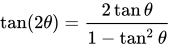
- No, it is not a coincidence. See trigonometric formulas#Double-angle formulae.
- .
- and apply that. JRSpriggs (talk) 01:53, 9 August 2026 (UTC)
- In fact, if (a, b, c) and (d, e, f) are Pythagorean triples, then so is (ad-be, ae+bd, cf) (provided ad-be>0). The angle opposite the ae+bd side will then be the sum of the angles opposite the b and e sides in the original triangles. The 7-24-25 is a special case, the "product" of the 4-3-5 triangle with itself. --RDBury (talk) 08:39, 9 August 2026 (UTC)
- I naively expected that iterating starting with would soon converge to some set of angles. Instead, this keeps jumping all over the place. Then I realized this corresponds to iterating where This map has the sole fixpoint in which is not stable, making convergence impossible. ‑‑Lambiam 10:30, 9 August 2026 (UTC)
- Thanks very much, everyone. cmɢʟee τaʟκ (please add
{{ping|cmglee}}to your reply) 11:40, 9 August 2026 (UTC)
- Thanks very much, everyone. cmɢʟee τaʟκ (please add
- I naively expected that iterating starting with would soon converge to some set of angles. Instead, this keeps jumping all over the place. Then I realized this corresponds to iterating where This map has the sole fixpoint in which is not stable, making convergence impossible. ‑‑Lambiam 10:30, 9 August 2026 (UTC)
- In fact, if (a, b, c) and (d, e, f) are Pythagorean triples, then so is (ad-be, ae+bd, cf) (provided ad-be>0). The angle opposite the ae+bd side will then be the sum of the angles opposite the b and e sides in the original triangles. The 7-24-25 is a special case, the "product" of the 4-3-5 triangle with itself. --RDBury (talk) 08:39, 9 August 2026 (UTC)


Group of rational points on the unit circleRich (talk) 18:41, 9 August 2026 (UTC)
August 12
Humanities
July 29
Clemenceau's hat

What kind of hat is Georges Clemenceau wearing here? Thank you, DuncanHill (talk) 02:07, 29 July 2026 (UTC)
- See https://lionheartautographs.com/autographs/original-portrait-of-clemenceau-publisher-of-zolas-jaccuse/ - it's actually a custom make. Nanonic (talk) 03:27, 29 July 2026 (UTC)
- According to that article, the designer (one Mlle. Jeanne Taty), based it on the French Army calot or forage cap; an example is shown here. Alansplodge (talk) 16:29, 29 July 2026 (UTC)
Appointing an Australian premier
With the replacement of Jacinta Allan by Ben Carroll as Premier of Victoria, I'm left wondering — what's involved in the appointment of a new premier, whether here in Victoria or elsewhere? Let's imagine a situation like this one, where there's no question of which party/coalition has a majority, and no question who leads that party/coalition; I'm just wondering about the formalities. Does the governor just sign some paperwork, or is there a formal kissing hands-type ceremony, or is it somewhere in between? I didn't find anything online, but ChatGPT told me that the new premier must visit Government House, formally have an audience with the governor, take an oath of office, etc., but the whole situation is much less elaborate than a royal audience. But then, yesterday ChatGPT told me that bus services to Marysville didn't exist, so I know I can't trust it. Nyttend (talk) 04:50, 29 July 2026 (UTC)
- ChatGPT got those formalities right. HiLo48 (talk) 06:11, 29 July 2026 (UTC)
- @JackofOz: as a fellow Aussie, any insights on this? ~2026-42237-99 (talk) 02:00, 30 July 2026 (UTC)
- Comment on "much less elaborate than a royal audience": My impression - that's the best I can do, given that I've never been summoned to one - is that royal audiences are not elaborate at all. You turn up at the palace or wherever, get ushered in to the royal presence, shake hands, sit down, accept tea if offered, answer questions, then leave at the appropriate time.
- Visiting a state governor would be virtually identical to this. In the case of a new premier, there's an oath to be administered by the governor, and spoken and signed by the new premier. That's it. Well, the Governor may firstly ask the person whether they'd be willing to accept the role of premier - but that's nearly always a foregone conclusion in these circumstances. That piece of paper, and the official notice about the visit in the newspapers, constitute the complete official record of the occasion. There may be a photographer present for the oath swearing bit, but whether that video is the property of Government House or some private organisation like a TV station, I could not say.
- We tend to expect some grand announcement of the new premier - but that's the media's job. As far as Government House is concerned, the baton has been handed on quietly without any fuss, and the governance of the state keeps calm and carries on. -- Jack of Oz [pleasantries] 22:37, 30 July 2026 (UTC)
- The elaborate part of the Buckingham Palace operation seems to be ushering the previous incumbent out of the back door, while the new boy or girl is welcomed at the front, without the twain meeting. Presumably this is so that there is a minimal time when the country lacks governance. Alansplodge (talk) 16:41, 1 August 2026 (UTC)
- But this would depend on the reason for the previous one leaving office. I get the impression that the 2007 Labour Party leadership election (UK) was not a contest to overthrow Tony Blair (which would have been similar to what we had here last week) but a contest to replace him after he decided that he wanted to leave office, and that Blair was happy to have Brown succeed him, so I suppose it wouldn't have been uncomfortable for them to meet. Nyttend (talk) 07:50, 3 August 2026 (UTC)
- But I think the protocol still applies. Messers Starmer and Burnham seem to be on speaking terms, but one was going out the back before t'other went in the front. Alansplodge (talk) 16:04, 8 August 2026 (UTC)
- The departing PM doesn't have to wait upon the monarch. When Asquith replaced Campbell Bannerman, Asquith had to go to Biarritz, but CB stayed at home in Number 10, and indeed remained there until his death. DuncanHill (talk) 16:54, 8 August 2026 (UTC)
- Indeed, my understanding is that while the monarch has the incoming PM visit them to be formally invited to create a government, the outgoing individual doesn't need any such courtesy. Pickersgill-Cunliffe (talk) 17:49, 8 August 2026 (UTC)
- The departing PM doesn't have to wait upon the monarch. When Asquith replaced Campbell Bannerman, Asquith had to go to Biarritz, but CB stayed at home in Number 10, and indeed remained there until his death. DuncanHill (talk) 16:54, 8 August 2026 (UTC)
- But I think the protocol still applies. Messers Starmer and Burnham seem to be on speaking terms, but one was going out the back before t'other went in the front. Alansplodge (talk) 16:04, 8 August 2026 (UTC)
- But this would depend on the reason for the previous one leaving office. I get the impression that the 2007 Labour Party leadership election (UK) was not a contest to overthrow Tony Blair (which would have been similar to what we had here last week) but a contest to replace him after he decided that he wanted to leave office, and that Blair was happy to have Brown succeed him, so I suppose it wouldn't have been uncomfortable for them to meet. Nyttend (talk) 07:50, 3 August 2026 (UTC)
- The elaborate part of the Buckingham Palace operation seems to be ushering the previous incumbent out of the back door, while the new boy or girl is welcomed at the front, without the twain meeting. Presumably this is so that there is a minimal time when the country lacks governance. Alansplodge (talk) 16:41, 1 August 2026 (UTC)
July 30
Was Bruno Bettelheim really Bruno Bettelheim? asking for reports on speculation, not asking for
| Enough already. |
|---|
| The following discussion has been closed. Please do not modify it. |
|
speculation. Could the actual Bruno Bettelheim have been murdered in Buchenwald and then someone stole his identity and emigrated to the United States? It would fit the character traits of the man we know as Bettelheim. Richard Pollak, among others, obviously didn't trust Bettelheim, or at least the man he knew as Bettelheim, and since he thought that man was such a liar, maybe he had private speculations in his notes and conversations that Bettelheim wasn't really him. Rich (talk) 00:37, 30 July 2026 (UTC)
|
August 1
Decelerating history
Is there an idea or well known examples of a historical topic where the interesting events are near the beginning, and then it's mostly just stuff playing out routinely? As an extreme example, The First Three Minutes is about the early history of the universe, from the big bang til 3 minutes later. After that, stuff was roughly like it is now. Some fiction writers have dated the Star Wars saga (a long time ago, in a galaxy far far away) to around 5 billion years ago, when the universe was around 2/3 of its present age. I'm specifically looking for the idea that stuff gets less important or interesting as time passes. Obviously that will be false for a lot of topics, like the history of mathematics goes back 1000s of years but most of the good parts are in the past century. Thanks. ~2026-42295-00 (talk) 06:23, 1 August 2026 (UTC)
- You're not going to like this answer, but I suspect the entire idea you propose is flawed and culture bound. I say this because when you study history closely, things are always interesting, even when we say they are not. There was even a book about this that came out last year but I can't remember the name. Anyway, I'm instead taken with the edge of chaos. The most interesting events don't necessarily happen at the beginning. They happen whenever a system is balanced between rigid order and complete disorder. This could be why you get periods of stability and upheaval all the time. This doesn't need to happen at the so-called "beginning". And maybe there isn't really a beginning in the first place; as a matter of perspective, that's just a story we like to tell ourselves to make things make sense. From this point of view, forget about beginnings and endings. There is no unique beginning, there are many, endlessly occurring. Whenever order becomes disordered the cycle begins again and again. You can see this happening now around you. Things are stable at first, then they tend to get rigid, followed by a crisis of some kind. Then you get innovation and the cycle repeats itself. And don't forget about the Copernican principle: don't assume your location in space or time is special. Viriditas (talk) 07:07, 1 August 2026 (UTC)
- The present time is typically chaotic or worse. The past is in the past. I think this quote is attributed to Lincoln: "The quiet past is inadequate to the stormy present." ←Baseball Bugs What's up, Doc? carrots→ 15:04, 1 August 2026 (UTC)
- And attributed rightly, though more fully "The dogmas of the quiet past...". --Antiquary (talk) 08:16, 2 August 2026 (UTC)
- The present time is typically chaotic or worse. The past is in the past. I think this quote is attributed to Lincoln: "The quiet past is inadequate to the stormy present." ←Baseball Bugs What's up, Doc? carrots→ 15:04, 1 August 2026 (UTC)
- Isn't this supposed to have happened whenever you see a history book talking about a revolution at a particular time?
- Anyway, in the understanding of the world by humans, I think of the early 20th century this way. Ever since the understanding of quantum mechanics reached a critical point in the 1920s, nothing has changed the worldview as much on a fundamental level (even though it took decades to understand some consequences of the formalism, like Bell's theorem only in 1964). Icek~enwiki (talk) 16:55, 1 August 2026 (UTC)
Official name
Hello, I wanted to ask what the official name of the Mayan underground city was [3]? I didn't find it. Vyacheslav84 (talk) 17:52, 1 August 2026 (UTC)
- I'm guessing you found this report referenced in our article Maya cave sites.
- For interest, there is another slightly more detailed report on the same discovery Here. Such sites were portals to the Mayan underworld Xibalba, a name which has been applied to part of a different cave system, the Chiquibul Cave System.
- The underground complex in question is near a village called called Tzibichen or Tahtzibichen, itself near the city of Mérida, Yucatán (we have a further article on the city, Timeline of Mérida, Yucatán), but I have not been able to find an official name for it, despite searching on the name of the lead archaeologist Guillermo de Anda (aka Guillermo de Anda Alanis).
- A possible avenue of enquiry might be to contact a museum, university or research institution in Mérida (see its article, several mentioned there have their own articles). Hope this helps. {The poster formerly known as 87.81.230.195} ~2026-41275-62 (talk) 22:53, 1 August 2026 (UTC)
- OK, thank you!--Vyacheslav84 (talk) 07:54, 3 August 2026 (UTC)
- User:Vyacheslav84, do you have reason to believe that there was an official name for it? The idea of official names for cities (like concepts such as municipal boundaries, incorporation, etc) seems to me to be a modern thing, and I'll just guess that all references to the city in Mayan writing would have been what we call a common name, since they wouldn't have had any reason to call it one thing and officially name it something else. Nyttend (talk) 01:32, 7 August 2026 (UTC)
- Well, at least some kind of name.--Vyacheslav84 (talk) 19:06, 7 August 2026 (UTC)
- We might take any name used by archaeologists to refer to this site (which wasn't exactly a 'city' in modern terms) as its current 'official' name – they must have some term for it.
- In its Acknowledgements, this book, Exploring Maya Ritual Caves by Stanislav Chládek, AltaMira Press 2011 (ISBN 987-0-7591-1987-1 cloth, 987-0-7591-1989-5 electronic) refers to "the newly discovered Tzibichen Caves in Yucatán". Further text unviewable through Google may have a different or more academic name for the site, as might any scholarly papers that the book references, but which I have not been able to find by online searching. Hope this helps. {The poster formerly known as 87.81.230.195} ~2026-41275-62 (talk) 06:43, 7 August 2026 (UTC)
- OK, thank you!--Vyacheslav84 (talk) 19:06, 7 August 2026 (UTC)
- User:Vyacheslav84, do you have reason to believe that there was an official name for it? The idea of official names for cities (like concepts such as municipal boundaries, incorporation, etc) seems to me to be a modern thing, and I'll just guess that all references to the city in Mayan writing would have been what we call a common name, since they wouldn't have had any reason to call it one thing and officially name it something else. Nyttend (talk) 01:32, 7 August 2026 (UTC)
- OK, thank you!--Vyacheslav84 (talk) 07:54, 3 August 2026 (UTC)
copyright of the us declaration of independence
What was the copyright recognition of the US Declaration of Indepencence in England when it was first created? Would it have been in the public domain from the outset? How long was it copyrighted under US law? 781h (talk) 19:57, 1 August 2026 (UTC)
- At the time, importing foreign works into Great Britain was prohibited. More importantly, copyright was only granted to printed books. ‑‑Lambiam 23:04, 1 August 2026 (UTC)
- The news and text of the Declaration of Independence reached England by mid-August 1776. In the newly United States, the text had been printed in over 30 newspapers in the span of a month. In Great Britain and Ireland, the Declaration was printed in still more newspapers, from London to Dublin, from Edinburgh to Canterbury. The majority of British newspaper printings of the Declaration of Independence look similar to the American printings. But some censored the text, even going so far as to change words or only excerpt certain portions.
- Unsullied by Falsehood: The Present ---- of G---- B------ from the Harvard Declaration Resources Project. Alansplodge (talk) 16:24, 2 August 2026 (UTC)
- You may be interested in this handwritten copy of the Declaration that was copied by Vice‑Admiral Molyneux Shuldham and sent off to London on 10 July 1776.
- And this copy of the Declaration which was presented in the House of Lords at Westminster on 20 January 1778.
- Also this copy, one of only eleven known examples of the "Exeter Broadside" which was recently discovered in the British National Archives, having been captured from an American brig by HMS Raisonnable and brought to Plymouth (the one in England) in January 1777. Alansplodge (talk) 16:24, 2 August 2026 (UTC)
- Assuming the founding fathers wanted this to be widely distributed, wouldn't copyrighting it have been counterproductive? ←Baseball Bugs What's up, Doc? carrots→ 17:33, 2 August 2026 (UTC)
- Under the current rules as they apply in most of the world, copyright exists automatically as soon as a work is recorded on some physical medium (including as bits in a file). An author who does not want this needs to declare that the work is released in the public domain. Perhaps the questioner did not know that in the 18th century being entitled to copyright protection required registration. ‑‑Lambiam 08:37, 6 August 2026 (UTC)
- You might want to look into whether a copyright notice were required in English-and-Welsh law at the time. Lambiam has an interesting point, although that would be a non-copyright restriction. Nyttend (talk) 07:45, 3 August 2026 (UTC)
Why was Loyd "Budget"?
Why was Charles Loyd nicknamed "Budget"? Thank you, DuncanHill (talk) 20:20, 1 August 2026 (UTC)
- Dubious but - "Second to None - The Coldstream Guards 1650-2000"[4] pg 46 "So called because he joined the regiment in 1910, the year of Lloyd George's Budget. Nanonic (talk) 22:07, 1 August 2026 (UTC)
- @Nanonic: Thanks - sounds reasonable. DuncanHill (talk) 13:47, 2 August 2026 (UTC)
August 2
Morality of non-combatants in a war of aggression
Have there been any answers by philosophers and theologians to the issue of morality of some non-combatants helping the offending side in a war of aggression (such as medics in the Wehrmacht)? The crux is apparently saving a human life vs. facilitating a return of any such soldier to kill the defending side and/or inflict injuries that are treated by medics of that defending side, creating a vicious circle where Hippocratic Oath or Declaration of Geneva become controversial. A particular aspect of it is that a medic of a defending side may treat a person who suffered because of an enemy soldier, brought back to the frontline by enemy's medic. The same generally applies to the offending side's firefighters, workers of military factories, priests, engineers, etc. Brandmeister talk 21:12, 2 August 2026 (UTC)
- A place to start might be our Conscientious objector article. In Britain, some of those refused combat roles but were willing to serve in auxilliary roles such as the Friends' Ambulance Unit, while others eschewed anything war related. Alansplodge (talk) 12:08, 3 August 2026 (UTC)
- Our article Killing baby Hitler suggests you may want to consider deontological, consequentialist, and utilitarian approaches to your question. Basically, you pays your money and you takes your choice. DuncanHill (talk) 12:33, 3 August 2026 (UTC)
- There can be no doubt both philosophers and theologians have pondered and/or pontificated on the issue. There can be little doubt that, in either category, they have reached mutually contradictory conclusions. Some may even have reached self-contradictory conclusions. Any such conclusions are only answers to those who hear what they are open to hearing.
- In any case, under Article 12 of the Geneva Conventions, wounded combattants in the field must be treated humanely and cared for by the belligerent party in whose power they are, also if they are enemy combattants. Which side they are on may not be used to discriminate in their care.[5] ‑‑Lambiam 09:24, 4 August 2026 (UTC)
August 3
1764 RSA art awards
April 16th, 1764.—Wednesday Evening last the Society for the Encouragement of Arts, &c, adjudged the first Premium of fifty Guineas, for the best Landscape, to Mr. Barratt, a celebrated painter from Dublin; the second of twenty-five, to Mr. Bond of Birmingham; and the third of fifteen to Mr. Stewart, of London.
Who were the three artists? Andy Mabbett (Pigsonthewing); Talk to Andy; Andy's edits 17:46, 3 August 2026 (UTC)
- George Barret Sr. was a celebrated painter from Dublin, Daniel Bond was from Birmingham. DuncanHill (talk) 17:52, 3 August 2026 (UTC)
- Quick work, thank you. Andy Mabbett (Pigsonthewing); Talk to Andy; Andy's edits 17:54, 3 August 2026 (UTC)
- I think Charles Stewart was Charles Steuart, see also here. DuncanHill (talk) 17:58, 3 August 2026 (UTC)
- Quick work, thank you. Andy Mabbett (Pigsonthewing); Talk to Andy; Andy's edits 17:54, 3 August 2026 (UTC)
August 4
AD or BC?
The article about Glaucias of Athens contradicts itself. It says that he "appears to have lived in the 1st century BC", but one of the categories labels him as a 1st-century Athenian. Clarityfiend (talk) 08:04, 4 August 2026 (UTC)
- Fixed. ‑‑Lambiam 08:43, 4 August 2026 (UTC)
- He could of course have lived in both, a lot of people did. DuncanHill (talk) 11:04, 7 August 2026 (UTC)
- Unlikely in this case, I would say. A translation of Plutarch's Symposiacs can be found here. These relate conversations at symposia, at some of which both Plutarch and Glaucias were present. Plutarch's birth is given as "before 50 CE", and apparently he was in Athens as a student in 66/67. So Glaucias would have been very very old when he attended those symposia if he had been born BC. I wonder whether the title "Glaucias of Athens" can be justified. Shouldn't the article be renamed "Glaucias (Athens)", "Glaucias (orator)" or something like that? --Wrongfilter (talk) 13:06, 7 August 2026 (UTC)
- 'X of Y' is a common formulation for persons of that era and milieu, commonly used (in the appropriate language) at the time; I would say it is the most likely name (other than the bare name X) that people would search on, and the most common form of name that students of the period will actually have read, so it is the most useful form of title, having some disambiguation built in. {The poster formerly known as 878.81.230.195} ~2026-41275-62 (talk) 15:54, 7 August 2026 (UTC)
- I don't think we even know that Glaucias is from Athens. In § 635a, Plutarch writes "In Eleusis, after the solemn celebration of the sacred mysteries, Glaucias the orator entertained us at a feast". Our source therefore seems to argue in favour of "Glaucias of Eleusis", but we can't be sure of that either (did he entertain them at home or did he just pay the bill?). I think the "of" form needs has a ring of officiality that needs to be supported directly by a source, otherwise the usual wikipedia convention of parentheses (as in Glaucias (physician, 3rd century BC)) seems more appropriate. --Wrongfilter (talk) 16:55, 7 August 2026 (UTC)
- Glaucias is first called "orator" (Γλαυκίας δὲ ὁ ῥήτωρ) in § 628d, at the symposion at Serapion’s in Athens. Note that Plutarch identifies one Xenocles in § 635a explicitly as "Xenocles of Delphi", whereas Glaucias is again identified as "the orator". More likely (IMO), Plutarch and Glaucias-the-orator were part of a group of Athenians that also included Lamprias, who had traveled to Eleusis to attend the popular Eleusinian Mysteries. ‑‑Lambiam 09:28, 8 August 2026 (UTC)
- I don't think we even know that Glaucias is from Athens. In § 635a, Plutarch writes "In Eleusis, after the solemn celebration of the sacred mysteries, Glaucias the orator entertained us at a feast". Our source therefore seems to argue in favour of "Glaucias of Eleusis", but we can't be sure of that either (did he entertain them at home or did he just pay the bill?). I think the "of" form needs has a ring of officiality that needs to be supported directly by a source, otherwise the usual wikipedia convention of parentheses (as in Glaucias (physician, 3rd century BC)) seems more appropriate. --Wrongfilter (talk) 16:55, 7 August 2026 (UTC)
- 'X of Y' is a common formulation for persons of that era and milieu, commonly used (in the appropriate language) at the time; I would say it is the most likely name (other than the bare name X) that people would search on, and the most common form of name that students of the period will actually have read, so it is the most useful form of title, having some disambiguation built in. {The poster formerly known as 878.81.230.195} ~2026-41275-62 (talk) 15:54, 7 August 2026 (UTC)
- Unlikely in this case, I would say. A translation of Plutarch's Symposiacs can be found here. These relate conversations at symposia, at some of which both Plutarch and Glaucias were present. Plutarch's birth is given as "before 50 CE", and apparently he was in Athens as a student in 66/67. So Glaucias would have been very very old when he attended those symposia if he had been born BC. I wonder whether the title "Glaucias of Athens" can be justified. Shouldn't the article be renamed "Glaucias (Athens)", "Glaucias (orator)" or something like that? --Wrongfilter (talk) 13:06, 7 August 2026 (UTC)
- He could of course have lived in both, a lot of people did. DuncanHill (talk) 11:04, 7 August 2026 (UTC)
August 8
Witnesses to deeds
Were witnesses to deeds typically paid in England (and Canada and Ireland) in the 18th and 19th centuries? Serving as a witness seems to have taken some time, since the witness would have to be present at the signing and also swear to their witnessing at the courthouse or registrar’s office. —Amble (talk) 22:31, 8 August 2026 (UTC)
- While I defer to anyone with earlier information, my experience in mid-20th century England is that witnesses to signings in civil matters would not normally have to attend a courthouse or registrar's office except at civil weddings. Deed transfer documents often required signatures of two witnesses who sign each with their name, their address, date and possibly other identifying details, but not necessarily at a specific location (an exception is where a Notary Public requires to see the act of signing). While a witness may have received a payment or promise for their signature it would be unwise to record any such remuneration because it would expose the witness's motivation and thereby the deed's validity to suspicion later. ~2026-39925-22 (talk) 08:19, 9 August 2026 (UTC)
- Thank you! Your experience gives helpful context. Some deeds I have seen do say that the witnesses personally appeared before the registrar, so I took that to be standard. I’ll pay more attention to which ones actually said so. —Amble (talk) 18:56, 9 August 2026 (UTC)
- It is a trope of early twentieth century detective fiction that household servants are called upon to witness the legal documents of their employers. For example, this forms a significant plot point in Sayers' Unnatural Death and in Christie's Why Didn't They Ask Evans?. In neither case do they have to go to a courthouse (and it would have spoiled the villain's plot had they had to do so). Chuntuk (talk) 08:02, 10 August 2026 (UTC)
- Indeed, but typically (almost invariably) these are wills, which do not need to be registered (itself another common propellant for plots in fiction). In English law, very few types of document need to be registered on signing, other than those relating to companies and their shares, which are posted to the registrar at Companies House (since 1844), and I think always have been, and documents of various sorts for sending to some branch of government, such as passport applications (which need witnesses to certify the photos, but are all handled by post). Witnesses are required for marriage certificates - not sure about death certificates. In a long life with various types of business activity, the only times I have had to get things registered in person, for UK purposes, were I think on my marriage and the births of my children. If you are dealing with documents required by other countries that all changes. English towns don't actually have "courthouses", they have magistrate's courts, and a registrar's office in the town hall or council offices - see Register office (United Kingdom). HM Land Registry (est 1862) does not require personal visits. Unlike some other countries, the police have managed to keep clear of involvement in all that sort of thing. So being a witness in England was normally a matter of moments, and payment not expected, although I think possible. Johnbod (talk) 10:46, 10 August 2026 (UTC)
August 9
Technique for displaying horses for sale or show
L.B. (1877), Recollections of New Street, Birmingham, in the Year 1817, OCLC 1166350254, Wikidata Q140944645 tells us:
Near this spot the Horse Market was held; not the Horse Fair, which was then, as now, held in the place still bearing its name. The footpath here was raised about a foot above the level of the road, so that the horse's fore feet might rest upon it, and thus show the animals to advantage, as is still done in the Horse Fair.
Do any artworks or early photographs demonstrating this technique exist? Do we have it documented on Wikipedia? Was it common, or peculiar to the Birmingham area? Is it still used? Andy Mabbett (Pigsonthewing); Talk to Andy; Andy's edits 12:48, 9 August 2026 (UTC)
- This photo of the Wolverhamton horse fair has the spectators standing on a raised footpath, rather than the horses. Nothing else I'm afraid. Alansplodge (talk) 18:20, 9 August 2026 (UTC)
Top row of Zygalski sheets

On our Zygalski sheets article, there is this sample sheet, which I am thinking of vectorising.
Why do the top two squares appear to have a row above "a"?
The source of the diagram is here. Marnanel (talk) 13:22, 9 August 2026 (UTC)
- It seems to me to be an error in the attempt to reproduce such a sheet on a typewriter. Rather than being in a separate row, the o's in the columns b, e and f are supposed to be in row a, just as in the bottom two squares, but got somehow vertically somewhat misaligned. Another irregularity is that row z is missing from the bottom two squares.
- This may be a photograph of a set of four real Zygalski sheets, displayed in the Enigma Cipher Centre in Poznan. All rows are aligned well (inasmuch as they are visible), and row z is present in each quadrant of each sheet. ‑‑Lambiam 22:16, 9 August 2026 (UTC)
- Row z missing isn't a mistake - you can see that column z is also missing from the right-hand side. When these sheets are used, you're effectively selecting a 26x26 section of it (which you line up with other sheets and shine light through), representing the original 26x26 grid in the top left corner shifted by 0-25 positions on either axis. There's no need for the 52nd row and column because shifting by 26 positions would be the same as shifting by 0. Adam Sampson (talk) 19:28, 10 August 2026 (UTC)

How do we know that Katharinenkirche, Nuremberg is the setting for the opening scene of Meistersinger? The article asserts this without any citation, except to a blog, and the blog doesn't explain why, unless I overlooked something. Does Wagner specify that it's set here? Nyttend (talk) 19:57, 9 August 2026 (UTC)
- According to our article Die Meistersinger von Nürnberg Act 1, Scene 1, opens in the "Interior of Katharinenkirche (St. Catherine's Church) in Nuremberg, Saint John's Eve or Midsummer's Eve, June 23". DuncanHill (talk) 20:22, 9 August 2026 (UTC)
- And here is a libretto with parallel German and English texts. DuncanHill (talk) 20:24, 9 August 2026 (UTC)
- So the answer to the question is, "Yes, Wagner's libretto does specify this." ‑‑Lambiam 21:46, 9 August 2026 (UTC)
- Thank you. I didn't know whether comments in printed libretti, like the italicised elements in the link, were written by the librettist or by some later editor, so I was unsure how much to trust them. Nyttend (talk) 01:06, 11 August 2026 (UTC)
- Wagner was notorious for the detailed directions he gave in his libretti. DuncanHill (talk) 01:19, 11 August 2026 (UTC)
- I've added the playbill for the premiere, which says Act One takes place in the interior of the Catherine Church. DuncanHill (talk) 01:27, 11 August 2026 (UTC)
- And here is the autograph score, the opening of Act 1. The note at the top is what we need. DuncanHill (talk) 01:39, 11 August 2026 (UTC)
- A quick question about the playbill - what units are the prices in? (That is, what currency was in use in Bavaria in 1868?) German Coinage Act lists the various German currencies in use in 1871, but doesn't say where they were used. ~2026-44322-25 (talk) 14:10, 11 August 2026 (UTC)
- That would have been the South German gulden (fl), subdivided into 60 Kreuzer (kr). --Wrongfilter (talk) 14:25, 11 August 2026 (UTC)
- And gulden was abbreviated fl because it was also called a florin. DuncanHill (talk) 15:31, 11 August 2026 (UTC)
- That would have been the South German gulden (fl), subdivided into 60 Kreuzer (kr). --Wrongfilter (talk) 14:25, 11 August 2026 (UTC)
- A quick question about the playbill - what units are the prices in? (That is, what currency was in use in Bavaria in 1868?) German Coinage Act lists the various German currencies in use in 1871, but doesn't say where they were used. ~2026-44322-25 (talk) 14:10, 11 August 2026 (UTC)
- Thank you. I didn't know whether comments in printed libretti, like the italicised elements in the link, were written by the librettist or by some later editor, so I was unsure how much to trust them. Nyttend (talk) 01:06, 11 August 2026 (UTC)
- So the answer to the question is, "Yes, Wagner's libretto does specify this." ‑‑Lambiam 21:46, 9 August 2026 (UTC)
August 10
The actual meaning of a "safe harbor"
(This is not a request for legal advice)
The Safe harbor (law) article brings up an abstract reckless driving law as an example of a safe and unsafe harbor. But isn't a speed limit only part of what commonly qualifies "recklessness"? It seems to even be the most objective one. You can actually measure velocity! The way I understood the term was exactly the way the lead put it, a provision of a statute or a regulation that specifies that certain conduct will be deemed not to violate a given rule
. While technically checking out, that example doesn't register as particularly useful to me...
Is a safe harbor about ranges of acceptable values, where if it's acceptable it's safe and if it's not it's unsafe? Is a safe harbor about emergency vehicles being able to drive into a park when something happens?[1]: 14–15 Is it both? (If so, what is even the point of this term and why does it seem to have a narrower meaning as a reasonable exception?) — EmoryNB (they/them) talk contribs 05:45, 10 August 2026 (UTC)
- I've most often encountered the term in reference to safe harbor 401(k) plans. Basically, "safe harbor" plans -- those with certain matching and employer contribution structures -- are exempted from the penalties for having too great a disparity in contribution rates between employees with high compensation and other employees.
- IANAL, but as far as I can tell, it just refers to any provision of a law that indicates that under X circumstances (you choose a plan with structure Y; the pollution happened before you bought the house; you're just a "dumb pipe" transmitting the copyright-violating data, not hosting it; you ran afoul of the anti-prostitution laws because you're a kid and someone forced you to, not of your own adult volition; etc) you're in compliance with law Z even if something happened that otherwise would be considered a violation. -- Avocado (talk) 10:30, 10 August 2026 (UTC)
as far as I can tell, it just refers to any provision of a law that indicates that under X circumstances [...] you're in compliance with law Z even if something happened that otherwise would be considered a violation.
- That does seem fair, but the way I see that speed limit example is that it just describes the law Z and its base circumstances (not the exemption part!). Otherwise, the term would just refer to the inverse of the conditions that get you in violation of a law. Am I correct to think that that example is just flawed and should instead, for example, bring up how emergency vehicles can break the speed limit in certain circumstances? — EmoryNB (they/them) talk contribs 10:48, 10 August 2026 (UTC)
- The metaphor is that of a ship being hit by a storm; in what may be a devastating event, the ship is safe if it has managed to reach a safe harbour.
- What corresponds to the "storm" may vary with the context in which the term is used for some provision. Being hit by a lawsuit is one; incurring severe penalties is another. In either case, a safe-harbour provision offers protection from such troubles. ‑‑Lambiam 13:26, 10 August 2026 (UTC)
- Our Safe harbor (law) article really needs some work. The whole discussion of reckless driving is a made-up example that does not reflect anything in the real world. Also, “unsafe harbor” is not a standard legal term.
- There are a number of safe harbors in U.S. securities law. For example, section 4(a)(2) of the Securities Act of 1933 provides that the key requirements of the statute do not apply to transactions by an issuer not involving any public offering. Well, what’s a public offering? That turns out to be a highly abstract concept that can be difficult to apply to the vast range of transactions that may be used. In practice, issuers usually rely on any of several safe harbors promulgated by the Securities and Exchange Commission. John M Baker (talk) 14:42, 10 August 2026 (UTC)
- This is interesting. From searching online I hadn't seen many sources say "unsafe harbor" other than in quotation marks or in passing.
- I see you do have a law degree, so here's a question: is this example from the paper I referenced better in that regard?
The rule-writer provides a general principle that is accessible, albeit subjective, along the lines of “no vehicles are permitted in the park unless reasonably required under the circumstances.” […] At the same time the rule-writer can identify the specific situations expected to arise most frequently, and address them with specifically tailored, objective safe-harbor (or unsafe-harbor) rules. Those objective rules can be written to avoid at least the most foreseeable hard cases associated with objective guidelines (“emergency vehicles on official business are permitted in the park”), and anything falling outside safe-harbor contours can be left to be captured by the standard.
- I'm thinking that if that article is to have an abstract illustrative example, this one seems good to reference. — EmoryNB (they/them) talk contribs 15:08, 10 August 2026 (UTC)
- I suppose that that one does work, if you have a good reference for it. Certainly it’s a lot better than what we have now. If you are looking for other sources, there are many at SSRN. John M Baker (talk) 03:00, 11 August 2026 (UTC)
- Now updated: Special:Diff/1368808668
- I will summarize the relevant portions of this thread on the parent article's talk page later today. Interested parties are welcome to work on bringing it into presentable shape! :) — EmoryNB (they/them) talk contribs 06:15, 11 August 2026 (UTC)
- I suppose that that one does work, if you have a good reference for it. Certainly it’s a lot better than what we have now. If you are looking for other sources, there are many at SSRN. John M Baker (talk) 03:00, 11 August 2026 (UTC)
If I'm high tailing it down the road at twice the speed limit, because there's a raging forest fire right behind me, you can bet your bottom dollar that I'll plead for leniency, based on extenuating circumstances ... another type of "safe harbor." DOR (ex-HK) (talk) 01:00, 11 August 2026 (UTC)
- This is not a safe harbor. It’s just your judgment (which seems clearly correct on these facts) that you come well within the general rule. John M Baker (talk) 03:02, 11 August 2026 (UTC)
- It would be a safe-harbour provision if it occurred in some regulation as follows:
- (j) The penalties as set forth in (i) shall not be imposed on a motorist operating a vehicle exceeding the locally applicable speed limit if said motorist was high-tailing it down the road at up to twice this speed limit while there was a raging forest fire right behind them.
- ‑‑Lambiam 09:10, 11 August 2026 (UTC)
Not familiar with this term, and I'm wondering if the following would be an example. When I lived in Virginia (and probably still now), I heard that the state had a law with the following provisions (I'm writing this text myself):
- No motorist shall drive in the leftmost lane of a freeway at a speed markedly slower than that of other vehicles in the leftmost lane.
- This provision shall not apply to any motorist actively using the leftmost lane to overtake a slower vehicle in the lane to the right.
Does the second bullet provide a safe harbour, since the act of overtaking makes it impossible to violate the first bullet? Nyttend (talk) 01:11, 11 August 2026 (UTC)
- I would argue that, as you have expressed it, this is just part of the main rule, but I suppose it could be formulated as a safe harbor.
- Off-topic, but I always wondered about rules requiring high speeds in the left lane. If you are going the speed limit, but everyone else is going faster, is there really a chance you will be stopped for moving too slowly? John M Baker (talk) 03:13, 11 August 2026 (UTC)
- A friend of mine once talked about that on a Pittsburgh-area freeway; I think he got stopped, but maybe he was only talking about the idea. The point is that significant speed differences between vehicles are dangerous. Nyttend (talk) 04:55, 11 August 2026 (UTC)

Slower traffic keep right indeed! - There actually seems to be, yes! Vox has a good video on this in case you like edutainment: "Why you shouldn't drive slowly in the left lane" on YouTube
- Also: State "keep right" laws
- But from what anecdotal evidence I have heard and read about, impeding traffic this way is not prioritized as much by US law enforcement. — EmoryNB (they/them) talk contribs 05:32, 11 August 2026 (UTC)

References
- ^ Stumpff, Andrew Morrison (July 18, 2013), Case Law, Systematic Law, and a Very Modest Suggestion, doi:10.2139/ssrn.2295245, SSRN 2295245
Byngo Bango Bungo
According to our article Julian Byng, 1st Viscount Byng of Vimy "At Eton Byng first received the nickname "Bungo"—to distinguish him from his elder brothers "Byngo" and "Bango"". It appears from our article on his father George Byng, 2nd Earl of Strafford that Bungo had three half and three whole older brothers. So, which ones were Byngo and Bango, and what were the others nicknamed? Thank you, DuncanHill (talk) 14:44, 10 August 2026 (UTC)
- Unlikely to have been the half brothers. The youngest of them was 27 years older than Julian. It seems unlikely that anyone at Eton with him would remember the half brothers' nicknames or care if they clashed with Julian's. Chuntuk (talk) 16:08, 10 August 2026 (UTC)
- This gives us three nicknames for a set of four full brothers {Charles, Alfred, Lionel, Julian}. ‑‑Lambiam 08:47, 11 August 2026 (UTC)
- Julian was born ca 13 years after Charles (the brothers' four birth years were 1849, '51, '58 and '62) and 11 years after Alfred: Julian might have just overlapped with Alfred (since pupils could arrend Eton from the age of 7 in that era) but not Charles, who therefore might also have been (the first) "Bungo", however, there would be an inherited continuity of nickname knowledge in the College (independent of the brothers' own – in my experience pupils have no say in their own nicknames, which are imposed by their contemporaries), so a duplication is not particularly likely.
- It's also possible that Charles, being eldest, had no nickname, as "Byng" verges on humorous by itself: unreliable AI tells me no Eton nickname is documented for him, so we may never know for sure. {The poster formerly known as 87.81.230.195} ~2026-43920-01 (talk) 09:37, 11 August 2026 (UTC)
- This gives us three nicknames for a set of four full brothers {Charles, Alfred, Lionel, Julian}. ‑‑Lambiam 08:47, 11 August 2026 (UTC)
Manchuria timeline
Hi all, a bit confused so hoping someone could help me out. I'm working on the Tōru Takemitsu for FAR. RS says that he was born in Tokyo on 8 October 1930, and that by November 1930 (under a month), he had moved to Dalian, where his father was a government official. Dalian is in China, more specifically Manchuria.
My question is: how was his father in the government controlling Dalian in November 1930, when the invasion was not until a year later (September 1931: Japanese invasion of Manchuria) and the puppet state not founded a year after that (1932: Manchukuo)? Aza24 (talk) 18:38, 10 August 2026 (UTC)
- @Aza24: Port Arthur/Dairen/Dalien was ruled by Japan from 1905, after being captured from Russia. See Treaty of Portsmouth and Kwantung Leased Territory. DuncanHill (talk) 18:55, 10 August 2026 (UTC)
- Japan gained control of the Liaodong Peninsula, including Dalian and Port Arthur, via the Treaty of Portsmouth. This area became known as the Kwantung Leased Territory. Unlike the rest of Manchuria, which remained under Chinese sovereignty (albeit with significant Japanese influence and railway interests) until the 1931 invasion, Dalian was legally leased to and governed directly by Japan starting in 1905. In short, Dalian was not "invaded" in 1931; it had been an established Japanese colonial enclave for decades before the rest of Manchuria was seized to create the puppet state of Manchukuo. ~2026-41824-87 (talk) 18:56, 10 August 2026 (UTC)
- Quite helpful, thank you both! Aza24 (talk) 19:04, 10 August 2026 (UTC)
August 11
Age of Louise Omer? (Australia)
Louise Omer is Australian author. Her age at marriage and divorce interspersed, in indirect manner in multiple book reviews and multiple sources. She divorced in her early twenties or late twenties is bit confusing since at least two sources seem to lead to different calculations.
Following are the sources known to me . [1][2][3][4][5][6][7][8][9]. May be few more are there.
Requesting help in confirming her age at different life stages. Bookku (talk) 04:55, 11 August 2026 (UTC)
- The Guardian article, published in July 2022, says that she is 33 years old. That would mean she was born in 1988 or 1989. But I'm not sure a book review (I didn't have time to read all of them) serves as a reliable source for her date of birth. Maybe better to omit a birth date until you can find something more definitive. Since her book is a memoir, maybe she says when she was born in there? Chuntuk (talk) 08:31, 11 August 2026 (UTC)
- I gather that she herself reviews books for The Guardian, so it is perhaps less likely than other papers to be in error: however that is still not enough to yield even a definite year. It seems that her actual birthdate is not something she readily makes public.
- "She was aged 33 at [date of Guardian statement]" might be the best doable. {The poster formerly known as 87.81.230.195} ~2026-43920-01 (talk) 09:47, 11 August 2026 (UTC)
References
- ^ "Holy Woman by Louise Omer | Book". Scribe. Retrieved 2025-10-09.
- ^ Morand, Rosalind (2022). "On Banquets and Crumbs.(Reviewed Louise Omer Holy Woman, Scribe)". In Green, Jonathan; Tan, Cher (eds.). Meanjin (Quarterly). Vol. 81 (1 ed.). Melbourne: Melbourne University Publishing (published September 15, 2022). ISBN 978-0-522-87851-6. Archived from the original on 2024-02-27.
- ^ Shorter, Rosie Clare (2022-07-18). "Holy Woman's fleshy, feminist spiritual pilgrimage is a warning against religious coercive control". The Conversation. Archived from the original on 2022-07-18. Retrieved 2025-10-09.
- ^ Cain, Sian (2022-07-15). "Why is God a man? The woman who searched the world for a feminist religion". The Guardian. ISSN 0261-3077. Archived from the original on 2022-08-01. Retrieved 2025-10-09.
- ^ Koch, Megan (2022-07-08). "Book review: Holy Woman – A Divine Adventure - InReview | InDaily, Inside South Australia". www.indailysa.com.au. Archived from the original on 2025-06-13. Retrieved 2025-10-09.
- ^ Fisher, Ellie (2022-07-05). "Book review: Holy Woman, Louise Omer". Arts Hub. Archived from the original on 2022-07-07. Retrieved 2025-10-09.
- ^ Nguyen, Giselle Au-Nhien (2022-08-05). "Spirited memoir of travel after divorce is a long way from Eat, Pray, Love". The Sydney Morning Herald. Archived from the original on 2022-08-05. Retrieved 2025-10-11.
- ^ Foster, Rebecca (2022-11-18). "Reviewer Rebecca Foster Interviews Louise Omer, Author of Holy Woman: A Divine Adventure". www.forewordreviews.com. Archived from the original on 2022-12-05. Retrieved 2025-10-11.
- ^ Korsten, Tracey (2022-08-21). "Book Review: Holy Woman, by Louise Omer". Glam Adelaide. Archived from the original on 2022-08-21. Retrieved 2025-10-11.
Bookku (talk) 04:55, 11 August 2026 (UTC)
August 12
Language

July 29
What does Trump say here (or even anything)?
What did Donald Trump presumably say on July 13, 2024 after the failed assassination attempt, in this moment before the agents took him down the stair? Of course, in this video there is no chance to hear it, but in this photographers video indeed we hear him a bit. (The time URL parameter for starting at the right point apparently does not work with short videos; the scene is at ~43 seconds). --KnightMove (talk) 07:42, 29 July 2026 (UTC)
- Here is a regular link: https://www.youtube.com/watch?v=PwVzoae7zA8. I can't hear any sound emanating from POTUS's mouth after the shot. ‑‑Lambiam 09:34, 29 July 2026 (UTC)
- Thanks. Then at first, I set this video with time parameter. --KnightMove (talk) 10:17, 29 July 2026 (UTC)
- I don't hear him because the speakers on my laptop don't work, but the journalist Salena Zito, an eyewitness, has Trump first calling for his shoes, then saying "USA", then "Fight! Fight! Fight!".[6] Indeed she seems to have got a whole book out of that. --Antiquary (talk) 11:59, 29 July 2026 (UTC)
- I perfectly agree with her [addition: You can see it in the main video a few seconds earlier - although I doubt that Trump really said "USA". He asked for his shoes, then "wait, wait, wait!" as he wanted to pose, then "Fight, fight, fight!"], but that specific moment was after he said all that [and when he was a few further, and away from the microphone].
- Do we maybe have some lipreaders reading this? --KnightMove (talk) 12:39, 29 July 2026 (UTC)
- People here are ignoring the reason Trump asked for his shoes. When most people are involved in traumatic events like this, they do not ask for their shoes, and very often leave them behind. Trump asked for them for a very specific reason. Viriditas (talk) 22:54, 4 August 2026 (UTC)
- Which would be what exactly? --KnightMove (talk) 08:12, 5 August 2026 (UTC)
- People here are ignoring the reason Trump asked for his shoes. When most people are involved in traumatic events like this, they do not ask for their shoes, and very often leave them behind. Trump asked for them for a very specific reason. Viriditas (talk) 22:54, 4 August 2026 (UTC)
- I don't hear him because the speakers on my laptop don't work, but the journalist Salena Zito, an eyewitness, has Trump first calling for his shoes, then saying "USA", then "Fight! Fight! Fight!".[6] Indeed she seems to have got a whole book out of that. --Antiquary (talk) 11:59, 29 July 2026 (UTC)
- Thanks. Then at first, I set this video with time parameter. --KnightMove (talk) 10:17, 29 July 2026 (UTC)
Maybe I have posed the wrong question: Does he even say anything in this moment (again the video), or does he just take a deep breath? --KnightMove (talk) 14:40, 3 August 2026 (UTC)
Polly matete cry town is my daskalon.
In The History of Tom Jones, a Foundling we read "I remember my old schoolmaster, who was a prodigious great scholar, used often to say, Polly matete cry town is my daskalon. The English of which, he told us, was, That a child may sometimes teach his grandmother to suck eggs." Presumably "Polly matete cry town is my daskalon" is a mangling or mis-remembering of some Latin or Greek quotation. But what? Thank you, DuncanHill (talk) 17:03, 29 July 2026 (UTC)
- The note in my copy says: "Source unknown, quoted by Cicero". I'll try to type in the original Greek, but the translation is given as "Many scholars are wiser than their teachers". --Wrongfilter (talk) 17:23, 29 July 2026 (UTC)
- It's explained here as "a humorous transcription of πολλοὶ μαθηταὶ κρείττονες διδασκάλων, i.e., Many pupils are cleverer than their teachers, which occurs in Menander, Monostichs 651 Jaekel; Cicero, Letters to Friends 9.7.2; and Greek Anthology 11.176.5 (by Lucilius)". -- Fut.Perf. ☼ 17:28, 29 July 2026 (UTC)
- I'm a bit disappointed with my copy now (Penguin, 1966). --Wrongfilter (talk) 17:36, 29 July 2026 (UTC)
- Many thanks, DuncanHill (talk) 21:22, 29 July 2026 (UTC)
- I'm a bit disappointed with my copy now (Penguin, 1966). --Wrongfilter (talk) 17:36, 29 July 2026 (UTC)
- The quotation by Cicero can be seen here.
- It appears that Partridge is indeed misremembering. His old schoolmaster probably said, "... is the daskalon". Perhaps Partridge was not among these polly matete. ‑‑Lambiam 22:41, 30 July 2026 (UTC)
- at first I wondered how Eric Partridge came into this. —Antonissimo (talk) 03:18, 1 August 2026 (UTC)
- It's explained here as "a humorous transcription of πολλοὶ μαθηταὶ κρείττονες διδασκάλων, i.e., Many pupils are cleverer than their teachers, which occurs in Menander, Monostichs 651 Jaekel; Cicero, Letters to Friends 9.7.2; and Greek Anthology 11.176.5 (by Lucilius)". -- Fut.Perf. ☼ 17:28, 29 July 2026 (UTC)
Questions again
- If the word strange is pronounced /streɪ̯nd͡ʒ/, then how would a word that is pronounced /streɪ̯ŋ/ be spelled?
- Can the word seen be used as an adjective like in Seen crimes can be reported to the police (meaning the crimes that have been seen by people)
- Can the word made be used as an adjective like in Made changes (meaning the changes that have been made)?
- Is this correct: I can’t wait when it will be 2027, or should is be used in place of will be?
- Are there any words in English where Greco-Latin φ/ph appears in English as ⟨f⟩, rather than ⟨ph⟩?
- Why the word kolkhoz is pronounced as /kolkɔːz/, rather than /kolhɔːz/? How would it be pronounced if it were spelled kolhoz?
- Do English speakers ever pronounce original /x/, /ç/, /χ/ and /ħ/ sounds as /h/ if they can’t pronounce the original sound, in foreign names?
--40bus (talk) 20:43, 29 July 2026 (UTC)
- 1.) Predicting English spelling is always a dangerous game but I might go with "strang" based on "bang". This could also be pronounced /stræeŋ/ or /strɑːŋ/ but most English spellings are simply not unambiguous.
- 2.) Not usually. The sentence would ordinarily be rephrased with a full verb "crimes that have been seen".
- 3.) Same as 2 above.
- 4.) Either verb tense is correct but the conjunction(?) should be "till" or "until".
- 6.) Because most English speakers don't know how to pronounce 'kh' (in Russian or really any language) and use a spelling pronunciation based on English phonemes. Without the 'k' I would pronounce it /kolhɔːz/ and expect most other English speakers to do the same.
- 7.) I am sure the answer is more than never but it depends mostly on the spelling used. The standard English approximation for /x/ and /χ/ is /k(h)/, for /ħ/ /h/ was traditional but other approximations are sometimes seen especially when it is spelled 'ch', for /ç/ it varies by language and speaker; I would expect /k(h)/ and /tʃ/ are at least as common as /h/. Eluchil404 (talk) 21:39, 29 July 2026 (UTC)
- I can think of one possible exception for #3, which would be made man. GalacticShoe (talk) 00:03, 30 July 2026 (UTC)
- 1. straing perhaps.
- 2, 3. That horse may not be dead yet, keep whipping!
- 4. Either will do, if you replace when with until.
- 5. fantasy
- 6. Because most English-speakers do not know what kh means in transcription.
- 7. For Semitic languages, at least. —Antonissimo (talk) 21:56, 29 July 2026 (UTC)
- 1: Predicting the spelling of non-existing English words, even when allowed by phonotactics, is like walking on thin ice, but based on words like strain, my guess would be "straing".
- 2, 3: In English's closest relatives, it seems generally possible to use participles as adjectives without any restriction. At least in Dutch, it's common to extend those participles into entire subclauses (you can do this recursively), which are then used as adjectives (this is made easier by the verb-final word order marking the end of a subclause). English seems a bit more restrictive. Even if not ungrammatical, it often is unidiomatic to use a participle as an adjective.
- 7: English isn't Finnish. In Finnish, /h/ and /x/ may be seen as allophones and in the Slavic languages they are variations of the same too, but English's closest relatives normally make a threefold distinction between /k/, /x/ and /h/ (or something similar). English lost /x/ (except in some loans from Celtic languages in dialects where this Celtic influence is strong), turning it into various other sounds often written <gh>. When encountering /x/ from another language, English speakers tend to interpret it as /k/. Why /k/ and not /h/? Can't say, but making a distinction between /h/ and /x/ is pretty common. PiusImpavidus (talk) 11:07, 30 July 2026 (UTC)
- 5 Filipino, sulfur (though not traditionally so spelled in the UK), griffin. --Antiquary (talk) 11:22, 30 July 2026 (UTC)
- I have heard that in English, using present participles as adjectives such as in a coffee-drinking man (meaning a man who drinks coffee) is common but with past participles like in a coffee-drunk man (meaning a man who drank coffee) it is not similar. Where in English can such past participles be formed from compound verbs? --40bus (talk) 20:01, 30 July 2026 (UTC)
- "A drunk man" sounds like an inebriated man, so "a coffee-drunk man" sounds like a man who's inebriated on coffee, and "a fish-eaten man" sounds like a man who has been eaten by fish. 惑乱 Wakuran (talk) 20:44, 30 July 2026 (UTC)
- Milk is a commonly drunk beverage.[7] Does this mean that milk has a drinking problem? ‑‑Lambiam 21:26, 30 July 2026 (UTC)
- Some past participles are homonymous with adjectives derived from these past participles, while others are not. There is no rule governing this.
- You can use past participles as participial adjectives when they are modified by an adverb:
- The job was finished → *the finished job (wrong)
- The job was recently finished → the recently finished job (fine)
- The sonata was performed → *a performed sonata (wrong)
- The sonata is rarely performed → a rarely performed sonata (fine)
- The cake is decorated → *a decorated cake (unusual)
- The cake was beautifully decorated → a beautifully decorated cake (fine)
- (In the sense of having received awards, decorated is not only a past participle but also an adjective, so "a decorated cake" could mean, "an award-winning cake".)
- Also, the agent of the verb of the (passive) past participle can sometimes turn into an adjective-forming modifier:
- The lad was struck by love → a love-struck lad
- The coat was eaten by moths → a moth-eaten coat
- This is idiomatic, but is rather productive when the agent is oneself:
- The album was produced by herself → a self-produced album
- ‑‑Lambiam 22:09, 30 July 2026 (UTC)
- @Lambiam: I might be missing something subtle in your reply, but where I live (UK) "a decorated cake" is far from unusual. [8], [9], [10]. I'm aware of a cultural difference between what constitutes "cake" between countries: could this be a factor in you assigning "unusual" to your example? Bazza 7 (talk) 08:47, 31 July 2026 (UTC)
- Maybe there is a cultural difference, not in what is a cake but in how a cake should be. Where I'm from, the kind of cakes that are usually decorated are not conventionally sold in undecorated make-up; one would have to specifically order one. ‑‑Lambiam 10:17, 31 July 2026 (UTC)
- @Lambiam: I might be missing something subtle in your reply, but where I live (UK) "a decorated cake" is far from unusual. [8], [9], [10]. I'm aware of a cultural difference between what constitutes "cake" between countries: could this be a factor in you assigning "unusual" to your example? Bazza 7 (talk) 08:47, 31 July 2026 (UTC)
- In English (and, AFAIK, the other Germanic and Romance languages), the past participle of a transitive verb, when used as an adjective, defaults to a passive voice (skipping over some details wrt impersonal passives etc.). So, a drunk man, when not referring to a man who's had too much alcohol, must refer to a man who has been liquefied and then consumed. You may be able to form an active voice by combining it with the present participle of the auxiliary that forms the perfect tense active, but it doesn't look like this is supported over the entire language family. It doesn't seem idiomatic in English.
- The present participle defaults to the active voice. PiusImpavidus (talk) 09:03, 31 July 2026 (UTC)
- If a drunk man refers to ”a man who has been drunk”, how would then ”a man who drank” be changed to a participle + noun construction? In Finnish, both present and past participles have both active and passive forms, and ”a man who drank” is juonut mies and ”a man who has been drunk” is juotu mies. --40bus (talk) 07:04, 1 August 2026 (UTC)
- @40bus: The phrase a drunk man contains no information about timing, so it refers to a man who is, has been, was and still is, or will be in the future, drunk (or drunken). You continue to assume that all grammatical constructions you enjoy in Finnish have direct equivalents in English, despite other contributors' efforts to point out that this is not the case.
- a man who drank = a person who has imbibed tea, coffee, water, milk, beer...; also colloquially a person who imbibes alcoholic drinks to excess
- a man who has been drunk = a previously drunken man = a person who has imbibed alcoholic drinks to excess but no longer is inebriated
- a man who is drunk = a drunken man = a person who has imbibed alcoholic drinks to excess and is inebriated
- a man who is drinking = a drinking man = a person who is imbibing tea, coffee, water, milk, beer...; also colloquially a person who habitually I'm ibes alcoholic drinks to excess
- Bazza 7 (talk) 09:01, 1 August 2026 (UTC)
- @40bus: The phrase a drunk man contains no information about timing, so it refers to a man who is, has been, was and still is, or will be in the future, drunk (or drunken). You continue to assume that all grammatical constructions you enjoy in Finnish have direct equivalents in English, despite other contributors' efforts to point out that this is not the case.
- If a drunk man refers to ”a man who has been drunk”, how would then ”a man who drank” be changed to a participle + noun construction? In Finnish, both present and past participles have both active and passive forms, and ”a man who drank” is juonut mies and ”a man who has been drunk” is juotu mies. --40bus (talk) 07:04, 1 August 2026 (UTC)
- "A drunk man" sounds like an inebriated man, so "a coffee-drunk man" sounds like a man who's inebriated on coffee, and "a fish-eaten man" sounds like a man who has been eaten by fish. 惑乱 Wakuran (talk) 20:44, 30 July 2026 (UTC)
- I have heard that in English, using present participles as adjectives such as in a coffee-drinking man (meaning a man who drinks coffee) is common but with past participles like in a coffee-drunk man (meaning a man who drank coffee) it is not similar. Where in English can such past participles be formed from compound verbs? --40bus (talk) 20:01, 30 July 2026 (UTC)
July 31
Roman Numerals
Why do Roman numerals lack a symbol for zero? ~2026-42339-28 (talk) 04:51, 31 July 2026 (UTC)
- Because the Western Classical World did not come up with the ideas of zero as a mathematical number requiring a symbol rather than a blank space until quite late, partly because it did not use Positional notation. It is very difficult to use Roman numerals for positional notation: try writing out a complicated calculation such as a long division substituting Roman numerals for Arabic, such as we now use.
- The early Western scholars who did use an equivalent to zero (such as Ptolomy in the second century CE, did not use Roman numerals for calculations. {The poster formerly known as 87.81.230.195} ~2026-41275-62 (talk) 05:46, 31 July 2026 (UTC)
- Not only did the ancient Romans lack an idea of zero as a mathematical number, but they had no concept of zero as a number at all. In response to the question, "How many people have responded?", one can say in English, "Null people have responded" or "Zero people have responded". Speakers of Classical Latin couldn't do much better than "Nemo respondit" or "Nullus respondit" ("No one has responded"). Only in Medieval times did Dionysius Exiguus repurpose the word nulla, a shortening of nulla quantitas ("no quantity"), to serve as a numeral, allowing one to write, "Nulla persona respondit." ‑‑Lambiam 10:09, 31 July 2026 (UTC)
Dress
Greetings! What are dresses that look like shirts but longer called? ~2026-35599-34 (talk) 19:12, 31 July 2026 (UTC)
- Maybe a Kaftan? ←Baseball Bugs What's up, Doc? carrots→ 19:25, 31 July 2026 (UTC)
- You may be thinking of a shift dress or chemise, but more details or a picture might help us be more specific. Eluchil404 (talk) 19:51, 31 July 2026 (UTC)
- Maybe the OP can find a pic of Avril Lavigne wearing one. ←Baseball Bugs What's up, Doc? carrots→ 20:02, 31 July 2026 (UTC)
- Are you thinking of shirtdresses? GalacticShoe (talk) 20:25, 31 July 2026 (UTC)
- @Eluchil404 Kinda like the dress worn by Nicole Richie at the 2010 Oscars, but shorter. Also this one by Elizabeth Olsen https://www.reddit.com/media?url=https%3A%2F%2Fpreview.redd.it%2Fvev0omzwd5bh1.jpeg%3Fwidth%3D510%26auto%3Dwebp%26s%3Dc9ab8d2efad4eeaf910e4c8ea49a3f49d44fd3a4 ~2026-35599-34 (talk) 12:06, 1 August 2026 (UTC)
- I dont get it. That example doesn't look like a shirt at all to me. 惑乱 Wakuran (talk) 14:28, 1 August 2026 (UTC)
- It looks like a normal dress. ←Baseball Bugs What's up, Doc? carrots→ 14:58, 1 August 2026 (UTC)
- Like Nicole Richie at the 2010 Oscars? You mean this dress, but shorter? To me, that seems distinctly unshirtlike. John M Baker (talk) 14:17, 2 August 2026 (UTC)
- I dont get it. That example doesn't look like a shirt at all to me. 惑乱 Wakuran (talk) 14:28, 1 August 2026 (UTC)
- @Eluchil404 Kinda like the dress worn by Nicole Richie at the 2010 Oscars, but shorter. Also this one by Elizabeth Olsen https://www.reddit.com/media?url=https%3A%2F%2Fpreview.redd.it%2Fvev0omzwd5bh1.jpeg%3Fwidth%3D510%26auto%3Dwebp%26s%3Dc9ab8d2efad4eeaf910e4c8ea49a3f49d44fd3a4 ~2026-35599-34 (talk) 12:06, 1 August 2026 (UTC)
- Another possibility is A-line (clothing). ←Baseball Bugs What's up, Doc? carrots→ 16:01, 2 August 2026 (UTC)
- @John M Baker I find it shirtlike because it covers her shoulders. Most dresses don't. Also, dresses usually begin above cleavage. This one is full body. ~2026-35599-34 (talk) 16:52, 3 August 2026 (UTC)
- I'm increasingly confused by your descriptions. The dress you linked to doesn't cover Ms Olsen's shoulders. And what do you mean "dresses usually begin above cleavage", as the neck line on that dress is obviously above her cleavage. --User:Khajidha (talk) (contributions) 13:24, 10 August 2026 (UTC)
- @John M Baker I find it shirtlike because it covers her shoulders. Most dresses don't. Also, dresses usually begin above cleavage. This one is full body. ~2026-35599-34 (talk) 16:52, 3 August 2026 (UTC)
August 1
Time expressions
- Does English ever use the word ”three quarters” to describe a period of 45 minutes, like Finnish ”kolme varttia”? Would anyone say ”I come back three quarters from now”?
- When 24-hour clock is used in public transportation announcements, is 21:00 ”twenty-one oh oh” and 0:25 ”oh twenty-five”?
- Is ”half a day” commonly used to describe a period of 12 hours?
- Is ”half a year” commonly used to describe a period of 6 months?
- Is a period of 15 seconds ever called ”quarter of a minute”?
--40bus (talk) 14:16, 1 August 2026 (UTC)
- 1. Not in normal English.
- 3. Can be.
- 4. Can be.
- 5. Not very often.
- ←Baseball Bugs What's up, Doc? carrots→ 14:57, 1 August 2026 (UTC)
- 1.) The English expression is "three quarters of an hour" and is rather old fashioned but not unknown. The "of an hour" is however never dropped when referring to a period of time.
- 3.) "Half a day" is a common enough phrase but doesn't mean 12 hours so much as half a work day or all morning or all afternoon. It would not be used to describe a 12 hour work shift, for instance, at least not commonly.
- 4.) Yes. But the meaning can be either general 5-7 months or precise depending on the usage.
- 5.) Not as any kind of ordinary idiom, but certainly not impossible. Personally, I strongly associate "quarter" time references with analog clocks versus the precise numerical displays of modern digital ones. When I imagine someone timing a quarter of a minute I see them using an old analog watch with a smoothly moving second hand. I don't know if that's universal. Eluchil404 (talk) 15:05, 1 August 2026 (UTC)
- "Three quarters of an hour" is still current in British English, but agree that it's never shortened. Alansplodge (talk) 16:51, 1 August 2026 (UTC)
- 2. Not usually. It would normally be rendered in hundreds, like "twenty one hundred hours". For early hours, the zero in front may or may not be used (zero seven hundred hours or oh seven hundred hours or oh seven hundred, etc.)
- 3/4 - yes, but only context would tell you how precisely those things were meant. If I broke my foot "half a year ago", it could mean anything from four months to eight months ago (or thereabouts). If we wanted precision, it would always be rendered in units, not fractions: 182 days ago, 12 hours 15 seconds ago, etc. And as Eluchil404 said above, it might not refer to a full clock day at all. Matt Deres (talk) 15:44, 1 August 2026 (UTC)
- 5. Here are examples of a time interval of 15 seconds being called "a quarter minute": [11], [12], [13]. ‑‑Lambiam 16:06, 1 August 2026 (UTC)
- 1) "I'll be about an hour and three quarters" is normal, as is "I'll be about three quarters of an hour", but "I'll be about three quarters" is not. You have to get the "hour" in there somewhere. Nothing old-fashioned about "three quarters of an hour". DuncanHill (talk) 18:05, 1 August 2026 (UTC)
- ”One hour and a three quarters” sounds like a full hour of 60 minutes and then additional three quarters of an hour (45 minutes), thus a period of 105 minutes. Is this phrase ever used to mean that number of minutes? --40bus (talk) 20:31, 1 August 2026 (UTC)
- "an hour and three quarters" means "105 minutes". "One hour and a three quarters" wouldn't be said by a native speaker. It would probably be understood though. DuncanHill (talk) 20:33, 1 August 2026 (UTC)
- ”One hour and a three quarters” sounds like a full hour of 60 minutes and then additional three quarters of an hour (45 minutes), thus a period of 105 minutes. Is this phrase ever used to mean that number of minutes? --40bus (talk) 20:31, 1 August 2026 (UTC)
- 2) As one example, ScotRail use an automated announcement system which reads 21:00 as "twenty-one hundred". I've never heard an 00:25 announcement because trains normally don't run that late here. However, they released all the announcement recordings as of 2022 as a result of a FOIA request, and the section with hour numbers goes "midnight", "oh one", "oh two"... "twenty-three" with no "oh oh", which suggests it'd say "midnight twenty-five". (Which then makes me wonder whether it would read 00:00 as "midnight" or "midnight hundred". There's no special case for "midday"; it says "twelve hundred".) Adam Sampson (talk) 18:17, 2 August 2026 (UTC)
- Not Scottish, nor British, so I suppose it's possible the Scots have some ideosyncratic way of talking about times that I don't know about, I am fairly sure they do not say "midnight hundred", because "midnight" only means exactly 12:00/00:00 (or sometimes even 24:00), but not as a prefix for the entire hour. I do not know (nor can guess) what they do with 25 after midnight trains. Also it makes sense why they would call midnight "midnight" but not noon "noon": with 24 hour times 12:00 is unambiguous. And so is 00:00, but there's no good way to say that time aloud other than "midnight".
- With 12 hour time "12:00" is problematic because it's not actually correct to use am or pm for 12:00 as they literally mean "before noon" and "after noon" respectively. But noon is neither and midnight is both. ~2026-40817-33 (talk) 01:51, 5 August 2026 (UTC)
- "Twenty-five past twelve" or "twenty-five past midight" would be usual anywhere in Britain. A few older folks might say "five-and-twenty past twelve", but that's vanishingly rare these days. Alansplodge (talk) 16:12, 7 August 2026 (UTC)
As far as PT announcement, I can speak only about Melbourne. At Flinders Street, I routinely hear this automated announcement: "The next train departing from platform six is the five pee em Frankston service, stopping all stations to South Yarra, then running express..." If I miss that train, I'll wait for a train that triggers an automated announcement beginning with "The next train departing from platform six is the five ten Frankston..." If I decide to walk from West Richmond to Richmond, there's a human announcer on the platform who says things like "Train now arriving on platform four is your five oh four Frankston, stopping at South Yarra..." Nyttend (talk) 20:23, 8 August 2026 (UTC)
August 2
French regional accent
[14] Video is of a French guy reacting to a music performance. Can anyone tell what part of France the guy is from? Is there a name for his dialect? Is it plausible that he'd have trouble understanding French as spoken in other parts of France? I don't mean obscure dialects, I mean Paris vs Marseilles or that sort of thing. Thanks. ~2026-42295-00 (talk) 05:55, 2 August 2026 (UTC)
- The accent sounds pretty standard to me and easily understandable. In another video he says he's the founder of a company called teletech; googling around then links him to Dijon. --Wrongfilter (talk) 06:41, 2 August 2026 (UTC)
- Thanks, yes, I can (somewhat) understand him too, while I can't understand Quebecois French at all. The video guy also reacted to a song with French lyrics performed by a non-French speaker, complaining that he couldn't understand the lyrics without reading them from the captions. But other French-speaking reactors have said the singer mostly did fine. So I'm trying to get a sense of how much the video guy is being a snob, and how much it might be a regional thing. ~2026-42295-00 (talk) 07:39, 2 August 2026 (UTC)
- There is no "standard" French accent. There are, however, around eight or so regional dialects, and you can generally only place a French speaker to within a hundred or even two hundred miles or so. It's not like England, where the accent can change quite considerably every 30 miles or so. I would suggest that the speaker in the clip is definitely not from the north, including Paris, Normandy, the Loire valley, Brittany or the eastern Champagne region. He is also not from the south, either SE around Marseilles or SW towards Toulouse. There's always the French-speaking Belgians, also a very distinct dialect once you have heard it. Before reading the comments above, I thought he's probably from the middle of France, perhaps from the Midi: and Dijon certainly makes sense. Beware following generalisations! Don't forget that the whole of French discussion is based around disagreeing - in an intellectual way - with your interlocutor. The French are naturally argumentative. They are very particular and critical about attempts by foreigners to speak their semi-sacred tongue: I don't think he's being snobby in the slightest, certainly not being disagreeable: he's just being French. MinorProphet (talk) 22:58, 4 August 2026 (UTC)
- I have to disagree. There is a "standard" French accent, that is the accent of most French people (Continental France). We say that these persons have "no accent". It is impossible to say from what part of France is a person with no accent. The speaker in the video has "no accent". There are regional accents. In this case the speaker has not the burgundian accent (Dijon is in Burgundy). Moreover dialect and accent are different concepts. However speakers of French dialects (there are becomming fewer and fewer) have an accent. AldoSyrt (talk) 09:57, 6 August 2026 (UTC)
- Thanks for clearing up the distinction between 'accent' and 'dialect'. But I'm afraid I have to disagree with your disagreement. Let's consider, therefore, regional pronunciation. You can't be saying that it is impossible to tell whether anyone comes from Marseilles, or Calais, or Brittany. I would say it's very easy. I got the impression that he perhaps came from central France, not from the extreme north or south. Perhaps I am completely wrong, perhaps he could from anywhere. I am merely un rosbif, although I have spent many happy times in the Hexagone. It was Wrongfilter who said he came from Dijon, I merely tended to agree with him. If you say he's not a dijonnais, where do you think he might come from? Is it literally impossible to tell, even for a native French speaker with an interest in the way people pronounce French? I would still suggest that the way he speaks is locatable within -say- 200km. He is almost certainly not from any of the regions I have mentioned - mais, d'ou vient-il donc, ce bon bougre? Saintonge? Metz? Hautes-Alpes? Pau? Amicablement, MinorProphet (talk) 18:57, 7 August 2026 (UTC)
- I did not say that "it is impossible to tell whether anyone comes from Marseilles..." If someone has an accent you can tell where is from (it is not so easy to be precise), but if he/she has no accent it is not possible. Most Bretons have no accent. If someone has a Breton accent he/she certainly was raised in Brittanny. I have a friend raised in Bordeaux. He lives in Paris, he has no accent. But when he returns in Bordeaux, he regains his accent after a few days. I did not say the video speaker is not dijonais, I say he has not the burgundian accent. To my ears, he has no accent, therefore I cannot say where he is from. Another way to determine where someone is from is to check the vocabulary, if he/she uses regional words (even with no accent). If someone says to me "J'ai mis des chocolatines dans une poche" I am sure he/she is from South of France, in the North we would say "J'ai mis des pains au chocolat dans un sac". May be experts of French regional accents could establish where the video speaker is from, I am not one of them. AldoSyrt (talk) 06:55, 8 August 2026 (UTC)
- PS You mentioned
the accent of most French people (Continental France)
: Are we comparing the speech of les gens de bon chic, de bon genre to that of la canaille? I'm genuinely interested - would you happen to have any statistics about those who maintain a 'standard' French accent vs. a regional dialect? :>MinorProphet (talk) 23:37, 7 August 2026 (UTC)- I cannot refer to any statistics. We are comparing "regional speeches". But it can be "social speeches", in Paris people from upper class could have a "snobish" accent, most of the middle class have no accent and some of the working class have a "popular" accent. See this insteresting site [[15]]. In this site it is precised (tab présentation du site) that " la prononciation du français s'est considérablement homogénéisée sur tout le territoire". It is a fact. AldoSyrt (talk) 06:55, 8 August 2026 (UTC)
- Yeah, hurrah for facts. If only they were backed up by reliable sources. Interesting reading: but can you not even hazard a guess as to where the video guy comes from, which is why are we are here? MinorProphet (talk) 20:05, 8 August 2026 (UTC)
- Facts, of course. A little search on the WEB shows that the speaker was born on June 1956, he ran call centers (Teletech), lives in Dijon and was student at Lycée Montchapet (a High school in Dijon) from 1956 to 1974. In this video and others I detect no trace of an accent (but I am very far to be good at this exercise if the accent is very slight). About sources... as usual, any subject has a Wikipedia page. There is one in French: [16] and another one in Persian [17], that's it. You can try to consult the references (of the French page). The reference seems to be this study by Durand and al. [18] AldoSyrt (talk) 15:06, 10 August 2026 (UTC)
- I am genuinely enjoying this conversation about the very specific ways that French speakers speak French: but it has taken you this long to concede that are you no expert in this matter. I therefore intend (unless someone else has something to contribute) to forward this query to the French Ref Desks, and I await the torrent of conflicting yet well-meaning opinions which which will doubtless ensue. En garde, messieurs-dames! MinorProphet (talk)
- Facts, of course. A little search on the WEB shows that the speaker was born on June 1956, he ran call centers (Teletech), lives in Dijon and was student at Lycée Montchapet (a High school in Dijon) from 1956 to 1974. In this video and others I detect no trace of an accent (but I am very far to be good at this exercise if the accent is very slight). About sources... as usual, any subject has a Wikipedia page. There is one in French: [16] and another one in Persian [17], that's it. You can try to consult the references (of the French page). The reference seems to be this study by Durand and al. [18] AldoSyrt (talk) 15:06, 10 August 2026 (UTC)
- Yeah, hurrah for facts. If only they were backed up by reliable sources. Interesting reading: but can you not even hazard a guess as to where the video guy comes from, which is why are we are here? MinorProphet (talk) 20:05, 8 August 2026 (UTC)
- I cannot refer to any statistics. We are comparing "regional speeches". But it can be "social speeches", in Paris people from upper class could have a "snobish" accent, most of the middle class have no accent and some of the working class have a "popular" accent. See this insteresting site [[15]]. In this site it is precised (tab présentation du site) that " la prononciation du français s'est considérablement homogénéisée sur tout le territoire". It is a fact. AldoSyrt (talk) 06:55, 8 August 2026 (UTC)
- Thanks for clearing up the distinction between 'accent' and 'dialect'. But I'm afraid I have to disagree with your disagreement. Let's consider, therefore, regional pronunciation. You can't be saying that it is impossible to tell whether anyone comes from Marseilles, or Calais, or Brittany. I would say it's very easy. I got the impression that he perhaps came from central France, not from the extreme north or south. Perhaps I am completely wrong, perhaps he could from anywhere. I am merely un rosbif, although I have spent many happy times in the Hexagone. It was Wrongfilter who said he came from Dijon, I merely tended to agree with him. If you say he's not a dijonnais, where do you think he might come from? Is it literally impossible to tell, even for a native French speaker with an interest in the way people pronounce French? I would still suggest that the way he speaks is locatable within -say- 200km. He is almost certainly not from any of the regions I have mentioned - mais, d'ou vient-il donc, ce bon bougre? Saintonge? Metz? Hautes-Alpes? Pau? Amicablement, MinorProphet (talk) 18:57, 7 August 2026 (UTC)
- I have to disagree. There is a "standard" French accent, that is the accent of most French people (Continental France). We say that these persons have "no accent". It is impossible to say from what part of France is a person with no accent. The speaker in the video has "no accent". There are regional accents. In this case the speaker has not the burgundian accent (Dijon is in Burgundy). Moreover dialect and accent are different concepts. However speakers of French dialects (there are becomming fewer and fewer) have an accent. AldoSyrt (talk) 09:57, 6 August 2026 (UTC)
- There is no "standard" French accent. There are, however, around eight or so regional dialects, and you can generally only place a French speaker to within a hundred or even two hundred miles or so. It's not like England, where the accent can change quite considerably every 30 miles or so. I would suggest that the speaker in the clip is definitely not from the north, including Paris, Normandy, the Loire valley, Brittany or the eastern Champagne region. He is also not from the south, either SE around Marseilles or SW towards Toulouse. There's always the French-speaking Belgians, also a very distinct dialect once you have heard it. Before reading the comments above, I thought he's probably from the middle of France, perhaps from the Midi: and Dijon certainly makes sense. Beware following generalisations! Don't forget that the whole of French discussion is based around disagreeing - in an intellectual way - with your interlocutor. The French are naturally argumentative. They are very particular and critical about attempts by foreigners to speak their semi-sacred tongue: I don't think he's being snobby in the slightest, certainly not being disagreeable: he's just being French. MinorProphet (talk) 22:58, 4 August 2026 (UTC)
- Thanks, yes, I can (somewhat) understand him too, while I can't understand Quebecois French at all. The video guy also reacted to a song with French lyrics performed by a non-French speaker, complaining that he couldn't understand the lyrics without reading them from the captions. But other French-speaking reactors have said the singer mostly did fine. So I'm trying to get a sense of how much the video guy is being a snob, and how much it might be a regional thing. ~2026-42295-00 (talk) 07:39, 2 August 2026 (UTC)
Stereotypical Swedish
Apologies to any Swedish people reading this. I've been reading American joke books from the 1930s and 40s. Joke books at that time were heavily expurgated in terms of their sexual content, but had no trouble at all with the most vicious racial stereotyping; Black characters were portrayed about the same as they would in a minstrel show. Back then, Swedes were often given the parts that later went to the Polish in Polish jokes a few decades later. In an attempt to mimic or mock a Swedish accent, the word "bane" gets liberally used and I'm not sure what it's supposed to represent. At times it could possibly be meant to represent the word "being", but in other contexts that wouldn't seem to make sense. For example, in the punchline to this joke, the Swedish maid misunderstands what dickering means and replies, "Don't you tank that bane do some good. I bane raspactable 'oman; and I bane need the money, too!"
Now, all the racial caricatures presented are just the worst kind of stereotypes, but the written text at least faithfully represents the racist way the joke is meant to be told orally. So what are they trying to indicate here? Do Swedish people often insert "bane" into their speech? Is it supposed to be a heavily accented English word? I've just provided the one example, but it pops up all over - like all the Irish saying begorra. Matt Deres (talk) 15:15, 2 August 2026 (UTC)
- Here is a nice small piece (a 'squib' as linguists would call it nowadays) about this topic: https://www.jstor.org/stable/pdf/451586.pdf –Austronesier (talk) 15:28, 2 August 2026 (UTC)
- Interesting! Thank you. It's not an answer per se, but I can at least be assured that I am very far from the first person to be puzzled by the word. Matt Deres (talk) 16:43, 2 August 2026 (UTC)
- Alright, I am a native Swede, and I can't come up with any common Swedish word it would credibly imply. I guess it is some way of approximating various forms of the verb be, such as 'being' or 'been'. One strained explanation is that words like 'being' and 'been' pronounced as if they were Swedish words (with Swedish orthography) would be pronounced with an [e:]-sound, like in French café, which then would have been approximated with the CaCe-spelling. Also, conjugation of Swedish verbs is generally somewhat simpler than in English, with Swedish basically lacking conjugation by person and number, but the ubiquity of the word - to me - just looks like lazy comedic shorthand. 惑乱 Wakuran (talk) 18:52, 2 August 2026 (UTC)
- Thank you. Lazy comedic shorthand is very likely. Matt Deres (talk) 13:50, 4 August 2026 (UTC)
- Alright, I am a native Swede, and I can't come up with any common Swedish word it would credibly imply. I guess it is some way of approximating various forms of the verb be, such as 'being' or 'been'. One strained explanation is that words like 'being' and 'been' pronounced as if they were Swedish words (with Swedish orthography) would be pronounced with an [e:]-sound, like in French café, which then would have been approximated with the CaCe-spelling. Also, conjugation of Swedish verbs is generally somewhat simpler than in English, with Swedish basically lacking conjugation by person and number, but the ubiquity of the word - to me - just looks like lazy comedic shorthand. 惑乱 Wakuran (talk) 18:52, 2 August 2026 (UTC)
- Interesting! Thank you. It's not an answer per se, but I can at least be assured that I am very far from the first person to be puzzled by the word. Matt Deres (talk) 16:43, 2 August 2026 (UTC)
Street names in Quebec
Are there any places in Quebec where there streets have official English names on street signs, which appear alongside, or even above or without, French names, such as "Rue Principale" and "Main Street" on the same sign? --40bus (talk) 22:13, 2 August 2026 (UTC)
- No. Streets have one official name, so as not to create confusion for mail delivery, first responders and the like. Many English street names were translated into French when they were generic (i.e. Main Street becoming rue Principale or Church Street becoming rue de l'Église), but not when they were proper names. If translated, only the French name remained official. Xuxl (talk) 14:51, 3 August 2026 (UTC)
- Are there any English names in widespread use in areas with large Anglophone population, such as Montreal West and Nunavik (with Inuit names in addition in the latter)? And as New Brunswick is bilingual, do street names in any city in that province have bilingual English-French names? --40bus (talk) 18:22, 3 August 2026 (UTC)
- Not in North America, but Brussels actually has bilingual street signs, in Vlaams and French. Some info to be found here: Francization_of_Brussels. Lectonar (talk) 09:44, 4 August 2026 (UTC)
- Likewise parts of Wales and, surprisingly perhaps, Cornwall have bilingual street-name signs. There are Welshmen who speak little or no English, but I'd be very surprised if that was true of even the most nationalist Cornishman. --Antiquary (talk) 10:10, 4 August 2026 (UTC)
- And while 40bus obviously knows this, others may not be aware that street name signs are by law bilingual in the parts of Finland where the minority language (usually Swedish, but Sámi in the far north) is spoken by at least 8% of the population. When visiting Helsinki in 2017 I (being English) found it easier to navigate on foot by reading the Swedish names, because both languages are Germanic and have some affinities. {The poster formerly known as 87.81.230.195} ~2026-41275-62 (talk) 13:55, 4 August 2026 (UTC)
- A similar situation happens in South Tyrol in Italy where German (more specifically Austrian German) is a co-official language of that region. Italian is the main language spoken in Bolzano but elsewhere in the region, German is the main language. Road signs are also bilingual. And regarding Finland, only 5% of Finns speak Swedish as their native language, so its just above average. JuniperChill (talk) 12:56, 6 August 2026 (UTC)
- And while 40bus obviously knows this, others may not be aware that street name signs are by law bilingual in the parts of Finland where the minority language (usually Swedish, but Sámi in the far north) is spoken by at least 8% of the population. When visiting Helsinki in 2017 I (being English) found it easier to navigate on foot by reading the Swedish names, because both languages are Germanic and have some affinities. {The poster formerly known as 87.81.230.195} ~2026-41275-62 (talk) 13:55, 4 August 2026 (UTC)
- Likewise parts of Wales and, surprisingly perhaps, Cornwall have bilingual street-name signs. There are Welshmen who speak little or no English, but I'd be very surprised if that was true of even the most nationalist Cornishman. --Antiquary (talk) 10:10, 4 August 2026 (UTC)
- Not in North America, but Brussels actually has bilingual street signs, in Vlaams and French. Some info to be found here: Francization_of_Brussels. Lectonar (talk) 09:44, 4 August 2026 (UTC)
- While I agree with the explanation that a street needs a single official name, I just realized that many streets have both a numeric name and a word name. For example, I grew up on Highway 152, which was also known as Barry Road. Some people called it 152. Some called it Barry. Some are popularly multi-named. CA-1 is the PCH. US 441 is the Blue Ridge Parkway. Visitors call it the Blue Ridge, but locals call it the 441. Perhaps it is accepted that roads have a number and name, but they can't have two names (unless you live in the Southeast where the street names tend to change every few blocks ... Turn right on Orleans, it will turn into Tobias Gadsden and then turn into William Kennerty, you know the O-T-W stretch). ~2026-41824-87 (talk) 11:25, 4 August 2026 (UTC)
- Are there any English names in widespread use in areas with large Anglophone population, such as Montreal West and Nunavik (with Inuit names in addition in the latter)? And as New Brunswick is bilingual, do street names in any city in that province have bilingual English-French names? --40bus (talk) 18:22, 3 August 2026 (UTC)
- At least one: Stanstead, an anglophone community on the Vermont border. Google Maps shows you that they have streets with names like "Rue Railroad". If you visit the town on Google Street View and go to the intersection of Rue Ball and Rue Sunset, you'll see that the signs say ᴿᵘᵉSUNSETₛₜᵣₑₑₜ and ᴿᵘᵉBALLₛₜᵣₑₑₜ rather than just ᴿᵘᵉSUNSET and ᴿᵘᵉBALL. Nyttend (talk) 20:07, 8 August 2026 (UTC)
- Also, User:40bus, since you mention Montreal West, see Google Street View in some of that area. For example, at the intersection of Edinburgh and Hudson, the street signs are CH. EDINBURGH RD and AV. HUDSON AVE And they've retained English "basic" names in the same neighbourhood; Edinburgh also intersects with "Luck" and "Smart", and elsewhere you have streets named Coronation, West Broadway (not just Broadway), Emerald, and Blossom. I can imagine a little border town like Stanstead getting overlooked if "basic" names had to be translated, but since part of Montreal can retain its "basic" names and get just the street types ("street", "avenue", etc) translated, I would guess that streets aren't required to be translated, e.g. Main to Principale. Nyttend (talk) 20:18, 8 August 2026 (UTC)
August 3
Old English
What would ‘I come in peace’ (or something to that effect) be in Old English? (Around the 1050s, and near London if that makes any dialectal difference.) Unfortunately, Google Translate doesn’t appear to have Old English.
In addition, any general pointers on ways Old English’s grammar structure differs from Modern English’s that might trip up someone trying to translate sentences? (I’m aware of the Old English grammar article (which I have partly read through), but I’m asking if there’s any differences in particular that might be especially problematic for a speaker of Modern English.) Thanks! Cheers, 𝔰𝔥𝔞𝔡𝔢𝔰𝔱𝔞𝔯 (𝔱𝔞𝔩𝔨) (any/all) In solidarity. 08:11, 3 August 2026 (UTC)
- The inflections (cases, gender agreement, strong/weak adjectives, modes) and verb-second word order in Old English were greatly simplified on the way to Modern English. In this specific simple sentence this is not a factor; a word-by-word translation works: iċ cume in friþ. (The dot on the ⟨c⟩ is a modern convention and would not have appeared in an Old English manuscript.) In this case, since the preposition in is used with the accusative case, friþ has to be in the accusative, but for this word the accusative has the same form as the nominative. For the synonym sibb the accusative form is different; if this is substituted, it needs to be altered to sibbe. ‑‑Lambiam 09:24, 3 August 2026 (UTC)
- Shouldn't it be friþe (dative), since it's the inessive/non-illative meaning of in (i.e. "in", not "into")? I'm not actually sure in would be the most appropriate preposition; mid friþe seems to be attested in Old English, though in the sense of "depart in peace" rather than "come in peace"; "on friþe wunedon" ('they lived in peace') is also attested in West Saxon. But none of the combinations of preposition+friþe I've seen seem to match the exact intended semantics here, where "in peace" means "having peaceful intentions"; they all seem to mean "enjoying a state of peace" instead. Maybe for the intention meaning they would have used some adverbial expression instead, like gesibsumlíce? (Or, possibly, Old English folks just never went anywhere "in peace" at all, and didn't have a word for it.) Fut.Perf. ☼ 09:43, 3 August 2026 (UTC)
- You are probably right. It is hard to tell, though. Also in the American English of 1951, the semantics of in following come is unclear in this phrase, so we cannot be fully sure why Klaatu used a prepositional adverbial instead of proclaiming "I come peacefully", and also not which case he would have used, had he landed in 11th-century London. In 1951, the US was one of the belligerents in the Korean War, so the visitor may have been in a peaceful state of mind but his landing site was not in a state of peace. The syntactically nearest I can think of in current English is "We come in good faith",[19] which basically means the same as Klaatu's "I come ... with good will". ‑‑Lambiam 07:58, 4 August 2026 (UTC)
- Not "come in peace" but "go in peace" appears several times in the Bible, Luke 7:50 for example. So the construction would seem to predate classic sci-fi. Alansplodge (talk) 15:54, 7 August 2026 (UTC)
- You are probably right. It is hard to tell, though. Also in the American English of 1951, the semantics of in following come is unclear in this phrase, so we cannot be fully sure why Klaatu used a prepositional adverbial instead of proclaiming "I come peacefully", and also not which case he would have used, had he landed in 11th-century London. In 1951, the US was one of the belligerents in the Korean War, so the visitor may have been in a peaceful state of mind but his landing site was not in a state of peace. The syntactically nearest I can think of in current English is "We come in good faith",[19] which basically means the same as Klaatu's "I come ... with good will". ‑‑Lambiam 07:58, 4 August 2026 (UTC)
- Shouldn't it be friþe (dative), since it's the inessive/non-illative meaning of in (i.e. "in", not "into")? I'm not actually sure in would be the most appropriate preposition; mid friþe seems to be attested in Old English, though in the sense of "depart in peace" rather than "come in peace"; "on friþe wunedon" ('they lived in peace') is also attested in West Saxon. But none of the combinations of preposition+friþe I've seen seem to match the exact intended semantics here, where "in peace" means "having peaceful intentions"; they all seem to mean "enjoying a state of peace" instead. Maybe for the intention meaning they would have used some adverbial expression instead, like gesibsumlíce? (Or, possibly, Old English folks just never went anywhere "in peace" at all, and didn't have a word for it.) Fut.Perf. ☼ 09:43, 3 August 2026 (UTC)
August 4
Fucken vs. fuckin'
I'm reading the novel The Tribute by John Byron (2019). It's very well written and researched, has a very engaging plot, and I'm constantly in the state of wanting to know what happens next. It has a wealth of technical medical terms, and various cultural references to Renaissance personages like Vesalius, etc. I'm at page 229 and have yet to detect a single spelling or grammatical error. (He does refer to Leonardo da Vinci as "Da Vinci" as if this were his surname, but that's not uncommon.)
But there's a problem with the swear words he has his characters say. Or, more to the point, the spelling of one of those words. "Fucken" crops up quite early in the piece. After a few dozen fuckens I quietened my inner editor and accepted that this has become one of the ways of spelling fuckin'. But then, he has one character use fuckin', another use fucking, and then all three variants have a party. The first character to use fuckin' says it three times, then reverts to fucken, and later says fucking – there goes my theory that he's using the different spellings to mark his characters.
So, I'm left wondering whether there's a difference in meaning between fuckin' and fucken. I'm in little doubt that the author has deliberately chosen these different spellings, because he's so careful with his wording and spelling generally.
- Another person encountered the same issue in 2004. [20]
- Wiktionary just says it's an alternative spelling of fuckin'. [21]
- Urban Dictionary says, inter alia: childish spelling for the adjectival/adverbial intensive "fucking". Easy way to identify you're chatting with an illiterate &/or child. [22]
I could accept that last quite readily, were it not for the fact that Byron is far from an illiterate or a child.
Any ideas on this? -- Jack of Oz [pleasantries] 21:49, 4 August 2026 (UTC)
- I think your post is the first time I've ever seen "fucken". Fucken Awesome question. Is it perhaps an Australianism? DuncanHill (talk) 22:02, 4 August 2026 (UTC)
- I've been seeing it on social media for over 15 years. That's obviously become the Great 21st Century Word Foundry. -- Jack of Oz [pleasantries] 22:45, 4 August 2026 (UTC)
- Would fucken or fuckin have different intonation in the Sydney patois? Alanscottwalker (talk) 22:17, 4 August 2026 (UTC)
- Not being a Sydneysider, I don't know. But having spent much time there, I rather doubt it. -- Jack of Oz [pleasantries] 22:45, 4 August 2026 (UTC)
- Might be able to ask him about it. [https://www.simonandschuster.com.au/authors/John-Byron/235314559] Alanscottwalker (talk) 23:29, 4 August 2026 (UTC)
- Not being a Sydneysider, I don't know. But having spent much time there, I rather doubt it. -- Jack of Oz [pleasantries] 22:45, 4 August 2026 (UTC)
- Based entirely on my limited experience of Australian films, I would suggest that fucken' might be more of a random interjection with little aggressive intent, whereas fuckin' is perhaps more emphatic, with the voice more obviously lifting at the end of the phrase. MinorProphet (talk) 23:15, 4 August 2026 (UTC)
- Interesting, thanks. (I was in my mind sounding it out as fucken would have the stress on the second syllable FukEN compared to the other, fuk'n). Alanscottwalker (talk) 23:20, 4 August 2026 (UTC)
- Based entirely on my limited experience of Australian films, I would suggest that fucken' might be more of a random interjection with little aggressive intent, whereas fuckin' is perhaps more emphatic, with the voice more obviously lifting at the end of the phrase. MinorProphet (talk) 23:15, 4 August 2026 (UTC)
- The only thing I can think of for an author to intentionally vary the spelling of a term in a character's direct speech, corresponding to subtly different pronunciations, is that in the narrative the character themself is varying the pronunciation. Not having read any part of the novel I can only speculate as to why the character from the novel would do such a thing, but we're not allowed to engage in speculation. Among candidate reasons is that a speaker may change register depending on the occasion, such as whom they are addressing, but if the variations occur within a contiguous block of speech addressed to an unvarying audience, this can be ruled out. Another potential reason, perhaps far-fetched but not unreasonable, is that the speaker is imitating the way various others pronounce the term, so that they are as it were quoting these others. ‑‑Lambiam 09:27, 5 August 2026 (UTC)
- My first thought - as with some above - is that this is meant to show slight differences in pronunciation. It wouldn't be accents since the same character uses different spellings, but perhaps different vowel stresses depending on the situation (?), but I think if that were the case, you'd see it in more than the one word. Like, he might be thinken about fucken in one scene, but in a different context he'd be talkin' about fuckin'. If that's not what's going on, I'm a bit stumped. Matt Deres (talk) 12:52, 5 August 2026 (UTC)
And would someone from New Zealand pronounce fuckin' the same way an Aussie would? Would fuckin' in New Zealand sound closer to fucken? ~2026-40817-33 (talk) 00:55, 5 August 2026 (UTC)
- Off-topic: No idea, but ignoring The Quiet Earth, the unsung Shaker Run is one of my fave road movies ever, especially if you like your Trans-Am in pink... [23] MinorProphet (talk) 01:24, 5 August 2026 (UTC)
- Sorry, further off-topic (tsk) although vaguely relevant: The super-stressy but hunky Cliff Robertson (in Shaker Run as above and pushing said pink beast at speed along some fairly twisty roads) while sporting some super-macho shades, is chatting with Leif Garrett, his super-chilled, utterly relaxed guru car mechanic:
- "Doesn't anything get to you, KC? Anything at all?"
- "Hmm - yeah..."
- "What?"
- "Well, ummm... I haven't been with a New Zealand woman yet."
- "Doesn't anything get to you, KC? Anything at all?"
- Sorry, further off-topic (tsk) although vaguely relevant: The super-stressy but hunky Cliff Robertson (in Shaker Run as above and pushing said pink beast at speed along some fairly twisty roads) while sporting some super-macho shades, is chatting with Leif Garrett, his super-chilled, utterly relaxed guru car mechanic:
- I have to confess to a partiality for Australian dashcam vids. A few years ago the worst thing anyone said was, "Idiot!" Now, it tends to be "Fucking idiot!" with variations. Compare from 5:38, perhaps "What are you fuckin' doing, you fucken' muppet?" And from 7:38 - "What an absolute fuckin' cockhead! Fucken' Jesus, chum. What the fuuuck?" MinorProphet (talk) 01:08, 5 August 2026 (UTC)
- Another Australian here. There are no doubt different pronunciations of the word in question here. Are we seeing attempts by the author to reflect that? It's a bit class based, with the "ing" ending coming from more upper class swearers. HiLo48 (talk) 02:00, 5 August 2026 (UTC)
- Thanks for all your thoughts so far, folks. I'm not sure I'm convinced the fucken vs fuckin' split is about pronunciation. Maybe the author has an arcane point that's escaping my understanding. Or maybe it's a glitch that wasn't picked up in the editing stage. I won't lose any sleep over it. -- Jack of Oz [pleasantries] 09:18, 7 August 2026 (UTC)
- It might be a [ə] vs. [ɪ] distinction, I guess. 惑乱 Wakuran (talk) 11:10, 7 August 2026 (UTC)
- So, I acted on Alanscottwalker's suggestion, and emailed Simon & Schuster in the vague hope they might forward this interesting discussion to the author. MinorProphet (talk) 19:10, 7 August 2026 (UTC)
August 5
Alphabetical ordering of people's names
What How do cultures without surnames list/order people? Indonesia seems to be a particularly chaotic situation; Indonesian names says most (but not all) western Indonesians don't have them, but eastern Indonesians generally do. Clarityfiend (talk) 13:28, 5 August 2026 (UTC)
- In Iceland, many people do not have a surname. They sort by given (first) name. The call directory for a hospital I did work for there was mostly just first names, sorted alphabetically. Not everyone has an alphabet like English. In Myanmar, they use a script (abugida). The script has order itself (same as our alphabet having order), so they can sort their names by abugida order. In China, they use characters. They do not spell out words. Names are usually sorted by radical and stroke order. They usually have family names and personal names. The family name comes first, so you would see all the Wu people listed under the radical kou (mouth) with a stroke order of seven. As with memorizing the order of letters in the alphabet, Chinese have memorized the order of the radicals. Japanese uses both hiragana and katakana. When working there, I had to learn the kana order for their symbols to look up items in lists. It is similar to sorting in alphabetical order. This made me wonder about the case where a culture has no surname (so they likely sort by first name) and they do not use letters, scripts, or characters. That indicates that they do not write. So, an oral-only culture, they wouldn't write down a list of names. Perhaps they will follow the practice of many African communities which sort by birth order. Older people are first and younger people are last. That does cause age inflation. A similar age-sorting practice was common in Abkhazia. The result was that almost everyone was well over 100 years old because every time they had to be sorted into a line they would add a year or two to their age. ~2026-41824-87 (talk) 14:13, 5 August 2026 (UTC)
- In Indonesia, it seems to be common with people having only one name, and thus, that is the one used for listing and ordering (as per the Latin alphabetical order). 惑乱 Wakuran (talk) 14:19, 5 August 2026 (UTC)
- Re: Japan, out of curiosity, do you happen to remember what the kana order was for lists? When I learned kana it was arranged as a two dimensional grid, with the vowels as columns and consonants (or lack thereof) as rows and (syllable-final) n ( ん / ン ) by itself. So I'm curious if the "list order" is the same. Did all of the open vowel names come before all the names that begin with consonants? I remember the vowel order was A I U E O. ~2026-40817-33 (talk) 04:50, 6 August 2026 (UTC)
- The grid you likely saw is the order. It is ordered left to right, top row down to bottom row.
- あ い う え お
- か き く け こ
- さ し す せ そ
- た ち つ て と
- な に ぬ ね の
- は ひ ふ へ ほ
- ま み む め も
- や ゆ よ
- ら り る れ ろ
- わ を ん ~2026-41824-87 (talk) 11:00, 6 August 2026 (UTC)
- Also: in Iceland, is everyone sorted by given name, or are the people who do have surnames sorted by their surname? ~2026-40817-33 (talk) 05:10, 6 August 2026 (UTC)
- My only experience is name lists for a hospital system. They sorted everyone by first name. I have a first and last name. I was sorted by by first name even though my last name was listed. Of note, almost everyone had their name followed by their mother's name with either 'son' or 'dottir' added. So, if you are John, daughter of Martha, your name would be listed as John Marthadottir, sorted into the J's. ~2026-41824-87 (talk) 11:03, 6 August 2026 (UTC)
- Yeah, I believe just about everyone born on Iceland has a patronymic (more commonly, rather than a matronymic as explained), rather than a proper surname. If you want to become a proper Icelandic citizen, you would need to change your name . Also, for transgender purposes, apparently it was now accepted to add a -bur rather than a -son or dottir to your patronymic. (Which in context, would mean "child".) 惑乱 Wakuran (talk) 19:42, 6 August 2026 (UTC)
- Isn't using just given names horribly inefficient? A popular first name would lead to massively long lists (say the non-English equivalent of John). Clarityfiend (talk) 23:51, 6 August 2026 (UTC)
- Worse than a list of Smiths? —Antonissimo (talk) 00:58, 7 August 2026 (UTC)
- Yes, the Smiths all have first names as well. All the Johns are just called John. ~2026-43309-20 (talk) 07:52, 7 August 2026 (UTC)
- In Iceland, people would have a first (personal) name and last (patronymic) name, but I would assume hospital wards and such might have a bunch of Jón Gunnarssons and similar. 惑乱 Wakuran (talk) 09:40, 7 August 2026 (UTC)
- Adding onto/clarifying this, it seems the argument for the inefficiency of first names relies on the idea that last names are spread out more evenly than first names. When the last name in question is a patronymic, this argument might not work as well, given that one would expect the distribution of patronymics to be roughly aligned with the distribution of given names. GalacticShoe (talk) 11:50, 7 August 2026 (UTC)
- Whatever the arguments, the fact is that this is how Iceland operates, without any reported problems. Perhaps if its population were significantly larger, it might not work so well.
- For that matter, in England I myself, though with not-the-most-common forename or surname, have experienced one confusion between myself and another of the same fore-initial and surname, living in the same road, on the part of medical (actually dental) administrators, and I have previously heard of two people with the same fore- and surname who have greater 'notability' than me (one was/is a civil rights campaigner and has a Wikipedia article, the other was convicted for murder), and there are three more who (I now see) also have Wikipedia articles. {The poster formerly known as 87.81.230.195} ~2026-41275-62 (talk) 15:40, 7 August 2026 (UTC)
- Communities have a way of making things work. I used to know a guy from Skipwith, Virginia named James Wilkinson. According to him, everyone in Skipwith is named Wilkinson, so they go by their first name. Since James, Jimmy, Jim, and every other variation on James was already in use, everyone decided to call him Skippy. ~2026-41824-87 (talk) 16:25, 7 August 2026 (UTC)
- Sweden used to have a system similar to Iceland some centuries ago. I think it was mainly changed when Sweden was involved in a bunch of ongoing wars, and a lot of rural farmers were more or less forcibly enlisted for service. The bureaucracy required the system to get rid of all the doublet Lars Anderssons and Karl Janssons, so a lot of new last names were coined, either inspired by local placenames or from military terms or positive attributes (such as shield, sword and swift). 惑乱 Wakuran (talk) 17:06, 7 August 2026 (UTC)
- It was not until 1901 that Swedes were required to have surnames rather than patronymics, but the Swedish Allotment System is what you are thinking of, a source of many Swedish surnames. See also Swedish name. DuncanHill (talk) 11:02, 9 August 2026 (UTC)
- Sweden used to have a system similar to Iceland some centuries ago. I think it was mainly changed when Sweden was involved in a bunch of ongoing wars, and a lot of rural farmers were more or less forcibly enlisted for service. The bureaucracy required the system to get rid of all the doublet Lars Anderssons and Karl Janssons, so a lot of new last names were coined, either inspired by local placenames or from military terms or positive attributes (such as shield, sword and swift). 惑乱 Wakuran (talk) 17:06, 7 August 2026 (UTC)
- Communities have a way of making things work. I used to know a guy from Skipwith, Virginia named James Wilkinson. According to him, everyone in Skipwith is named Wilkinson, so they go by their first name. Since James, Jimmy, Jim, and every other variation on James was already in use, everyone decided to call him Skippy. ~2026-41824-87 (talk) 16:25, 7 August 2026 (UTC)
- In South Korea, the five most common family names; Kim, Lee, Park, Jung and Choi, combined account for more than 50% of the population. 惑乱 Wakuran (talk) 10:02, 10 August 2026 (UTC)
- Adding onto/clarifying this, it seems the argument for the inefficiency of first names relies on the idea that last names are spread out more evenly than first names. When the last name in question is a patronymic, this argument might not work as well, given that one would expect the distribution of patronymics to be roughly aligned with the distribution of given names. GalacticShoe (talk) 11:50, 7 August 2026 (UTC)
- In Iceland, people would have a first (personal) name and last (patronymic) name, but I would assume hospital wards and such might have a bunch of Jón Gunnarssons and similar. 惑乱 Wakuran (talk) 09:40, 7 August 2026 (UTC)
- Yes, the Smiths all have first names as well. All the Johns are just called John. ~2026-43309-20 (talk) 07:52, 7 August 2026 (UTC)
- Worse than a list of Smiths? —Antonissimo (talk) 00:58, 7 August 2026 (UTC)
- My only experience is name lists for a hospital system. They sorted everyone by first name. I have a first and last name. I was sorted by by first name even though my last name was listed. Of note, almost everyone had their name followed by their mother's name with either 'son' or 'dottir' added. So, if you are John, daughter of Martha, your name would be listed as John Marthadottir, sorted into the J's. ~2026-41824-87 (talk) 11:03, 6 August 2026 (UTC)
- In a culture where ordering by first name is common, mononymous persons would be listed by their first name. In a culture where ordering by last name is common, they would be listed by their last name. ‑‑Lambiam 22:02, 5 August 2026 (UTC)
- I had a
weird dreamnightmare last night, in which the incumbent at the White House announced that the alphabetical order we all know and love was no longer fit for purpose and he decreed a different order would henceforth apply. -- Jack of Oz [pleasantries] 19:30, 8 August 2026 (UTC)
- The first letter shall be D, the second J and the third T. And there will be a
tarifftax on all others! Clarityfiend (talk) 23:31, 8 August 2026 (UTC) - I read an article (in the Guardian, I think) suggesting that people's lives were affected by where their names sat in alphabetical order, and that it would be fairer to change it every month. Their idea was that the order would remain the same, but the starting letter would change - so it would go from A to Z one month, B to A the next, C to B the next, and so on. It wasn't a serious suggestion, but makes for an interesting thought experiment. Chuntuk (talk) 07:59, 12 August 2026 (UTC)
- Along similar lines, it has occurred to me that tasks involving large numbers of items often arranged by alphabetical order tend to get started with the A's and may 'run out of steam' some way into the alphabet, so that later letters are more often neglected. For that reason I sometimes start such tasks (filing documents, sorting books etc.) from the Z end of the alphabet to ensure a better distribution in the long term of whatever the purpose of the task is. One might call this an atebaflacal ordering (with a tweak using 'f' since 'hp' doesn't work), or an omegapsitical order if wanting to remain classical. {The poster formerly known as 87.81.230.195} ~2026-43920-01 (talk) 10:50, 12 August 2026 (UTC)
- The first letter shall be D, the second J and the third T. And there will be a
August 6
Jason Atta Kwei Arday
Jason Arday, of Ghanaian heritage, is much in the news. His full name is Jason Atta Kwei Arday. Are "Atta" and "Kwei" given names, or some form of patronymic or similar? In what language? Andy Mabbett (Pigsonthewing); Talk to Andy; Andy's edits 20:35, 6 August 2026 (UTC)
- Atta is a traditional Akan (especially Fante and Twi) male name meaning "twin," typically given to a boy who is one of a set of twins. Kwei is a Ga name (the Ga people are native to the Accra region of Ghana). It means "born on Thursday." ~2026-41824-87 (talk) 11:49, 7 August 2026 (UTC)
- Excellent; thank you. (Arday was indeed born on a Thursday.) Andy Mabbett (Pigsonthewing); Talk to Andy; Andy's edits 12:03, 7 August 2026 (UTC)
August 8
Latin pph
In Italianate Ecclesiastical Latin, is pph pronounced /ff/ like in Italian Saffo, or /pf/ like in Modern Greek Σαπφώ? Wiktionary says the latter, but with no external support I don't know if that's not simply some user's guess. ~2026-43802-97 (talk) 14:01, 8 August 2026 (UTC)
- Since Ecclesiastical Latin is essentially a tradition of spelling pronunciation, I would expect /pf/ which seems to be implicitly supported by one guide but none of the others I found discussed 'p' in detail at all. In practice there is a fair amount of variation in details such as this, in my experience. Eluchil404 (talk) 18:20, 8 August 2026 (UTC)
- Italianate Ecclesiastical Latin was also spoken before the Great Schism of 1054, with a phonology probably mostly based on Florentine, the literary language, but undoubtedly influenced by Romanesco. Florentine pronunciation would favour /ˈsaffo/. However, contact with Byzantine Greek-speaking clergy who pronounced the name /sapˈfo/ would have promoted /ˈsapfo/. I suppose that these two pronunciations would have coexisted and may even have continued to coexist, with /ff/ relatively more likely from natively Italian speakers and /pf/ from others. However, spontaneous conversations mentioning Sappho in Italianate Ecclesiastical Latin are not an everyday occurrence; a carefully designed experiment will be needed to generate unbiased observational data.
- The Latin pronunciations on Wiktionary are generated by its Module:la-IPA, so this is not merely "some user's guess". ‑‑Lambiam 13:10, 10 August 2026 (UTC)
August 12
Entertainment
July 29
Music notation oddity
This is something I've never seen before, in over 60 years of piano playing. The key signature of this piece (the first piece in the set, P. 2 is in 6 flats but the 6th flat (C-flat) is enclosed in parentheses. This raises questions before I've even read the first measure: How am I to interpret this? But lo and behold, in that first measure there's a C in the bass stave, but with a natural sign (♮). This tells me the C-flat in the key signature is to be obeyed. A C-natural appears in every single measure of the piece, and not a single C-flat. In other words, the key signature tells the player to play Cs as C-flats everywhere except where otherwise indicated; yet in every single case he does otherwise indicate. It all seems to be rather pointless.
It seems to be in a sort of weird version of E-flat minor, and not B-flat minor, so the 6-flat key signature is appropriate. It seems to be a cousin of the E-flat melodic minor scale, except that that scale naturalises both the C and D when ascending, and flattens both when descending. Ryazanov's scale naturalises only the C-flat universally. Many of the D-flats are also naturalised, but not all. When they're to be played as D-flat, they're marked with an explicit flat sign (♭) in the score, even though the key signature requires them to be flattened anyway. More pointlessness.
What am I to make of this pre-war Soviet oddity? -- Jack of Oz [pleasantries] 00:53, 29 July 2026 (UTC)
- So two things are notationally odd: the parenthesis in the signature, and the explicit flattening of the D-flats (as well of some other notes that are flats per the key signature, as in bars 9 and 11). Explicitly indicating already implied alterations is actually not uncommon when in the context playing naturals may feel more natural to one's fingers; I can't tell if this may have played a role here. One scenario for the odd key signature I can think of is that the composer originally only wrote the five flats that were needed, but was berated by his composition teacher because the key theoretically required six, and then half-heartedly wrote the sixth flat in. ‑‑Lambiam 19:53, 29 July 2026 (UTC)
- I get that, and thanks. What I don't get is: having gone through and laboriously added naturals to all instances of the note C, why confuse the player with parenthesising the C-flat in the key signature? Either it's part of the signature or it isn't, but the parentheses make it look like a bet each way. Naturals always countermand a previous instruction, whether in the same bar or in the general key signature. Hence the C-flat in the key signature does definitely apply, and the player is left in no doubt that they're playing the right notes. It's just a stupidly clunky way of doing things; adding tons of accidentals when there are already 6 flats in the key does not endear one to players. It must have snuck past his teacher on the way to the publisher.
- FWIW, this is one of those pieces that look really interesting on the page, but sound dreck to the ears. Stalin's mid-30s Russia was a pretty dreck place ... -- Jack of Oz [pleasantries] 21:55, 29 July 2026 (UTC)
- There were plenty of shows though. DuncanHill (talk) 22:09, 29 July 2026 (UTC)
- Sometimes you see this with music that is written in the Dorian mode or other ancient modes which don't have their 'own' key signature in the modern sense of musical notation. The root in your example is E♭, and an E♭ minor key signature would normally include six flat symbols. An E♭ Dorian mode only 'needs' five flat symbols, but a musician of the 20th century might automatically associate five flat symbols in the key signature with either B♭ minor or D♭ major, so adding the sixth flat symbol in parentheses (and then canceling it with ♮ on every occasion within the music) is one way of signalizing that its root is E♭, not B♭. For example, Bach's "Dorian" Toccata and Fugue in D minor, BWV 538 normally has no key signature, but you can find sheet music with a flat symbol in parentheses in the key signature. ---Sluzzelin talk 04:56, 30 July 2026 (UTC)
- Thanks to Lambiam and Sluzzelin, both of whose ideas make a lot of sense to me. -- Jack of Oz [pleasantries] 23:12, 31 July 2026 (UTC)
ResolvedAugust 2
A question for finding the Arabic CG Astroganger sequel asked by a blocked user on Teahouse interests me
| LTA evading block. Athanelar (talk) 14:14, 2 August 2026 (UTC) |
|---|
| The following discussion has been closed. Please do not modify it. |
|
They said this information is on the Japanese Wikipedia article for Astroganger and multiple Japanese websites. However, this user coundl’t find the Arabic CG Astroganger sequel series. When asked whatever or not this information is vandalism done in the Japanese Wikipedia, they said that this information is on multiple Japanese websites. Astroganger was very popular in Arabic-speaking world, and was also kind of popular in Spain and Italy. While i’m not from either of these countries, i do know Astroganger and i am interested about finding the Astroganger sequel. So this blocked user isn’t the only one talking about the Astroganger sequel in the Teahouse. I would like if we could find the Astroganger sequel. ~2026-42678-73 (talk) 11:11, 2 August 2026 (UTC)
|
August 3
questions about the song "Return to Innocence"
Is Return to Innocence a New-age and worldbeat song? Is yes, there any reliable source for helping me for making this article as Wikipedia:GA? VitorFriboquen :] (Talk) 00:54, 3 August 2026 (UTC)
- This article can be used to support the "new-age" and "worldbeat" genre labels. ‑‑Lambiam 09:45, 5 August 2026 (UTC)
- GA requires a very specific level of authenticity, and I would suggest that the article as it stands is guilty of over-promotion. Check out some other popular music articles that have reached GA, they are generally less ecstatic about the subject. MinorProphet (talk) 02:03, 11 August 2026 (UTC)
over-promotion
@MinorProphet Over-promotion? How so? VitorFriboquen :] (Talk) 20:43, 11 August 2026 (UTC)- One possible improvement would be to restructure the Reception section. Currently it's got contemporary and later reviews mixed together, and several of them are just describing the track rather than actually being critical about it (in either a positive or negative way). It'd be worth separating out the initial reception from its legacy, and checking the articles to see if they've got any more critical comments to highlight. Adam Sampson (talk) 23:28, 11 August 2026 (UTC)
- GA requires a very specific level of authenticity, and I would suggest that the article as it stands is guilty of over-promotion. Check out some other popular music articles that have reached GA, they are generally less ecstatic about the subject. MinorProphet (talk) 02:03, 11 August 2026 (UTC)
Can you guys confirm this text?
Is a true that Return to Innocence was released in December 1993 by Virgin Records as the lead single from the group's second album? yes, there any reliable source for helping me for making this article as Wikipedia:GA? VitorFriboquen :] (Talk) 23:25, 3 August 2026 (UTC)
- Billboard 1994-02-05 would be a good source for the "by Virgin Records" and "lead single" parts in the US. British Hit Singles and The Great Rock Discography confirm the same is true in the UK - note the dates in BHS are first chart entry, not release. I can't find a source for a December 1993 release date; it didn't enter the UK charts until 29th January. (And apparently Waylon Jennings liked it!) Adam Sampson (talk) 23:23, 11 August 2026 (UTC)
August 5
Newspapers
If a newspaper is published five days in a week - all except Saturday and Sunday - would it be called a "daily newspaper" then? And in English-speaking countries, are there any newspapers that are published two or three times in a week? Many newspapers in Finland are published in such a density. --40bus (talk) 12:28, 5 August 2026 (UTC)
- Depending on the context, yes it might be described as a daily, but the lack of weekend editions would probably be noted. I don't know the newspaper trade any more these days, but not publishing perfectly weekly or perfectly daily is still unusual I think (though see The Meridian Star). Of course, when everything is online the concept of days and editions is almost meaningless. If I heard of a paper that printed/published twice a week or something, I would assume it was a local or regional paper and not a serious publication. Canadian context. There are sections or articles on dailies and weeklies. Matt Deres (talk) 12:41, 5 August 2026 (UTC)
- It is becoming common:
- "The once-routine, seven-day-a-week print run is disappearing, with 42 of the largest 100 newspapers now delivering a print edition six or fewer times a week. Eleven of those largest dailies publish in printed form only one or two times a week." Northestern
- The same article explains that 'daily' and 'weekly' are used as value terms, not necessarily frequency. So, the definition of 'daily' still means "more often than weekly" but not necessarily 7 days a week. ~2026-41824-87 (talk) 12:59, 5 August 2026 (UTC)
- Traditionally in the UK, daily newspapers published Monday–Saturday but not Sunday, however a particular daily was/is often closely associated with a Sunday (only) paper having a similar graphic design (and some overlap of staff), though much thicker and often with one or more supplementary colour magazine(s); these would be called something like The Daily Gossip, and The Sunday Gossip with its accompanying Sunday Gossip Magazine. Some Sunday newspapers, however, had/have no associated daily.
- A variation was the influential London daily newspaper The Evening Standard (at times in its long history being an evening edition of The Standard, but latterly appearing from the early morning like other papers, though with updated editions appearing later in the day). This was published Monday–Friday with a Weekend edition appearing on Saturday to also cover Sunday, but in recent years this has been reduced to a weekly free paper.
- Other 'provincial' papers have always appeared once weekly, often on Thursday. {The poster formerly known as 87.81.230.195} ~2026-41275-62 (talk) 16:05, 5 August 2026 (UTC)
- USA Today is considered a "daily", though it does not have Saturday or Sunday editions. ←Baseball Bugs What's up, Doc? carrots→ 19:57, 5 August 2026 (UTC)
- A little odder, the Daily Illini (student paper at the University of Illinois Urbana-Champaign) is – or, as of 1981, was – published Tuesday-Saturday. —Antonissimo (talk) 20:27, 6 August 2026 (UTC)
- The masthead on the Chicago Tribune for Sundays used to say Chicago Sunday Tribune, until they changed it starting with the edition of February 17, 1963. ←Baseball Bugs What's up, Doc? carrots→ 03:32, 7 August 2026 (UTC)
August 9
Song in video
Greetings! What song is in the YouTube video Happy Birthday Singing Cake by The Chinafake Archive II? Not Happy Birthday. The one that plays in the background at the beginning. ~2026-43428-78 (talk) 10:42, 9 August 2026 (UTC)
- Can you provide a link? ←Baseball Bugs What's up, Doc? carrots→ 10:54, 9 August 2026 (UTC)
- @Baseball Bugs https:(slash) (slash)youtu.be(slash)Z7h6sxTHRIQ?si=96vIMyc2WUOObuoF ~2026-43428-78 (talk) 20:07, 9 August 2026 (UTC)
- Shazam says it's "Yi Ge Ren Tiao Wu" performed by A-Mei. The fourth track on her 1997 album Bad Boy ("一個人跳舞" (Dancing Alone)). ---Sluzzelin talk 11:28, 9 August 2026 (UTC)
- (Yi ge ren tiao wu = Alone dancing) I'm curious if it has the same double meaning as Dancing with Myself. ~2026-41824-87 (talk) 11:20, 10 August 2026 (UTC)
August 12
Miscellaneous
July 29
Celebrity photo search
Hello! Where can i find a photo of Avril Lavigne and Britney Spears together? Apparently it exists, but I can't find it. Photos of Avril with Paris Hilton or Kim Kardashian are easy to find, but these aren't. ~2026-35599-34 (talk) 00:19, 29 July 2026 (UTC)
- Like this?[24] I found it by googling "Avril Lavigne and Britney Spears together". ←Baseball Bugs What's up, Doc? carrots→ 02:55, 29 July 2026 (UTC)
August 1
Question about some Swiss road signs
Hello! On the page of Swiss road signs in the German Wikipedia it says that road signs  and
and  have been repealed and vice versa two new signals introduced
  and
and  only from 1 October 1995, even though according to the Swiss Federal Law website (see: [25]) it was decided (meaning "promulgated") on 19 June 1995 (but it only came into force from 1 October of the same year). This raises many doubts for me. In your opinion, did those two new signals already exist before 1 October and only from 19 June 1995? I ask this question because it is a bit like comparing it with the current Italian Highway Code on road signs, promulgated on 30 April 1992 and which came into force only on 1 January 1993, that is, those current Italian signs already existed the year before, as it says here. So at this point, the date on the German Wikipedia should be corrected from 1 October 1995 to 19 June 1995, as well as that of the Swiss Road Sign Law of 1979, which should also be corrected from 1 January 1980 to 5 September 1979, since the new Swiss signs already existed the year before. Furthermore, regarding the complete catalog of Swiss road signs, was it better before or after June 19, 1995 (or October 1, 1995)? With the removal of two signs and the addition of two others, the current set seems somewhat incomplete and very odd to me—as evidenced by the "EasyDriver 3.0" CD-ROM (the Swiss driving license software released in 1997), which lacked the "no entry for vehicles carrying explosives" sign and the round "Stop" sign. Thanks! DanielParoliere (talk) 11:29, 1 August 2026 (UTC)
- What does it mean for a national road sign to "exist"? Images of these signs must have been present in the text of the legislation on 19 June 1995, so they existed on paper. But, at the time, they were not yet "Swiss road signs". Presumably, after the proposal had become law, many physical items with these images were manufactured before 1 October 1995. Some were probably even installed along road sides days before 1 October 1995, possibly temporarily covered. These became "Swiss road signs" on 1 October 1995, or later, when revealed. ‑‑Lambiam 15:51, 1 August 2026 (UTC)
- The proper place for a discussion of a page on the German Wikipedia would be the talk page associated with that page, not an unrelated page in a completely different wiki. Lambiam's already talked about "existence." It's not at all unusual for a decision to be made on a particular date, but to only come into force on some later date. In fact, it's the normal way governments (and other large organisations) work. In this case the Swiss decided in June to remove two road signs and introduce two new ones, but gave themselves four months to manufacture and install the replacement signs, and to tell drivers what the new ones mean.
- I'm not sure what you mean by "was [the complete catalog of Swiss road signs] better before or after June 19, 1995?" Better in what way? And why would you expect a CD-Rom released in 1997 to include signs removed in 1995? Chuntuk (talk) 09:40, 3 August 2026 (UTC)
- Because if you don't believe it, that's how it is on EasyDriver 3.0: [26]. Furthermore, by "complete catalog", I mean a complete set of road signs. DanielParoliere (talk) 09:54, 3 August 2026 (UTC)
- Your original message implies that Easy Driver omitted the two abolished signs, your later one says they were included. I don't see why we should care either way. Maybe, despite the Swiss reputation for efficiency, they figured that some signs officially abolished two years earlier might still be visible on the nation's roads, and drivers should be told what they mean. It was thirty years ago now, what difference does it make?
- A list of the road signs that are currently officially recognised in Switzerland is a complete list. A list of the road signs that have ever been officially recognised in Switzerland is also a complete list. They're just lists of different things. Discussion of which approach would best be applicable on that wiki page should be done in its talk page, not here. Chuntuk (talk) 09:22, 4 August 2026 (UTC)
- So why, in 1995, did the Swiss regulation permanently remove those two signs—the "no entry for vehicles carrying explosives" sign and the round Stop sign? What was the purpose? Did it improve or worsen the traffic signs in Switzerland? DanielParoliere (talk) 09:08, 9 August 2026 (UTC)
- The "no entry for vehicles carrying hazardous materials" sign (it isn't only about explosives), the first sign in the OP, was replaced by the fourth sign in the OP, which has the same meaning. The round stop sign, the second sign in the OP, was replaced by the octagonal stop sign, already introduced in 1979 (valid since 1-1-1980). In both cases that matches signs in other European countries, reducing confusion for border crossing traffic. PiusImpavidus (talk) 09:47, 9 August 2026 (UTC)
- A quote from the article Stop sign:
- The 1968 Vienna Convention on Road Signs and Signals previously allowed for two types of stop signs as well as several acceptable variants. Sign B2a is a red octagon with a white stop legend. The European Annex to the convention also allows the background to be "light yellow". Sign B2b, which was discontinued after the 2025 amendment, was a red circle with a red inverted triangle with either a white or yellow background, and a black or dark blue stop legend.
- (It is not clear what "the 2025 amendment" refers to.)
- The new design 2.10.1 for "Verbot für Fahrzeuge mit gefährlicher Ladung" is not only clearer by itself, but also more in line with 2.11 "Verbot für Fahrzeuge mit wassergefährdender Ladung". ‑‑Lambiam 10:58, 9 August 2026 (UTC)
- But in Italy and the UK, the "No entry for vehicles carrying explosives" sign is still in use today—I don't know why... (see:
 ,
,  ) DanielParoliere (talk) 14:14, 9 August 2026 (UTC)
- Because... UK. ‑‑Lambiam 18:50, 9 August 2026 (UTC)
- The UK, separated from the European mainland by the sea, not being in the Schengen Area, and driving on the other side of the road, has considerably less cross-border motor traffic than Switzerland does, so they have less incentive to keep their road signs in step with their neighbours'. I don't know about Italy, but the world is not a logical place. Chuntuk (talk) 08:28, 10 August 2026 (UTC)
- There is a distinction between a prohibition of entry for vehicles carrying dangerous goods and prohibition of entry for vehicles carrying, more specifically, explosives. Distinct road signs signalling these prohibitions coexist in many countries; see Commons:Comparison of European road signs: Prohibitory. ‑‑Lambiam 10:51, 10 August 2026 (UTC)
- I always thought that the picture of a car with an explosion on its roof looked more like a car with a flashing light on its roof. But then, "no entry for emergency vehicles" makes no sense. PiusImpavidus (talk) 09:47, 10 August 2026 (UTC)
- But in Italy and the UK, the "No entry for vehicles carrying explosives" sign is still in use today—I don't know why... (see:
- A quote from the article Stop sign:
- The "no entry for vehicles carrying hazardous materials" sign (it isn't only about explosives), the first sign in the OP, was replaced by the fourth sign in the OP, which has the same meaning. The round stop sign, the second sign in the OP, was replaced by the octagonal stop sign, already introduced in 1979 (valid since 1-1-1980). In both cases that matches signs in other European countries, reducing confusion for border crossing traffic. PiusImpavidus (talk) 09:47, 9 August 2026 (UTC)
- So why, in 1995, did the Swiss regulation permanently remove those two signs—the "no entry for vehicles carrying explosives" sign and the round Stop sign? What was the purpose? Did it improve or worsen the traffic signs in Switzerland? DanielParoliere (talk) 09:08, 9 August 2026 (UTC)
- Because if you don't believe it, that's how it is on EasyDriver 3.0: [26]. Furthermore, by "complete catalog", I mean a complete set of road signs. DanielParoliere (talk) 09:54, 3 August 2026 (UTC)


August 10
Public libraries not offering textbooks, unlike academic or school libraries
Why don’t these public libraries offer school and academic textbooks, such as math, science, and history, unlike university, schools, and academic libraries? Why do public libraries offer more fiction and novels, than in academic libraries? ~2026-43977-89 (talk) 05:50, 10 August 2026 (UTC)
- Who says so? ←Baseball Bugs What's up, Doc? carrots→ 05:59, 10 August 2026 (UTC)
- I am only wondering and thinking, why and wherefore. ~2026-43977-89 (talk) 06:36, 10 August 2026 (UTC)
- To put it a different way, what is the basis for your premise? ←Baseball Bugs What's up, Doc? carrots→ 06:57, 10 August 2026 (UTC)
- Why no textbooks? ~2026-43977-89 (talk) 15:59, 10 August 2026 (UTC)
- How do you know? Have you surveyed every public library? Did you ask them about inter-library loan? ←Baseball Bugs What's up, Doc? carrots→ 01:43, 11 August 2026 (UTC)
- Why no textbooks? ~2026-43977-89 (talk) 15:59, 10 August 2026 (UTC)
- To put it a different way, what is the basis for your premise? ←Baseball Bugs What's up, Doc? carrots→ 06:57, 10 August 2026 (UTC)
- I am only wondering and thinking, why and wherefore. ~2026-43977-89 (talk) 06:36, 10 August 2026 (UTC)
- Because there's not exactly
a lot ofany demand for it from regular patrons, who are mostly not college students? (High school and elementary school students aren't clamoring for them either.) Clarityfiend (talk) 07:42, 10 August 2026 (UTC) - The overwhelming majority of people who want to consult or borrow textbooks are in, or associated with, an academic institution, and will look to that institution's library (or -ies) to do so; such libraries will know what particular books are actually specified by their institution's courses. Moreover, people who are not connected to any academic institution may often (in the UK, at least), by arrangement, still join and use their libraries, where such libraries have an element of public funding. (I have done so myself in my post-academic career.)
- Some conventional public libraries in the past have held some basic textbooks in some subjects (such as computer programming: again, I myself have borrowed such textbooks), although in today's internet era this is probably no longer common. There is an enormous variety of different textbooks on most subjects (as I well know, being a former bookseller and textbook editor). Because of this and inevitable constraints of room and expense, it was and is impractical for a general public library to carry a useful range of textbooks. Fiction and general non-fiction are (as others have said) what public library patrons primarily want. {The poster formerly known as 87.81.230.195} ~2026-41275-62 (talk) 09:47, 10 August 2026 (UTC)
- Just checked out local library. I can request pretty much any textbook I like. It may be because our county library system is in an inter-library loan agreement with many other library systems including Clemson, Furman, and USC. So, there are academic sources for materials. I am certain that is not unique as we do not have a very advanced library system. ~2026-41824-87 (talk) 11:27, 10 August 2026 (UTC)
- Public libraries have more fiction books and novels than academic libraries because their target audiences and core missions differ. Public libraries aim to meet the public's needs for leisure, entertainment, and lifelong learning; therefore, purchasing a large number of best-selling and popular novels is a wise move. Academic libraries prioritize academic research, therefore they dedicate most of their funding and space to professional academic journals, monographs, and non-fiction reference materials. Stanleykswong (talk) 19:05, 11 August 2026 (UTC)
August 12
Clementine
Today's featured picture is of a clementine, as in the fruit, and it made me think of the song (apparently O My Darling, Clementine). I had long assumed the girl was named after the fruit.
But the chronology is a little hard to reconcile, because the article on the fruit says it was discovered in the late 19th century and "officially" named in 1902, whereas the song seems to have been published in 1884. Assuming that Clem was at least, say, 16, she would have had to have been born at the latest in the 1870s, which I suppose counts as late-ish 19th century but the timeline is getting a bit compressed.
Does anyone know a good explanation for all this? --Trovatore (talk) 02:58, 12 August 2026 (UTC)
- Have you seen Clementine (given name)? The name has been around since at least the mid-18th century, according to that article, and was popular in the US after 1880. The masculine form, Clement (name), goes back much further.-Gadfium (talk) 03:15, 12 August 2026 (UTC)
- Yeah, that's probably it. I guess I thought the feminine name was like Tangerine (she says she's in it for fun/but she's only fooling just one/she's only fooling Tangerine). --Trovatore (talk) 05:12, 12 August 2026 (UTC)
- Except the two names don't rhyme. :( ←Baseball Bugs What's up, Doc? carrots→ 10:36, 12 August 2026 (UTC)
- Yeah, that's probably it. I guess I thought the feminine name was like Tangerine (she says she's in it for fun/but she's only fooling just one/she's only fooling Tangerine). --Trovatore (talk) 05:12, 12 August 2026 (UTC)
- As noted in the article and also in EO,[27] the Clementine fruit was named for some guy named Clement. ←Baseball Bugs What's up, Doc? carrots→ 03:30, 12 August 2026 (UTC)
Would the world be better if lying never existed?
| request for opinions |
|---|
| The following discussion has been closed. Please do not modify it. |
|
If every human and everything that could lie didn't have the ability to lie at all and told the actual truth no matter what and just didn't have the power to deceive would the world be better? Would our lives been better? Wordsonwordsonpagesonwordshello (talk) 09:35, 12 August 2026 (UTC)
}}hab}} |
Content Disclaimer
Informasi ini disarikan dari Wikipedia dan disajikan kembali untuk tujuan edukasi. Konten tersedia di bawah lisensi CC BY-SA 3.0. Kami tidak bertanggung jawab atas ketidakakuratan data yang bersumber dari kontribusi publik tersebut.
- The information displayed on this website is sourced in part or in whole from Wikipedia and has been adapted for the purpose of restating it. We strive to provide accurate and relevant information, however:
- There is no guarantee of absolute accuracy. Wikipedia is an open, collaborative project that can be edited by anyone, so information is subject to change.
- It is not intended to constitute professional advice. The content displayed is for informational and educational purposes only. For important decisions (e.g., medical, legal, or financial), please consult a professional.
- Content copyright. Wikipedia is licensed under the Creative Commons Attribution-ShareAlike License (CC BY-SA). This means that content may be reused with appropriate attribution and shared under a similar license.
- Responsible use. Any risk arising from the use of information from this website is entirely the responsibility of the user.