Orest Kiprensky
 | This article needs additional citations for verification. (December 2021) |
Orest Kiprensky | |
|---|---|
 Self-Portrait in A Striped Khalat, 1828, Tretyakov Gallery | |
| Born | Orest Adamovich Kiprensky 24 March 1782 |
| Died | 17 October 1836 (aged 54) |
Resting place | Sant'Andrea delle Fratte, Rome |
| Education | Grigory Ugryumov |
| Alma mater | Imperial Academy of Arts (1803) |
| Known for | Portrait painting |
| Notable work |
|
| Movement | Romanticism |
| Spouse |
Anna Maria Falcucci (m. 1836) |
| Awards |  Big Gold Medal of the Imperial Academy of Arts Big Gold Medal of the Imperial Academy of Arts |
| Elected | Member Academy of Arts (1812) |
| External image | |
|---|---|
 Carl Christian Vogel von Vogelstein, Orest Kiprensky, 1823, brown chalk on paper; Kupferstich-Kabinett, Dresden Carl Christian Vogel von Vogelstein, Orest Kiprensky, 1823, brown chalk on paper; Kupferstich-Kabinett, Dresden |
Orest Adamovich Kiprensky (Russian: Оре́ст Ада́мович Кипре́нский; 24 March [O.S. 13 March] 1782 – 17 October [O.S. 5 October] 1836) was a leading Russian portraitist in the Age of Romanticism. His most familiar work is probably his portrait of Alexander Pushkin (1827), which prompted the poet to remark that "the mirror flatters me."
Biography
Orest was born in the village of Nezhnovo in the Saint Petersburg Governorate on 24 March [O.S. 13 March] 1782.[1] He was an illegitimate son of a landowner Alexey Dyakonov, hence his name, derived from Kypris, one of the Greek names for the goddess of love. He was raised in the family of Adam Shvalbe, a serf. Although Kiprensky was born a serf, he was released from the serfdom upon his birth and later his father helped him to enter a boarding school at the Imperial Academy of Arts in Saint Petersburg in 1788 (when Orest was only six years old).
He studied at the boarding school and the Imperial Academy itself until 1803. He lived at the academy for three more years as a pensioner to fulfill requirements necessary to win the Major Gold medal. Winning the first prize for his work Prince Dmitri Donskoi after the Battle of Kulikovo (1805) enabled the young artist to go abroad to study art in Europe.
A year before his graduation, in 1804, he painted the portrait of Adam Shvalbe, his foster father (1804), which was a great success. The portrait so impressed his contemporaries, that later members of the Naples Academy of Arts took it for the painting by some Old Master – Rubens or van Dyck. Kiprensky had to ask the members of the Imperial Academy of Arts for letters supporting his authorship.
After that, Kiprensky lived in Moscow (1809), Tver 1811, Saint Petersburg 1812, in 1816–1822 he lived in Rome and Naples. In Italy he met a local girl Anna Maria Falcucci (Mariucci), to whom he became attached. He bought her from her dissolute family and employed as his ward. On leaving Italy, he sent her to a Roman Catholic convent.
In 1828, Kiprensky came back to Italy, as he got a letter from his friend Samuil Galberg, informing him that they had lost track of Mariucci. Kiprensky found Mariucci, who had been transferred to another convent. In 1836 he eventually married her. He had to convert into Roman Catholicism from Russian Orthodoxy for this marriage to happen. He died by pneumonia in Rome later that year. He has been interred into the church of Sant'Andrea delle Fratte.[2]
Selected works
- Portrait paintings
-
 Adam Schwalbe, the painter's stepfather, 1804
 -

-
 Count Fyodor Rostopchin, 1809
 -
 Evgraf Davydov, 1809
 -
 The Young Man in a Spanish Costume, the so-called Vasily Perovsky, 1811
 -
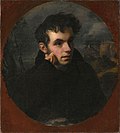 Vasily Zhukovsky, 1815
 -
 Sergey Uvarov, 1815
 -
![The Young Man in a Neckerchief, the so-called Karl Albrecht [ru], с. 1816](//upload.wikimedia.org/wikipedia/commons/thumb/e/e2/Albrecht_by_Kiprensky.jpg/120px-Albrecht_by_Kiprensky.jpg) The Young Man in a Neckerchief, the so-called Karl Albrecht, с. 1816
The Young Man in a Neckerchief, the so-called Karl Albrecht, с. 1816 -
 Anna Maria Falcucci as the Girl in a Poppy Wreath Holding a Carnation, 1819
 -
 Alexander Shishkov, 1825
 -
![Prince Nikita Petrovich Trubetzkoy [ru], 1826](//upload.wikimedia.org/wikipedia/commons/thumb/4/4f/Orest_Kiprensky_025.jpg/120px-Orest_Kiprensky_025.jpg)
-
 Alexander Pushkin, 1827
 -
 Ekaterina Telesheva, 1828
 -

-
 Bertel Thorvaldsen, 1833


![The Young Man in a Neckerchief, the so-called Karl Albrecht [ru], с. 1816](https://profilpelajar.com/en/File:Albrecht_by_Kiprensky.jpg)
.jpg)

![Prince Nikita Petrovich Trubetzkoy [ru], 1826](https://profilpelajar.com/en/File:Orest_Kiprensky_025.jpg)


- Portrait drawings
-
![Pyotr Olenin [ru], 1813](//upload.wikimedia.org/wikipedia/commons/thumb/d/de/Orest_Kiprensky_007.jpeg/120px-Orest_Kiprensky_007.jpeg) Pyotr Olenin, 1813
Pyotr Olenin, 1813 -
 Yefim Chaplits, 1813
 -

-
 Konstantin Batyushkov, 1815
 -

![Pyotr Olenin [ru], 1813](https://profilpelajar.com/en/File:Orest_Kiprensky_007.jpeg)


References
- ^ "Orest Adamovich Kiprensky". Britannica. Retrieved 2021-12-11.
- ^ Talalay, Mikhail G. [in Russian] (2014). Российский некрополь в Италии (in Russian). Moscow: Staraya Basmannaya. pp. 352–353. ISBN 978-5-906470-18-8. OCLC 910722058.
Further reading
- Bocharov, Ivan N.; Glushakova, Yuliya P. [in Russian] (1990). Кипренский. Жизнь замечательных людей (in Russian). Moscow: Molodaya Gvardiya. ISBN 5-235-01383-2.
- Paustovsky, Konstantin G. (1982). "Орест Кипренский". Собрание сочинений (in Russian). Vol. 3. Moscow: Khudozhestvennaya Literatura. pp. 498–529.
- Sarabyanov, Dmitry V. [in Russian] (1982). Орест Адамович Кипренский (artbook). Русские живописцы XIX века (in Russian). Leningrad: Khudozhnik RSFSR.
External links

- Orest Kiprensky at the Russian Academy of Arts' official website (in Russian)
- Gallery of Kiprensky's works


Content Disclaimer
Informasi ini disarikan dari Wikipedia dan disajikan kembali untuk tujuan edukasi. Konten tersedia di bawah lisensi CC BY-SA 3.0. Kami tidak bertanggung jawab atas ketidakakuratan data yang bersumber dari kontribusi publik tersebut.
- The information displayed on this website is sourced in part or in whole from Wikipedia and has been adapted for the purpose of restating it. We strive to provide accurate and relevant information, however:
- There is no guarantee of absolute accuracy. Wikipedia is an open, collaborative project that can be edited by anyone, so information is subject to change.
- It is not intended to constitute professional advice. The content displayed is for informational and educational purposes only. For important decisions (e.g., medical, legal, or financial), please consult a professional.
- Content copyright. Wikipedia is licensed under the Creative Commons Attribution-ShareAlike License (CC BY-SA). This means that content may be reused with appropriate attribution and shared under a similar license.
- Responsible use. Any risk arising from the use of information from this website is entirely the responsibility of the user.