Taishō era
| History of Japan |
|---|
 |
The Taishō period (大正時代, Taishō jidai), also known as the Taishō era, was a Japanese era name (年号,, nengō,; lit. "year name") after Meiji and before Shōwa.[1] This period started on July 30, 1912 and it ended on December 25, 1926. During this time, the emperor was Emperor Taishō-tennō (大正天皇).
The nengō Taishō means "Great Justice"[1] or "Great Righteousness".
Events of the Taishō period
The years in which Taishō was the Japanese monarch comprise this period or era.[2]
- 1920 (Taishō 9): First census of Japan, population 77 million[3]
- 1921 (Taishō 10): Prince Hirohito was made regent (sesshō)[1]
- 1923 (Taishō 12): Great Kantō earthquake;[1]
- 1925 (Taishō 14): The Emperor accepts the principle of the right to vote for everyone[1]
Politics
- 1912 (Taishō 1): Emperor Meiji died; and Saionji Kinmochi was the Prime Minister during the time of transition.[4]
- 1912 (Taishō 1): Katsura Tarō became 15th Prime Minister of Japan[5]
- 1913 (Taishō 2): Yamamoto Gonbee became 16th Prime Minister[6]
- 1914 (Taishō 3): Ōkuma Shigenobu became 17th Prime Minister[7]
- 1916 (Taishō 5): Terauchi Masatake became 18th Prime Minister[8]
- 1918 (Taishō 7): Hara Takashi became 19th Prime Minister[9]
- 1921 (Taishō 10): Takahashi Korekiyo became 20th Prime Minister[10]
- 1922 (Taishō 11): Katō Tomosaburō became 21st Prime Minister[11]
- 1923 (Taishō 12): Yamamoto became 22nd Prime Minister[12]
- 1924 (Taishō 13): Kiyoura Keigo became 23rd Prime Minister[13]
- 1924 (Taishō 13): Katō Takaaki became 24th Prime Minister[14]
- 1926 (Taishō 15):Wakatsuki Reijirō became 25th Prime Minister[15]
Gallery
-
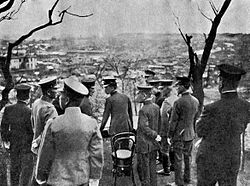 Prince Regent Hirohito visits Yokohama after 1923 Great Kantō earthquake
 -
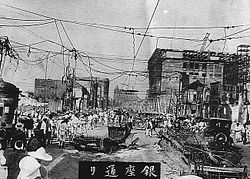 The Ginza in Tokyo after 1923 earthquake


Related pages
References
- ↑ 1.0 1.1 1.2 1.3 1.4 Nussbaum, Louis-Frédéric (2002). Japan Encyclopedia. Harvard University Press. p. 929. ISBN 978-0-674-01753-5.
- ↑ GlobalSecurity.org, Japanese years. Retrieved 2012-12-15.
- ↑ "First Census of the Japanese Empire Gives Its Total Population as 77,005,112," The New York Times. March 2, 1921. Retrieved 2011-12-15.
- ↑ Nussbaum, Louis-Frédéric (2002). Japan Encyclopedia. Harvard University Press. p. 808. ISBN 978-0-674-01753-5.
- ↑ Nussbaum, Louis-Frédéric (2002). Japan Encyclopedia. Harvard University Press. p. 494. ISBN 978-0-674-01753-5.
- ↑ Nussbaum, Louis-Frédéric (2002). Japan Encyclopedia. Harvard University Press. p. 1042. ISBN 978-0-674-01753-5.
- ↑ Nussbaum, Louis-Frédéric (2002). Japan Encyclopedia. Harvard University Press. p. 748. ISBN 978-0-674-01753-5.
- ↑ Nussbaum, Louis-Frédéric (2002). Japan Encyclopedia. Harvard University Press. p. 964. ISBN 978-0-674-01753-5.
- ↑ Nussbaum, Louis-Frédéric (2002). Japan Encyclopedia. Harvard University Press. p. 289. ISBN 978-0-674-01753-5.
- ↑ Nussbaum, Louis-Frédéric (2002). Japan Encyclopedia. Harvard University Press. p. 932. ISBN 978-0-674-01753-5.
- ↑ Nussbaum, Louis-Frédéric (2002). Japan Encyclopedia. Harvard University Press. p. 493. ISBN 978-0-674-01753-5.
- ↑ Prime Minister of Japan and Cabinet (Kantei), 1st-30th (1885-1934). Retrieved 2011-12-15.
- ↑ Nussbaum, Louis-Frédéric (2002). Japan Encyclopedia. Harvard University Press. p. 534. ISBN 978-0-674-01753-5.
- ↑ Nussbaum, Louis-Frédéric (2002). Japan Encyclopedia. Harvard University Press. p. 492. ISBN 978-0-674-01753-5.
- ↑ Nussbaum, Louis-Frédéric (2002). Japan Encyclopedia. Harvard University Press. p. 1025. ISBN 978-0-674-01753-5.
Other websites
 Media related to Taishō era at Wikimedia Commons
- National Diet Library, "The Japanese Calendar" -- historical overview plus illustrative images from library's collection
| Taishō | 1st | 2nd | 3rd | 4th | 5th | 6th | 7th | 8th | 9th | 10th | 11th | 12th | 13th | 14th | 15th |
|---|---|---|---|---|---|---|---|---|---|---|---|---|---|---|---|
| 1912 | 1913 | 1914 | 1915 | 1916 | 1917 | 1918 | 1919 | 1920 | 1921 | 1922 | 1923 | 1924 | 1925 | 1926 |
| Preceded by: Meiji |
Era or nengō: Taishō |
Succeeded by: Shōwa |
Content Disclaimer
Informasi ini disarikan dari Wikipedia dan disajikan kembali untuk tujuan edukasi. Konten tersedia di bawah lisensi CC BY-SA 3.0. Kami tidak bertanggung jawab atas ketidakakuratan data yang bersumber dari kontribusi publik tersebut.
- The information displayed on this website is sourced in part or in whole from Wikipedia and has been adapted for the purpose of restating it. We strive to provide accurate and relevant information, however:
- There is no guarantee of absolute accuracy. Wikipedia is an open, collaborative project that can be edited by anyone, so information is subject to change.
- It is not intended to constitute professional advice. The content displayed is for informational and educational purposes only. For important decisions (e.g., medical, legal, or financial), please consult a professional.
- Content copyright. Wikipedia is licensed under the Creative Commons Attribution-ShareAlike License (CC BY-SA). This means that content may be reused with appropriate attribution and shared under a similar license.
- Responsible use. Any risk arising from the use of information from this website is entirely the responsibility of the user.