User:ModlordD/sandbox
| Doctor Doom | |
|---|---|
| Publication information | |
| Publisher | Marvel Comics |
| First appearance | The Fantastic Four #5 (cover-dated July 1962; published April 10, 1962)[1][2][3] |
| Created by | Stan Lee (writer-editor) Jack Kirby (artist/co-plotter) |
| In-story information | |
| Full name | Dr. Victor Werner von Doom[4] |
| Place of origin | Latveria |
| Team affiliations | Acts of Vengeance Cabal Intelligencia Future Foundation Astonishing Avengers Doom's Avengers Guardians of the Galaxy |
| Abilities |
|
Doctor Doom is a supervillain appearing in American comic books published by Marvel Comics. Created by Stan Lee and Jack Kirby, the character first appeared in The Fantastic Four #5 (cover dated July 1962) and has endured as the archenemy of the Fantastic Four.
Doctor Doom is the self-proclaimed moniker of Victor Werner von Doom, the monarch of the fictional Eastern European country of Latveria. Born to a Latverian healer and a Romani witch, Doom spent his life mastering both science and sorcery until he was disfigured in a laboratory accident, after which he donned a magically forged suit of armor with a metal mask to conceal his scarred face and seized rulership of Latveria. Doom obsessively seeks to bring order to humanity through world domination and prove his intellectual supremacy over Mister Fantastic—his old college rival and the leader of the Fantastic Four—whom he blames for his disfigurement. His armor provides superhuman strength, flight, and high-tech weaponry, while his command of dark magic grants abilities ranging from energy projection to telekinesis. His diplomatic immunity as head of state shields him from prosecution for crimes committed outside Latveria. The character was conceived by Kirby as a figure of approaching death (entirely encased in metal and stripped of human mercy) and by Lee as a study in arrogance as its own undoing.
Major Doctor Doom stories include the "Unthinkable" arc in Fantastic Four (2003–2004), in which Doom abandons science for sorcery and imprisons Mister Fantastic in a magical dimension, and Books of Doom (2005–2006), a retelling of his origin written by Ed Brubaker. He is a central figure in the company-wide Secret Wars (2015) event, in which he claims godhood over a reconstructed multiverse before Reed Richards defeats and redeems him. The character temporarily adopted the Iron Man identity in the Infamous Iron Man series (2016–2018) and headlined the "One World Under Doom" crossover event in 2025. While his primary obsession is the Fantastic Four, Doom has also fought other heroes, including Spider-Man, Iron Man, Doctor Strange, Black Panther, the X-Men, and the Avengers.
The character has been listed as one of Marvel's most notable villains and among the greatest comic book villains ever created. Doom's likeness has been featured on merchandise such as clothing and collectible items, and he has inspired real-world elements (such as rapper Daniel Dumile's stage persona, and theme park attractions) and been adapted in various media incarnations, including films, television series, and video games. Joseph Culp, Julian McMahon, Toby Kebbell, and Robert Downey Jr. have portrayed the character in live-action.
Publication history
Creation and development
Like many of Marvel's Silver Age characters, Doctor Doom was conceived by Stan Lee and Jack Kirby. With the Fantastic Four title performing well, Lee and Kirby were trying to dream up a "soul-stirring...super sensational new villain" for the series.[5] Looking for a name, Lee latched onto "Doctor Doom" as "eloquent in its simplicity — magnificent in its implied menace".[5]
Kirby stated in a 1987 interview: "Dr. Doom was the classic conception of Death, of approaching Death. I saw Dr. Doom as The Man in the Iron Mask, who symbolized approaching Death. It was the reason for the armor and the hood. Death is connected with armor and inhuman-like steel. Death is something without mercy and human flesh contains that element of mercy. Therefore, I had to erase it, and I did it with a mask."[6]
Kirby further described Doom as being "paranoid", wrecked by his twisted face and wanting the whole world to be like him.[7] Kirby went on to say that "Doom is an evil person, but he's not always been evil. He was [respected]...but through a flaw in his own character, he was a perfectionist."[8] Stan Lee's writing typically showed Doom's arrogance as his constant downfall, and how his pride leads to von Doom's disfigurement at the hands of his own machine, and to the failures of many of his schemes.[9]
In the book Superhero: The Secret Origin of a Genre, Peter Coogan writes that Doom's original appearance was representative of a change in the portrayal of "mad scientists" to full-fledged villains, often with upgraded powers.[10] These supervillains are genre-crossing villains who exist in adventures "in a world in which the ordinary laws of nature are slightly suspended"; characters such as Professor Moriarty, Count Dracula, Auric Goldfinger, Hannibal Lecter, Joker, Lex Luthor, and Darth Vader, also fit this description.[10] Sanderson also found traces of William Shakespeare's characters Richard III and Iago in Doom; all of them "are descended from the 'vice' figure of medieval drama", who address the audience in monologs detailing their thoughts and ambitions.[11]
1960s and 1970s
The character first appeared in The Fantastic Four #5 (cover dated July 1962). The character reappears in issue #10 (January 1963); Ben Saunders says that this is the best early Doom story, establishing the character as Mister Fantastic's "Jungian shadow or distorted double."[12] Due to the rush to publish, the character was not given a full origin story until Fantastic Four Annual #2, two years after his debut.[13] The story establishes that Doom was born to a Romani family in Latveria, a small kingdom in the Alps, experienced persecution, but eventually became its undisputed leader. Saunders describes the story as transforming the character "from a malignant sci-fi warlock into a more complex figure: although narcissistically wounded and vengeful, he displays a sense of responsibility for his people, and a warped code of honor."[14]
At one point in the 1970s, Kirby drew his interpretation of what Doom would look like under the mask, giving Doom only "a tiny scar on his cheek".[15] Due to this slight imperfection, Doom hides his face not from the world, but from himself.[15] To Kirby, this is the motivation for Doom's vengeance against the world; because others are superior due to this slight scar, Doom wants to elevate himself above them.[8]
While the Fantastic Four had fought various villains such as the Mole Man, Skrulls, the Miracle Man, and Namor the Sub-Mariner, Doom managed to overshadow them all and became the Fantastic Four's archnemesis.[16] During the 1970s, Doom branched out to more Marvel titles such as Astonishing Tales,[17] The Incredible Hulk,[18] and Super-Villain Team-Up (1975). Beginning with issue #42, he also had appearances in Marvel Team-Up (February 1976). Doom's origin was also a feature in Astonishing Tales when his ties to the villain Mephisto were revealed.[19]
1980s and 1990s
Doctor Doom appeared as the main antagonist in the second Marvel/DC crossover, Superman and Spider-Man, in 1981. Marvel editor-in-chief Jim Shooter co-wrote the story with Marv Wolfman, and recalled choosing Victor von Doom based on his iconic status: "I figured I needed the heaviest-duty bad guy we had to offer — Doctor Doom. Their greatest hero against our greatest villain."[20]
In 1981 John Byrne began his six-year run writing and illustrating Fantastic Four, sparking a "second golden age" for the title[21] but also attempting to "turn the clock back [...] get back and see fresh what it was that made the book great at its inception."[22] Doctor Doom made his first appearance under Byrne's tenure with issue #236.[23] Whereas Kirby had intimated that Doom's disfigurement was more a figment of Victor's vain personality, Byrne decided that Doom's face was truly ravaged: only Doom's own robot slaves are allowed to see the monarch without his helmet.[24] Byrne emphasized other aspects of Doom's personality; despite his ruthless nature, Victor von Doom is a man of honor.[25][26]
Returning to Latveria after being temporarily deposed, Doctor Doom abandons a scheme to wrest mystical secrets from Doctor Strange to oversee his land's reconstruction.[24] Despite a tempestuous temper, Doom occasionally shows warmth and empathy to others; he tries to free his mother from Mephisto and treats Kristoff Vernard like his own son.[24] Byrne gave further detail regarding Doom's scarring: Byrne introduced the idea that the accident at Empire State University only left Victor with a small scar that was exaggerated into a more disfiguring accident by Doom's own arrogance—by donning his newly forged face mask before it had fully cooled, he caused massive irreparable damage.[27] During Steven Englehart's run on Fantastic Four (1987-1989), Doom was exiled by his heir, Kristoff, but this storyline was left unresolved when Englehart departed.
Doctor Doom also confronted the X-Men in Uncanny X-Men #145 (May 1981), in which he attempts to capture and seduce Storm.[28] He also appeared in titles such as Punisher, The Spectacular Spider-Man, and Excalibur.
Walt Simonson's Fantastic Four #350 (March 1991) controversially revealed that the Doom seen during Englehart's arc was a robotic imposter, with the real Doom returning in new armor to reclaim Latveria. Simonson's retcon suggested the last true appearance of Doom was in the "Battle of the Baxter Building", but later writers often disregarded his interpretations, leading to further revisions of Doom's character and history.[29][better source needed]
2000s and 2010s
Mark Waid began to redefine Doctor Doom in the 2003 "Unthinkable" storyline (Fantastic Four vol. 3, #66-70 and #500), where Doom forsakes technology for mysticism. He kills his first love, Valeria, to gain powers from demons and imprisons Franklin Richards in Hell. Doom challenges Reed Richards to escape a magical prison, but with Doctor Strange's help, Richards succeeds, causing Doom to be dragged to Hell. Doom remained there until the 2004 "Ragnarok" storyline in Thor, where Thor's hammer, Mjölnir, provided his escape.[citation needed] In 2005–2006, Doctor Doom starred in the limited series Books of Doom, written by Ed Brubaker. This retelling of his origin explored the early, less-seen parts of Doom's life and questioned whether his path to dictatorship was fated or due to personal faults—a nature versus nurture debate.[30] Brubaker's portrayal was influenced by the original Lee/Kirby version, and he chose not to show Doom's face, following Kirby's example.[31]
In Spider-Man/Fantastic Four #4, the Mighty Avengers invaded Latveria due to Victor's involvement in a chemical bomb plot involving the Venom symbiote, which was actually orchestrated by Kristoff Vernard.[32] In the Siege storyline, Doctor Doom initially supports Norman Osborn's attack on Asgard but later withdraws.[33] He also stars in Doomwar written by Jonathan Maberry,[34] where he allies with the isolationist Desturi to seize control of Wakanda.[35]
In Fantastic Four: Three, Doctor Doom seeks to be "reborn" and plans to abdicate his throne to Kristoff. Valeria von Doom visits him, notices his brain damage, and offers to restore his mental capacity in exchange for his help with Reed and the Fantastic Four.[36] A humbled Doom later attends Johnny Storm's funeral,[37] and is recommended for the Future Foundation.[38] Leading up to Secret Wars, Doom usurps the power of the Beyonders,[39] creating a new Battleworld where he assumes the role of God. However, Reed Richards and a group of heroes challenge Doom, and with the Molecule Man's help, they restore the multiverse. Reed ultimately uses the Beyonder's power to heal Doom's face and purify his soul.[40][better source needed]
Doom returns to his kingdom, saving Tony Stark from Latverian rebels and claiming to be a new man.[41] He relinquishes his dictatorship, entrusting Tony with a Wand of Watoomb to defeat Madame Masque. When more rebels appear, he teleports Stark to the Bronx Zoo,[42] and they later confront Madame Masque in Chicago.[43] After discovering she's possessed, Doom helps Tony trap her in his armor and exorcises the demon. He then vanishes before Tony wakes up.[44] Doom later interrupts Tony's breakfast with Amara, trying to prove he has changed, but Tony remains distrustful.[45] Following Stark's coma caused by Captain Marvel, Doom takes up the Iron Man mantle, faces Mephisto disguised as the Maker,[46] joins the Avengers,[47] and eventually conceives a child with Dr. Amara Perera.[48]
When Ben Grimm and Johnny Storm seek their teammates to restore the Fantastic Four's powers, Doom follows them into parallel universes to assist an alternate Reed Richards against a version of Doom who has merged with Galactus.[citation needed] Meanwhile, Gwenpool, unaware of Doom's reformation, tries to attack him using an AI Doombot named Vincent. Doom easily captures her but is amused by her taunts.[citation needed] Gwen escapes, believing Doom is still a threat, and attacks again, releasing an earlier version of Doom.[citation needed] Doom defeats his doppelganger to save Gwen, who realizes her mistake and hopes for reform. Later, she enlists Doom, Vincent, Doctor Strange, and Terrible Eye to help her friend Cecil regain human form.[citation needed]
Doctor Doom was featured in his first solo series in 2019. Doom is framed for a Moon space station explosion he had warned about, while also experiencing random encounters with rival supervillain Kang the Conqueror due to a theorized quantum entanglement.[49]
2020s
After Doom acquired the title of Sorcerer Supreme from Doctor Strange in Blood Hunt (2024), writer Ryan North and artist R.B. Silva launched One World Under Doom (2025), a nine-issue crossover in which Doom governed the entire planet.[50] Across multiple interviews, North identified the political question at the series' center: Doom's world takeover dramatizes "the dangerous anti-democratic fantasy" of one perfect leader who can fix everything, a fantasy he identified as the structural appeal of fascism.[51] North characterized Doom specifically as "the kind of guy who's like, 'Yes, OK, yes, that is fascism. But when I'm doing it, it's not fascism, it's the actual best guy doing it, so it's fine.'"[51]
The eighth issue saw Doom accidentally kill his goddaughter Valeria Richards. Contemporary analysis stated the love for his goddaughter is the one human attachment that could undo him.[52] North had emphasized the Doom/Valeria relationship as central to the series from its announcement, describing Doom approaching Valeria in the second issue to justify his actions: "He basically goes to Valeria and says, 'Look, you are my goddaughter and, unlike most people on Earth, I really care about what you think, so let me justify what I'm doing to you.'"[53]
Fictional character biography
 | This section's plot summary may be too long or excessively detailed. (April 2016) |
Victor von Doom was born in Latveria to a tribe of Romani people under the rule of an unnamed nobleman, the Baron. His mother, the witch Cynthia Von Doom, died at the hands of Mephisto when Victor was young. His father, Werner von Doom, a renowned medicine man, kept her sorcery a secret to protect Victor. After Cynthia's death, the Baron's wife fell ill, and when Werner failed to save her, he was labeled a murderer and forced to flee with young Victor. Werner ultimately died of exposure on a mountainside, leaving Victor to discover his mother's occult instruments and swear revenge on the Baron. As Victor grew, he became a brilliant inventor, merging sorcery and technology to defend the Roma people. His exploits attracted the attention of the dean of Empire State University,[54] who offered him a chance to study in the U.S., prompting Victor to leave his homeland and his love, Valeria, behind.
Upon arriving in the United States, Victor von Doom met Reed Richards, his future rival. He built a machine to communicate with the dead, specifically his mother, but ignored Richards’ warnings about its flaws, leading to a catastrophic explosion that severely damaged his face.[54] Expelled after the incident, Victor traveled until he collapsed on a Tibetan mountainside, where he was rescued by monks. Mastering their disciplines, he forged an iron mask that permanently bonded to his skin, adopting the identity of Doctor Doom.[54] As Doom, he sought revenge on those he held responsible for his accident, particularly Reed Richards, and successfully led a revolution to take over Latveria.[55]
1960s
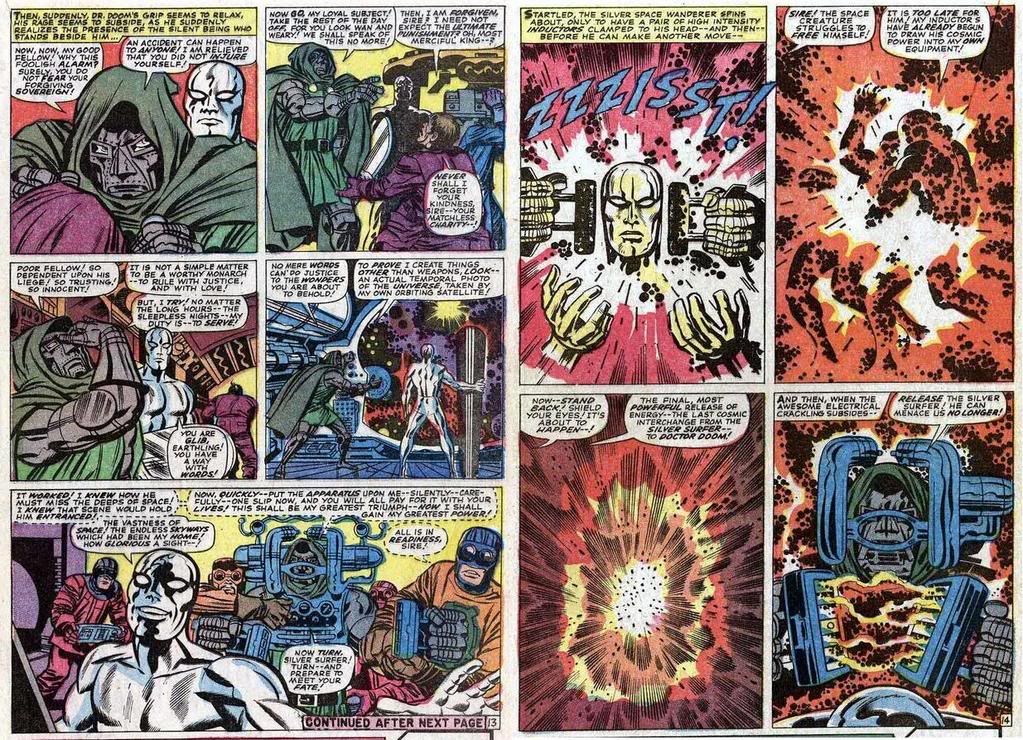
In his first appearance, Doctor Doom captures the Invisible Girl, using her as a hostage to force the Fantastic Four to travel back in time to steal Blackbeard's enchanted treasure to help him conquer the world. However, Reed Richards tricks Doom by swapping the treasure for worthless chains.[56] Doom then allies with the Sub-Mariner, who installs a magnetic device in the Baxter Building to pull them into space, aiming to eliminate the Fantastic Four. The Sub-Mariner returns the Baxter Building to New York, leaving Doom stranded on an asteroid. After learning the secrets of the advanced Ovoids, Doom swaps bodies with Mister Fantastic but accidentally switches back, ending up trapped in Sub-Atomica when hit by a shrinking ray he intended for the Fantastic Four.[57] Doom takes over this micro-world but is ousted by the Fantastic Four and thrown into space while trying to send them there.[58] Saved by Rama-Tut, he returns to Earth and uses a special berry juice to turn the Fantastic Four against each other. However, Richards outsmarts Doom with the hallucinogenic juice, leading Doom to believe he has killed him and depart.[59] During the 1960s, Doom attempted to recruit Spider-Man into joining forces with him,[60] and he came into conflict with the Avengers when Quicksilver and Scarlet Witch illegally entered Latveria to find a long-lost relative of theirs.[61] He stole the Silver Surfer's powers in 1967, but lost them after breaching a barrier Galactus had set for the Surfer on Earth.[62][63]
1970s and 1980s
During the 1970s, Doctor Doom expanded into more Marvel titles, featuring a battle for the Latverian throne against Prince Rudolfo in Astonishing Tales.[64] In August 1981, he appeared in Iron Man, where Stark thwarted Doom's time-travelling plan to enlist Morgan le Fay to defeat King Arthur's forces with an army of revived warriors. Stranded in the past due to this interference, Doom vowed revenge, but he had to postpone it to return to the present day.[65]
Doctor Doom later allies with the Puppet Master to trap the Fantastic Four in the miniature city of "Liddleville" using cybernetic copies of their bodies. However, he sabotages the plan to disrupt Reed's focus, but the Puppet Master ultimately aids the FF in escaping, trapping Doom in the android body he used to monitor them.[66]
During John Byrne's 1980s run, Doctor Doom attempted to steal Terrax's cosmic powers, leading to a fight that destroyed his body.[67] He survived by transferring his consciousness to another human and was later restored to his original body by the Beyonder.[68] On Battleworld, Doom briefly succeeded in stealing the Beyonder's power, but it was too vast for him to control, allowing the Beyonder to reclaim it.[69]
1990s
When Franklin Richards was kidnapped by Onslaught, Doctor Doom joined forces with the Fantastic Four, Avengers and the X-Men to battle him in Central Park.[citation needed] During the fight, Doom was forced to sacrifice himself alongside others to contain Onslaught, which allowed the X-Men to destroy him.[citation needed] Though believed dead, Doom and the heroes were saved by Franklin, who created a pocket dimension called Counter-Earth, where Doom later uncovered a secret power linked to Franklin and persuaded the boy to relinquish control of the world.[citation needed]
2000s
When Susan Richards faced complications with her second pregnancy, Johnny Storm contacted Doctor Doom for help, knowing he couldn't resist the chance to outdo Reed. Doom saved Susan's daughter and cured Johnny's inability to "flame off" by channeling Johnny's excess energy into her. Afterward, Doom named the baby "Valeria" and plotted to make her his familiar. His lust for power led to him sacrifice his long-lost love Valeria to demons for magical powers equivalent to years of sorcery study.[70] With this power, he trapped Franklin in Hell, immobilized Doctor Strange, and neutralized the Fantastic Four.[71] However, Reed freed Doctor Strange's astral self, allowing them to outsmart Doom and provoke his demonic benefactors to take him to Hell.[72]
To eliminate Doom as a threat, Reed took control of Latveria to dismantle his equipment,[73] and planned to trap them both in a pocket dimension.[74] This backfired when the team intervened, leading Doom to transfer his spirit into Sue, Johnny, and Ben. Reed was forced to kill Ben to stop Doom.[75] Doom returned to Hell, and Reed later used a machine Doom had once created to travel to Heaven and restore Ben to life.[76] Doom remained in Hell until he escaped during a dimensional tear caused by Mjölnir's fall to Earth, though he focused on rebuilding his power base instead of lifting the hammer. These events were later removed from Marvel continuity in the 2015 Secret Wars.[citation needed]
Later, a Doombot was defeated by Reed Richards, Hank Pym, Iron Man, and She-Hulk in New York City, raising questions about Doom's involvement.[citation needed] In the midst of the superhero Civil War, he sends a message to Storm and the Black Panther, inviting an alliance between Latveria and Wakanda.[citation needed] In Latveria, Panther spurns the invitation, detonating an EMP that blacked out a local portion of Latveria before Doom's robots could destroy his ship.[citation needed] It is later revealed that Doom is working with the Red Skull on a weapon, believing it would lead him to become the Baron of Iron, despite his disagreements with the Skull's principles.[citation needed]
At the end of the first chapter of the X-Men event "Endangered Species", Doom is contacted by Beast to help reverse the effects of Decimation but rejects the offer, admitting he lacks talent in genetics.[citation needed] In Spider-Man: One More Day, Doom is approached by Spider-Man for help in saving Aunt May.[77] Additionally, he transforms Latveria into a refugee camp for Atlanteans after the destruction of their kingdom,[78] and allies with Loki to manipulate his brother into unwittingly releasing his Asgardian allies.[79]
Doctor Doom later defends Latveria against the Mighty Avengers after it is revealed that one of his satellites carried the 'Venom Virus' released in New York City, a result of hacking by one of Doom's enemies.[80] During a battle with Iron Man and the Sentry, the time travel mechanism in his armor overloads, trapping them all in the past; Doom continues his relationship with Morgan le Fay using his time machine.[81] Although he and Iron Man eventually return to the present, Doom leaves Iron Man in his exploding castle and is falsely incarcerated at the Raft.[citation needed] He later escapes the Raft in the "Secret Invasion" storyline, thanks to a virus uploaded into the prison's systems by the Skrulls.[82]
After the Secret Invasion and the onset of "Dark Reign", Doctor Doom joins the Cabal with Norman Osborn, Emma Frost, Namor, Loki, and the Hood, seeking revenge for his tarnished reputation.[83] Soon after, he allies with the isolationist Desturi to seize control of Wakanda.[citation needed] Doom severely injures T'Challa, the Black Panther, aiming to take Wakanda's vibranium for his own enhancement. However, T'Challa destroys the vibranium stockpile, believing his people can survive without it.[citation needed] In Fantastic Four #566-569, written by Mark Millar, Doctor Doom receives a power upgrade after being thrown back in time by the Marquis of Death. He fights through time to seek revenge, claiming to have rebuilt himself to destroy the Marquis. However, later issues ignore this arc, suggesting it was merely a dream of Valeria von Doom.[citation needed] Doom then joins the supervillain group Intelligencia but is betrayed and captured during their plan.[84] He escapes with Bruce Banner's help and returns to Latveria, seemingly damaged by the experience.[citation needed]
2010s
At the start of the "Siege" storyline, Doom, working with the Cabal, demands that Osborn reverse his actions against Namor, but Osborn refuses. After a violent attack by the Void, it's revealed that the "Doctor Doom" present was actually a Doombot, which releases nanites that destroy Avengers Tower and force evacuations. The real Doom warns Osborn not to strike him again, threatening further consequences.[33]
It is revealed that the Scarlet Witch at Mount Wundagore is a Doombot, indicating that the real Wanda was captured by Doom after the House of M event.[85] Wanda's enhanced powers resulted from her and Doom's attempt to channel the Life Force to resurrect her children, which ultimately overwhelmed her. With Wiccan's help, they sought to use the entity possessing Wanda to restore mutant powers, but the Young Avengers intervened, concerned about the consequences. Doom aimed to transfer this entity into himself, gaining god-like powers,[86] but accidentally killed Cassie before Wanda and Wiccan could reclaim those powers from him.[87]
In "Fantastic Four: Three", a guilt-ridden Doctor Doom, planning to abdicate his throne to Kristoff, is approached by Valeria, who asks for his help with her father. Noticing Doom's brain damage and memory loss from a previous battle, she offers to restore his mental faculties in exchange for assisting with the Fantastic Four, which he agrees to.[36] Later, Doom attends Johnny Storm's funeral.[37] Due to this agreement, Doom is recommended by Nathaniel Richards and Valeria von Doom to join the Future Foundation.[38] Despite an angry attack from the Thing, Mister Fantastic and the Invisible Woman welcome him. Valeria learns that Kristoff Vernard is Doom's backup for restoring his memories, so they all head to Latveria, where a brain transfer machine successfully restores Doom's knowledge. Although Kristoff offers to return the throne to Doom, he declines, citing a promise to Valeria to help her defeat Mister Fantastic when needed.[88] Doom then plans a symposium to defeat the Council of Reeds—alternate versions of Reed Richards trapped in their universe.[89] Mister Fantastic, Victor, Valeria, and Nathaniel Richards meet with the supervillain geniuses and Uatu the Watcher about what to do with the Council of Reeds.[90]
Around this time, von Doom performed brain surgery on the Hulk to separate him from Bruce Banner in return for a favor from the Hulk.[91] Later, Doom is apparently killed by the Mad Celestials,[92] but survives and creates the Parliament of Doom. He later returns to rule Latveria for a millennium.[93] An ill-fated excursion into the alternate universe of the one of Infinity Gauntlets resulted in Reed and Nathaniel Richards rescuing Doom from his own council.[94]
During the confrontation between the Avengers and the X-Men, Doom allies with Magneto and others against Red Skull's Red Onslaught form.[95] In an attempt to atone for past misdeeds, Doom absorbs the Scarlet Witch's reality-altering powers and resurrects the dead Cassie Lang, whom he had accidentally killed.[96] After returning to normal, Doom is taken into captivity for his initial killing of Lang.[97]
As the final Incursion approaches in the Secret Wars storyline, Doom usurps the power of the Beyonders with the aid of Doctor Strange and Molecule Man.[39] He then creates a new Battleworld from the destroyed multiverse, claiming the role of God, and rewriting history to resurrect those he killed, while taking Sue as his wife and assigning roles to Franklin and Valeria. Ultimately, Reed and a group of survivors challenge Doom, and with Molecule Man's help, they restore the multiverse. Reed chooses to heal Doom's face using the Beyonder's power.[40]
In the All-New, All-Different Marvel, Doom returns to Latveria and saves Tony Stark by using a sonic attack to incapacitate a group of rebels.[41] He tells Tony he's a new man and gives him the Wand of Watoomb for protection against Madame Masque. When more rebels arrive, Doom teleports Iron Man to the Bronx Zoo,[42] then to the Jackpot Club in Chicago to confront a Masque.[43] Realizing she is demonically possessed, Doom has Tony trap her in the Iron Man armor while he exorcises the demon. He disappears before Tony regains consciousness,[44] then later interrupts Tony's breakfast date with Amara to prove he has changed, but Tony remains distrustful and Doom leaves again.[45]
After Tony Stark's defeat by Captain Marvel in Civil War II, Doom discovers his calling to heal the world, reflecting on his dissatisfaction as a god. Inspired by Stark, he establishes Stark's legacy, fights for his brand of justice as the third Iron Man, and later conflicts with Mephisto disguised as Maker.[46] Doom joins the Avengers and conceives a child with Amara Perera,[48] prompting a group of villains led by the Hood to target him.[98] The final battle occurs when the Hood tries to take over Stark Industries, leading to a confrontation between Doom and the Hood, during which Doom's face is severely burned by a demon. After the villains' defeat, Victor retreats to the ruins of Castle Doom.[99]
A young woman named Zora Vokuvic breaks into Castle Doom, demanding to see Doctor Doom and insisting that Latveria needs its leader back amid turmoil. Initially resistant, Doom is persuaded when Zora hands him his mask, prompting him to venture out and quell the civil war, vowing to restore the nation with his own strength.[100]
2020s
Doctor Doom is framed for the destruction of the Antlion space station by Symkarian rebels and is killed while on the run, only to be sent back to Earth by Death as her "greatest servant". After fending off assassins including Taskmaster and MODOK, he sends Reed Richards his solution to the black hole threatening Earth and sets off to regain his power.[101] During the "King in Black" storyline, Doctor Doom confronts Iron Man during Knull's invasion. Iron Man is bonded with an Extremis-powered symbiote, and they are attacked by a symbiote-possessed Santa Claus, revealed to be Mike Dunworthy. Doom seeks to learn from Iron Man's new armor, but is turned down.[102]
During the "Blood Hunt" storyline, Doctor Doom puts Latveria on high alert amidst a vampire invasion, ordering border guards to maintain defenses while noting he will have new subjects to attend to.[103] Doom informs Doctor Strange and Clea that Blade is possessed by Varnae and declares they need mages to bring back the Sun, requesting the title of Sorcerer Supreme.[104] After being temporarily granted the title of Sorcerer Supreme, Doom removes the Darkforce surrounding Earth, which inadvertently allows vampires to walk in sunlight. However, he betrays his promise and refuses to return the title, making Strange disappear.[105]
During the "One World Under Doom" storyline, Doom uses his power as Sorcerer Supreme to take over the world, making world leaders pledge allegiance to him. Doom uses time magic to ensure his victory cannot be undone, but inadvertently kills Valeria Richards during a battle with the heroes who oppose him. Unable to resurrect Valeria by himself, Doom makes a deal with the Living Tribunal to resurrect her in exchange for his life.[106][107] In a lead-up to the Avengers: Armageddon storyline, it is revealed that a younger clone of Doom was created at some point.[108]
Powers and abilities
 | This section may contain original research. (October 2024) |
Considered to be one of the smartest men on Earth, Doom's high-level intellect rivals that of his sworn nemesis Reed Richards. Doom has notably restored the Thing's human form—though Reed Richards also achieved this, he struggled to maintain it. However, Richards managed to process complex calculations to save Kitty Pryde from disintegration, a feat Doom admitted he could not replicate.[109] Doom has leveraged his scientific prowess to steal or replicate the powers of cosmic beings such as the Silver Surfer, the Beyonder, and even Galactus's world-ship.[110] Doom often uses "Doombots", his robot doubles, to retroactively explain his actions or erase events from his history. This device was also used to depict Kristoff Vernard believing himself to be the real Doom for a time.
In addition to being a genius level scientist and inventor, Doom is also a very powerful sorcerer with a mastery of dark magic, giving him a unique advantage over his rival, Mister Fantastic.[111] Initially trained by Tibetan monks, Doom's magical powers are later enhanced by his lover Morgan le Fay. The magical spells Doom casts grant him additional powers abilities including energy absorption and projection, technopathy, dimensional travel, healing, and is able to summon hordes of demonic creatures.[112] Doom placed second in a magic tournament held by the ancient sorcerer the Aged Genghis,[113] and after Doctor Strange relinquished the title of Sorcerer Supreme, he acknowledged Doom's potential to assume that role.[114]
The alien Ovoids inadvertently taught Doom how to psionically transfer his consciousness into another being through eye contact.[115][116][117][118] However, he rarely employs this ability, as it can revert if his concentration breaks, and he is reluctant to do so due to his ego about his appearance.
Doom's armor enhances his strength and durability to superhuman levels, allowing him to contend with more physically powerful foes like Spider-Man and the Hulk,[119] although he prefers long-range tactics against stronger opponents. The armor is nearly indestructible, shielding him from various forms of manipulation and housing advanced weaponry, including lasers, a force field generator,[120] and lethal electric shocks.[120] Additionally, his armor supports him with air, food, water, and energy systems for extended periods in extreme environments such as outer space. Even without the armor, Doom is a skilled hand-to-hand combatant,[49] capable of defeating strong opponents due to his knowledge of pressure points and skill with melee weapons.[121]
Monarch of Latveria
As the absolute monarch of Latveria, Doctor Doom rules the country with an iron fist and has frequently used his political power for his own personal benefit. Doom has reshaped the country in his own image, renaming both the capital city Hassenstadt and Castle Sabbat to Doomstadt and Castle Doom respectively. Doom frequently monitors the citizens of Latveria from Castle Doom and uses his Doombots to maintain order within his nation. Despite his infamous reputation as a supervillain, Doom has diplomatic immunity – allowing him to escape legal prosecution for most of his crimes he commits outside of Latveria. Doom also has total control of the nation's natural and technological resources, along with its manpower, economy, and military. Though from the outside it seems tyrannical, it seems the Latverian people really do adore Doom, as shown with two of his apprentices, Zora Vukovic, (aka, Victorious) and Kristoff Vernard.[122][123] He is also known to harbor fugitive supervillains within Latveria as means of protecting them from prosecution, although he only does this for villains who play a part in his schemes. After renouncing his rulership,[124] it is likely he lost this status.
Psychology
| This section may contain original research. (October 2024) |
Doom's primary weakness is his arrogance, which often blinds him to his own role in his failures. Layla Miller noted that he refuses to accept responsibility for the accident that scarred his face, instead blaming Reed Richards. While Doom typically views himself as superior, he occasionally listens to heroes like Mister Fantastic when it benefits him. Even when allied with others, he often seeks personal gain, as seen when he attempted to steal Thanos’ Infinity Gauntlet during a confrontation with the Titan. Doom adheres to a strict code of honor, keeping his word but often interpreting promises in a self-serving way. For instance, while he may not harm someone directly, he won't stop others from doing so. His sense of honor has led him to save Captain America and spare Spider-Man's life, but he refuses to attack weakened opponents, preferring that any victory over the Fantastic Four come solely from him. Despite his flaws, Doom is devoted to his subjects. As he is judged by Bast, it is revealed that Doom truly wished for a utopian future where humanity thrived, albeit one where he was in power.[125]
Personality and motivations
Doom's own account of himself is that of a guardian, not a conqueror. Official reference material on the character notes that although he is "branded a dictator by the wider world" and clashes constantly with outside heroes, his stated motivation has always been to protect Latveria from threats beyond its borders.[1] That self-image rests on a grievance he has never let go of: Doom holds Reed Richards responsible for the lab accident that scarred his face, even though it was his own carelessness, not any fault in Richards's warning, that caused the explosion.[1] Stan Lee, who co-created the character with Jack Kirby, built this resentment into Doom's design from the outset, making him a college classmate of Richards's specifically so the two men's pride and intelligence would have someone to measure themselves against; Lee later said he wanted Doom's ego to "match that of Reed Richards himself."[2]
That rivalry has remained the character's defining relationship for six decades, and writers across very different eras keep reaching for similar language to describe it. Iron Man writer David Michelinie called Doom Tony Stark's "reflection in a dark mirror," a genius of comparable ability whose talents are turned toward domination rather than improvement.[3] Literary scholar Ben Saunders has made a related argument specifically about Reed Richards, describing Doom as a distorted double defined by the same qualities Richards is praised for.[4] Writer Christopher Cantwell has compared the two men to a pair of high-school rivals unable to settle whether they respect or despise each other, and has argued Reed occupies Doom's thoughts far more than Doom occupies Reed's.[5] Writer Ryan North, promoting the 2025 event One World Under Doom, connected this directly to Doom's old facial injury, calling it "the blemish that he just can't accept," and arguing the same refusal keeps Doom from ever accepting Reed as an equal.[6]
Doom does not consider himself a villain, and some of the writers who have handled him at length have argued the character is at least partly right not to. Cantwell has described Doom as capable of genuine affection and still possessed of a conscience he would rather not have, while doubting he would ever carry out the kind of indiscriminate slaughter some of Marvel's other cosmic-scale villains commit without hesitation.[5] North has gone further, arguing Doom genuinely believes himself to be the hero of his own story and would likely be remembered as one if Reed Richards did not exist to overshadow him.[7] Late in his life, Stan Lee made a similar case, arguing it is unfair to call wanting to rule the world a crime and saying he wanted to "clear his name."[8] Other characters in the comics are less forgiving of this reasoning. Confronted by Doom over why the Avengers do not simply seize power to govern more efficiently themselves, Storm tells him, "We may have the power to take the world, but not the right."[9]
Kirby traced Doom's rage back to a wound smaller than most retellings suggest. In a 1992 interview, he described the young Victor von Doom as a respected, talented chemist whose only real injury from his accident was a minor scar, and argued that what actually disfigures him afterward is his own refusal to tolerate any imperfection in himself: "Perfectionists cannot accept imperfection."[10] In Kirby's reading, that scar comes to dominate Doom's entire sense of self, until a superior mind becomes one that treats everyone else's ordinary flaws as a personal insult.[10]
For a man who rules an entire country, Doom is written as someone with very few people in his life. Jonathan Hickman, who wrote Doom during the 2015 Secret Wars crossover, has argued that a lifetime spent alone tends to produce its own justifications, and that ruling and real friendship rarely coexist: "the wind blows really hard at the top of the mountain."[11] Asked whether Doom suffers for this isolation, Hickman said he does, and suggested there is more to it than loneliness alone.[11] The clearest break in that pattern is Valeria Richards, Reed and Susan's daughter, whom Doom helped deliver as an infant and has treated with a warmth he extends to almost no one else; Hickman has argued this matters for understanding Doom generally, since in Reed's absence Doom has effectively placed himself in Reed's role within that family.[11] Kristoff Vernard, an orphaned boy Doom later adopted as his ward and heir, occupies similar ground, giving Doom something close to a son even as his larger ambitions remain fixed on defeating the boy's adoptive family.[12]
As a ruler, Doom shows the same gap between self-image and outside perception. Reference works describe Latveria's citizens as genuinely well provided for under his rule even as he crushes dissent without hesitation, and his diplomatic immunity as a head of state remains a lasting source of frustration for the superheroes who oppose him.[13] Doom presents his own conduct as governed by honor, insisting he keeps his word once given, but he applies that standard selectively. In one story, the sorceress Morgan le Fay, one of his occasional allies, points out that he lectures her against tampering with the timeline while doing exactly that himself whenever it benefits him; Doom does not dispute the charge, he simply changes the subject.[14]
Across every era of the character, one trait has stayed fixed regardless of costume, continuity reboot, or writer: Doom's insistence on how he is addressed and spoken about. North has pointed to one of Doom's earliest appearances, in which he shrugs off having been marooned in deep space by simply asserting who he is, arguing that this habit of narrating his own legend in the third person is the character's true constant, more than any particular power set.[6] Cantwell reached a similar conclusion from the opposite direction, noting that nearly every other major Marvel character has changed costumes, identities, or allegiances repeatedly over the decades, while Doom essentially has not: "Doom is Doom is Doom is Doom."[5]
That consistency has not made Doom easy to write with much affection, even for writers who set out to. Ed Brubaker, who retold Doom's origin in the 2006 miniseries Books of Doom, has said he intended the character to stay sympathetic throughout the series but found that harder to sustain once Doom's belief in his own superiority began producing real cruelty on the page. By the story's midpoint, Brubaker said, "I'm going to be the only one feeling sympathy for him now."[15]
Inventions
![[icon]](https://profilpelajar.com/en/File:Wiki_letter_w_cropped.svg) | This section needs expansion. You can help by adding missing information. (July 2025) |
Doctor Victor von Doom's genius in science and technology has allowed him to build numerous devices to handle enemies or acquire greater power.[citation needed] The most notable among them include:
Doombots
Most Doombots are decoys of the real Doctor Doom. They are sometimes depicted without hoods to avoid confusion with the real Doom. They are used for many missions, typically those where Doom fears defeat, thus functioning as his version of a Life Model Decoy. The Doombots are programmed to believe themselves to be the real Doctor Doom unless they are in his presence.[24]
Servo-Guards
The Servo-Guards are robots that are programmed to attack the enemies of Doom.[126]
Time Platform
The Time Platform is Doctor Doom's time machine which features a 10-by-10-foot (3.0 by 3.0 m) platform and a control console, allowing transport to any point in Earth's timestream. He can return on his own using his armor's time circuitry. The Fantastic Four used the Time Platform to send Godzilla back in time.[127]
Empowerment Device
This unnamed device that was made on Battleworld was used by Doctor Doom to imbue people with superpowers. Mary MacPherran and Marsha Rosenberg were subjected to the device, turning them into Titania and Volcana.[128]
Other versions
Many alternate versions of Doctor Doom have appeared throughout the character's publication history.
Amalgam Comics
In the Amalgam Comics universe, Doom is a scientist working for Project Cadmus who experimented on himself using genetic samples from Doomsday, transforming him into Doctor Doomsday.[129]
Counter-Earth
On Counter-Earth, Victor von Doom did not become a villain thanks to the emotional support of Reed Richards. After Richards is transformed into the monstrous Brute, Doom sacrifices himself to stop Brute from destroying Counter-Earth and return him to his human form.
Earth-691
In the alternate 31st century of the original Guardians of the Galaxy, designated as Earth-691, Doom transferred his mind into Wolverine's adamantium skeleton and pretended to remain human using a replica of his original armor, cloak, hood, and simulated flesh.
House of M
In the House of M universe, Doom was left broken following the death of Valeria Richards and Kristoff Vernard and mutated himself, transforming his skin into liquid metal.[130]
Marvel 2099
In the Marvel 2099 imprint, Doom 2099 is a version of Doom who was transported to the year 2099 and seeks to conquer Earth to enforce order. In an alternate reality, Doctor Doom, known as Doom Supreme, became a master of dark arts after the death of Valeria Richards, using her remains to forge his armor through sacrifice.[131]
Marvel Mangaverse
In the series Marvel Mangaverse, T'Channa is Doom's disciple and took on the Doctor Doom name after banishing him to another dimension.[132]
Ultimate Marvel
In the Ultimate Marvel universe, Victor Van Damme, a descendant of Vlad Tepes Dracula, is part of the Baxter Building think tank alongside Reed Richards and Susan Storm. He secretly reprograms a teleporter's coordinates, causing the accident that gives the Fantastic Four their powers and giving himself metallic skin, claws, and hooves. When he learns of their transformation, Doom derides Reed as a "freak", believing himself to be the only one worthy of such power.[133]
Ultimate Universe
An alternate universe version of Victor von Doom appears in Ultimate Endgame. This version went into hiding when the Maker took over Latveria. One month after the Maker's defeat, Doom comes out of hiding and recovers a fragment of the Maker's body.[134]
Themes and motifs
Time machine and causality
Doctor Doom's time machine, introduced in his debut appearance in Fantastic Four #5 (1962), is the device that established time travel as a recurring plot mechanism in Marvel continuity.[135] Literary scholars Chris Gavaler and Nathaniel Goldberg have traced how the writers who picked up the device across the following five decades worked through several competing philosophical positions on the nature of time, often without settling on one and sometimes contradicting earlier stories outright.[135]
In its first outing, Doom sends the Fantastic Four to the Caribbean after Blackbeard's treasure; disguised in period dress, Ben Grimm turns out to be the origin of the Blackbeard legend himself.[135] Gavaler and Goldberg read this, along with a 1963 trip to ancient Egypt in which the time-displaced despot Rama-Tut is revealed to hail from the year 3000, as consistent with eternalism, the view that past, present and future all exist and cannot be undone by a visitor.[135] When other characters commandeered the machine, they encountered different causal rules; Gavaler and Goldberg note a 1968 Avengers story utilizing Doom's invention actually presented a closed causal loop where attempting to observe the past inevitably causes it.[135]
By the mid-1970s, writers began treating time as something that could branch rather than simply exist or not. In a 1976 Fantastic Four Annual, a sample of vibranium is accidentally sent to 1942 and falls into the hands of Baron Zemo, letting Germany win the war; when the Fantastic Four use Doom's machine to retrieve it, Reed Richards concludes they have arrived in "a different time continuum" rather than altered their own past.[135] Other writers soon used Doom's displaced futures to explore what philosophers call the growing block theory, in which past and present are fixed but the future stays open.[135] Writer-artist John Byrne revised the device's function again in 1983, having Reed conclude it does not permit time travel at all: attempts to visit the past instead shunt the traveler sideways into an already-existing parallel universe, a point Byrne dramatizes by having the team discover a New Amsterdam Daily Bugle standing in for the familiar New York one.[135]
Doom's device took on a different function in Iron Man's title starting in 1981, when writers David Michelinie and Bob Layton sent Doom and Tony Stark to Arthurian Camelot and began Doom's recurring alliance with the sorceress Morgan le Fay. A 1989 sequel has Doom confront and kill a future version of himself, rejecting the idea that his fate is fixed: "The future is fluid. It can be changed."[135]
Marvel's 2015 Secret Wars crossover erased the branching multiverse that decades of stories had built up around the device, replacing it with a single continuity going forward. A later retcon by writer Al Ewing attributes lingering instability in that timeline to Doom's own technology, coining the term "Doomlock" for a device that lets people cross into their own past and future.[135] Gavaler and Goldberg conclude that no single theory of time actually governs the machine's many appearances across this history; each writer who inherited it effectively proposed, revised or quietly abandoned a philosophical position of their own, leaving Doom's invention less a fixed piece of fictional technology than an unresolved argument about causality that Marvel has carried, mostly unintentionally, since 1962.[135]
The mask and the scar
Accounts of how severely Doom is actually disfigured, and why he covers his face at all, have shifted. Jack Kirbysaid in a 1987 interview that he conceived Doom's mask and hood as symbols of "the classic conception of Death," modeled loosely on The Man in the Iron Mask.[1] In a separate 1992 interview, Kirby gave a more personal account of the injury itself, describing it as nothing more than a shaving-style nick: "He gets a cut on his chin! ... small as that scar may be." In Kirby's telling, Doom's perfectionism does the rest of the damage. "That scar grows so large that it affects his entire brain," Kirby said, calling the result "a totally human viewpoint. It's an inferiority complex."[2]
Writer-artist John Byrne gave the story a firmer mechanism in Fantastic Four #278 (1985). In Byrne's version, the accident at Empire State University leaves Victor with only a thin scar; the true disfigurement comes afterward, when he puts on the freshly forged mask before the metal has cooled, searing his own face out of impatience and vanity rather than any flaw in the original experiment.[3] Later official summaries of the origin, including Marvel's own in-house guides, have generally followed Byrne's account over Kirby's.[4]
When Ed Brubaker retold the origin in the 2006 miniseries Books of Doom, he went back to Kirby's version of events rather than Byrne's, while making a separate decision about how to draw it. "I'm going with the Kirby version to some degree, but I'm just not showing his face," Brubaker said in a 2005 interview. "We don't see it."[5] That choice extends a visual rule that goes back to Doom's earliest stories: even at the moment of unmasking in his 1962 debut, Kirby's panel composition kept the face out of view, leaving readers only the character's own claim that the injury is worse than it looks.[1]
Christopher Cantwell, who wrote a solo Doctor Doom series in 2019 and 2020, has argued that the design of the mask itself changes what it means depending on which version an artist draws. A mask permanently fused to Doom's skin, Cantwell said, reads as "conviction and zealousness," a body permanently altered to match a belief in one's own destiny. A full-head design that leaves no skin showing reads instead as someone "seriously in hiding," someone who "would prefer not to be human." The version that covers only the face and leaves the hair visible, which Cantwell used in his own run with artist Salvador Larroca, struck him as the most interesting of the three: "a fleeting visage, a mask that can slip off, disappear, and return within a moment's notice," closer to The Phantom of the Opera than to armor.[6]
The face itself has gone through several public unveilings. At the close of the 2015 Secret Wars, Reed Richards uses power drawn from the Beyonders to heal Doom's scarring outright, and Doom spends the following Infamous Iron Man series without a mask for the first time in the character's history.[7] That period ends when a fight with the villain known as the Hood leaves his face burned again, sending him back to Latveria and back into the armor.[8] In a separate story, Susan Richards turns Doom's mask invisible during a confrontation, exposing his damaged face to onlookers without his consent.[4] Writer Jonathan Hickman, who wrote the 2015 unmasking scene with artist Esad Ribic, said the point of drawing it as severely as possible was to undercut Doom's own claims to godhood on Battleworld: "there's still something fundamentally flawed within him that manifests itself externally. So he can't heal his face and, of course, that matters."[9]
Writer Ryan North, discussing Kirby's earlier "tiny scar" sketches in a 2025 interview, connected the injury directly to Doom's rivalry with Reed Richards rather than treating it as a separate story thread. "The perfect face with the one scar, the blemish that he just can't accept," North said. "If he could accept that blemish, he could accept Reed Richards, but he can't do either."[10]
Romani representation
Doom's 1964 origin story places his family within a persecuted Romani community, referred to in the comic's own period language as a "Gypsy" tribe. The flashback depicting his parents' deaths falls roughly a generation before Victor's college years, plausibly the late 1930s; one academic analysis situates the scene against the real internment of Roma across parts of Europe during that period, camps that after 1938 increasingly fed into the Nazi concentration-camp system.[1] The story is not consistent about where any of this is meant to be happening — the same 1964 issue places Latveria "in the Bavarian Alps" in one caption and calls it "a remote Balkan kingdom" in another, an inconsistency later writers resolved by relocating the country near Serbia rather than settling on either original description.[2]
Before leaving for America, young Victor uses his mother's inherited "magic potions and strange scientific secrets" to swindle corrupt aristocrats and give the proceeds to his own people; the narration frames this explicitly as a Robin Hood role, noting "he kept none of his wealth, but gave it to the poor."[2] Johannes Valentin Korff, whose 2024 dissertation on Romani representation in comics, animation and games devotes a chapter to the character, argues this makes Doom unusual for the period: a "Gypsy" figure written as the protagonist of his own origin story rather than a side character or a hero's obstacle. Korff places the choice inside a broader pattern at Marvel in the mid-1960s of building new superhumans out of persecuted backgrounds, pointing to Scarlet Witch's same-year origin, in which she flees a village pogrom, and the 1966 debut of Black Panther.[2]
Korff also argues the story spreads its violence around rather than treating vengeance as something innate to Victor's background. The baron, Victor and the baron's own subjects are all caught in the same escalating cycle — nearly every party in the story, Latverian and Romani alike, at some point vows that someone "will pay" for a wrong done to them — which Korff reads as distributing the trope of supernatural vindictiveness across the whole cast instead of assigning it to one ethnicity.[2] He connects this to how the story handles Doom's later authority, drawing on literary historian Klaus-Michael Bogdal's concept of the "Gypsy Empire," a stock setting in older fiction where a "Gypsy" ruler's menace comes from operating at society's margins. Korff argues Doom inverts that convention by ruling from the center of a modern state rather than its edges, so that his threat comes from an excess of science and civilization rather than a lack of it.[2]
Ed Brubaker's Books of Doom (2006) kept the persecution backstory largely intact while changing its mechanics. The baron's campaign against Victor's community is left without a stated cause, and Cynthia von Doom's death follows from a demon she summons herself and cannot control, one that goes on to kill soldiers and villagers indiscriminately before the villagers turn on her.[2] The 1964 design was not an isolated choice within the wider industry, either. Korff traces a direct line from Doom's origin to a 1978–79 Avengers arc that gave Scarlet Witch and Quicksilver a Romani foster father, Django Maximoff, and from there to DC's own superheroine Gypsy, introduced in 1984 in a story Korff argues was built on that same Avengers arc's structure.[2]
The character's origin has also been cited as part of a pattern worth criticizing rather than praising. Writer Alyssa Shotwell named Doom, alongside Wanda and Pietro Maximoff and Kurt Wagner, among the major Marvel characters who are "explicitly written or heavily coded as Romani," arguing that these characters cluster disproportionately around sorceresses, fortune-tellers and circus performers, and calling on future screen adaptations to bring in Romani historians and consultants rather than repeat the same handful of tropes.[3] Reception from Romani commentators has not run only one way, though: the German advocacy group Roma Center e.V. has credited Lee and Kirby with a real knowledge of Romani history, tying the character's mid-1960s creation to the contemporaneous emancipation movements among Roma in Yugoslavia, Romania and other Eastern European countries.[2] Korff's own assessment sits between the two: he finds no evidence the comics pushed readers toward greater awareness of the Romani genocide specifically, and argues that outside Books of Doom and a small number of other characters, the persecution depicted tends to function as one more piece of the fantastical "Gypsy" motif rather than a documentary reference point — while still crediting the 1964 story with a more complex and humanized treatment than the largely one-dimensional "Gypsy" villains and victims that had appeared in American comics up to that point.[2]
In other media
As the archenemy of the Fantastic Four, Doctor Doom has appeared in various forms of Marvel-related media and been featured in almost every adaptation of the Fantastic Four franchise, including films, television series, and video games.
Most notably in film, the character is played by Julian McMahon in Fantastic Four (2005) and Fantastic Four: Rise of the Silver Surfer (2007). He is played by Toby Kebbell in Fantastic Four (2015).[136][137] Robert Downey Jr. portrays the character in the Marvel Cinematic Universe, first appearing in a cameo in The Fantastic Four: First Steps (2025).[138] Downey is set to reprise the role in Avengers: Doomsday (2026) and Avengers: Secret Wars (2027).[139]
References
- ^ Rovin, Jeff (1987). The Encyclopedia of Super-Villains. New York: Facts on File. pp. 90–91. ISBN 0-8160-1356-X.[1]
- ^ Misiroglu, Gina Renée; Eury, Michael (2006). The Supervillain Book: The Evil Side of Comics and Hollywood. Visible Ink Press. ISBN 9780780809772.
- ^ Conroy, Mike (2004). 500 Comicbook Villains. Collins & Brown. ISBN 1-84340-205-X.
- ^ Fantastic Four (Vol. 6) #33
- ^ a b Lee, Stan (1976). Bring On the Bad Guys!. New York: Simon & Schuster. p. 12.
- ^ "TwoMorrows Publishing - Ken Viola Interview - Kirby Collector Seventh Issue".
- ^ Schumer, Arlen (2003). The Silver Age of Comic Book Art. Collectors Press. p. 76. ISBN 1-888054-85-9.
- ^ a b Morrow, John; Kirby, Jack (2006). The Collected Jack Kirby Collector. TwoMorrows Publishing. p. 101. ISBN 1-893905-57-8.
- ^ Christiansen, Jeff (2004). Marvel Encyclopedia vol. 6: Fantastic Four. New York: Marvel Entertainment Group. pp. 63–66.
- ^ a b Sanderson, Peter (February 24, 2007). "Comics in Context #166: Megahero Vs. Megavillain". QuickStopEntertainment.com. Retrieved February 13, 2008.
- ^ Sanderson, Peter (February 17, 2007). "Comics in Context #165: The Supervillain Defined". QuickStopEntertainment.com. Retrieved February 13, 2008.
- ^ Saunders, Ben, Fantastic Four, Penguin Books, 2023, p. 143.
- ^ Lee, Stan (1976). Bring On the Bad Guys!. New York: Simon & Schuster. p. 13.
- ^ Saunders, Ben, Fantastic Four, Penguin Books, 2023, p. 274.
- ^ a b Schumer, Arlen (2003). The Silver Age of Comic Book Art. Collectors Press. p. 77. ISBN 1-888054-85-9.
- ^ Ashford, Richard (1995). Greatest Villains of the Fantastic Four: Introduction. Marvel Comics. pp. ii. ISBN 0-7851-0079-2.
- ^ Thomas, Roy (w), Wood, Wally (a). "Revolution!" Astonishing Tales, no. 2-6 (October 1970 – June 1971). Marvel Comics.
- ^ Thomas, Roy (w), Ayers, Dick (a). "Sanctuary!" Incredible Hulk, vol. 2, no. 143 (September 1971). Marvel Comics.
- ^ Conway, Gerry (w), Colan, Gene (a). Astonishing Tales, vol. 1, no. 8 (1971). Marvel Comics.
- ^ Eury, Michael (2006). The Krypton Companion. TwoMorrows Publishing. p. 77. ISBN 1-893905-61-6.
- ^ Plowright, Frank (1997). The Slings & Arrows Comic Guide. Aurum Press.
- ^ Mari, Christopher (2000). Current Biography Yearbook. H.W. Wilson, Co. p. 81.
- ^ Byrne, John (w, a). "Terror in a Tiny Town" Fantastic Four, no. 236 (November 1981). Marvel Comics.
- ^ a b c d Byrne, John (w, a). "Interlude" Fantastic Four, no. 258 (September 1983). Marvel Comics.
- ^ Staff (December 10, 2005). "The Religious Affiliation of Comic Book Character Victor von Doom". Adherents.com. Archived from the original on March 10, 2006. Retrieved February 12, 2008.
- ^ "Image: DoomPowerCosmic0157.jpg, (1023 × 740 px)". i388.photobucket.com. Retrieved August 31, 2015.
- ^ Byrne, John (w, a). "True Lies" Fantastic Four, no. 278 (1985). Marvel Comics.
- ^ [2]
- ^ Fantastic Four #357
- ^ Tramountanas, George (October 7, 2005). "Brubaker of Deflowering Doctor Doom". Comic Book Resources. Retrieved February 13, 2008.
- ^ Brady, Matt (October 27, 2005). "Brubaker on Books of Doctor Doom ". Newsarama. Archived from the original on May 11, 2008. Retrieved February 14, 2008.
- ^ Spider-Man/Fantastic Four #4
- ^ a b Siege: The Cabal #1
- ^ Richards, Dave (October 12, 2009). "MABERRY DECLARES "DOOMWAR"". Comic Book Resources. Retrieved October 3, 2010.
- ^ Gaber, Nabeel (November 15, 2020). "Doomwar: A Complete Guide to Black Panther's War With Doctor Doom". CBR. Retrieved March 10, 2025.
- ^ a b Fantastic Four #583
- ^ a b Fantastic Four #588
- ^ a b FF #1
- ^ a b Secret Wars (2015)
- ^ a b Secret Wars #9
- ^ a b Invincible Iron Man #1
- ^ a b Invincible Iron Man #2
- ^ a b Invincible Iron Man #4
- ^ a b Invincible Iron Man #5
- ^ a b Invincible Iron Man #6
- ^ a b "EXCLUSIVE: Doctor Doom is Marvel's "Infamous Iron Man," from Bendis & Maleev". Comic Book Resources. July 8, 2016.
- ^ Avengers #8 (June 2017)
- ^ a b Infamous Iron Man #12
- ^ a b Doctor Doom #1
- ^ "Ryan North ushers in a new age of Victor von Doom at Marvel Comics". AV Club. Retrieved May 25, 2026.
- ^ a b Polo, Susana (February 11, 2025). "Dinosaur Comics' Ryan North on merging 2025 politics with Marvel's 'best supervillain of all time'". Polygon.com. Retrieved May 25, 2026.
- ^ Lealos, Shawn (October 18, 2025). "Marvel Just Proved Doctor Doom's Biggest Weakness After 63 Years". ComicBook.com. Retrieved May 25, 2026.
- ^ Shammah, William. "'One World Under Doom' Writer Ryan North Unveils a New Status Quo for the Marvel Universe". www.marvel.com. Retrieved May 25, 2026.
- ^ a b c Lee, Stan (w), Kirby, Jack (a). "Origin of Doctor Doom" Fantastic Four Annual, no. 2 (1964). Marvel Comics.
- ^ "Doctor Doom (Victor von Doom) In Comics Powers, Enemies, History | Marvel". www.marvel.com. Retrieved March 16, 2026.
- ^ Lee, Stan (w), Kirby, Jack (a). "Prisoners of Doctor Doom!" Fantastic Four, no. 5 (July 1962). Marvel Comics.
- ^ Lee, Stan (w), Kirby, Jack, "The Return of Doctor Doom " Fantastic Four, #10, January 1963
- ^ Lee, Stan (w), Kirby, Jack (a). "The Master Plan of Doctor Doom" Fantastic Four, no. 23 (February 1964). Marvel Comics.
- ^ Lee, Stan (w), Kirby, Jack (a). "The Final Victory of Doctor Doom" Fantastic Four Annual, no. 2 (1964). Marvel Comics.
- ^ Lee, Stan (w), Ditko, Steven (a). "Marked for Destruction by Doctor Doom" The Amazing Spider-Man, no. 5 (October 1963). Marvel Comics.
- ^ Lee, Stan (w), Heck, Don (a). "Enter Doctor Doom !" The Avengers, no. 25 (February 1966). Marvel Comics.
- ^ Lee, Stan (w), Kirby, Jack (a). Fantastic Four, no. 57 (December 1966). Marvel Comics.
- ^ Lee, Stan (w), Kirby, Jack (a). Fantastic Four, no. 60 (March 1967). Marvel Comics.
- ^ Thomas, Roy (w), Wood, Wally (a). "Revolution!" Astonishing Tales, no. 2-6 (October 1970 – June 1971). Marvel Comics.
- ^ Michelinie, David (w), Romita, John (a). "Doctor Doom quest; Nightmare" Iron Man, no. 149-150 (Aug.–Sept. 1981). Marvel Comics.
- ^ Fantastic Four #236
- ^ Byrne, John (w, a). "Interlude" Fantastic Four, no. 258 (September 1983). Marvel Comics.
- ^ Fantastic Four #287-288
- ^ Stone, Sam. "Doctor Doom's Biggest Battles with the Avengers". www.marvel.com. Retrieved September 18, 2025.
- ^ Fantastic Four vol.3 #67
- ^ Fantastic Four vol.3 #70
- ^ Fantastic Four #500
- ^ Fantastic Four #503
- ^ Fantastic Four #507
- ^ Fantastic Four #508
- ^ Fantastic Four #509
- ^ The Amazing Spider-Man #544
- ^ Sub-Mariner (vol. 2) #1-6 (Aug. 2007–Jan. 2008)
- ^ Thor (vol. 3) #5
- ^ The Mighty Avengers #8
- ^ The Mighty Avengers #9
- ^ Secret Invasion #1
- ^ Dark Reign #1
- ^ The Incredible Hulk vol. 2 #606
- ^ Avengers: The Children's Crusade #2
- ^ Avengers: The Children's Crusade #7
- ^ Avengers: The Children's Crusade #8
- ^ FF #2
- ^ FF #3
- ^ FF #4
- ^ The Incredible Hulk (vol. 3) #5
- ^ FF #14
- ^ Winter Soldier #1
- ^ FF #23
- ^ Avengers & X-Men: AXIS #2
- ^ Avengers World #16
- ^ Avengers & X-Men: AXIS #9
- ^ Invincible Iron Man #594
- ^ Invincible Iron Man #600
- ^ Fantastic Four (vol. 6) #1 (2018)
- ^ Doctor Doom #1-6
- ^ King in Black: Iron Man/Doom #1
- ^ Blood Hunt #1
- ^ Blood Hunt #4
- ^ Blood Hunt #5
- ^ One World Under Doom #1-9
- ^ Schedeen, Jesse (November 20, 2025). "Marvel's One World Under Doom Crossover Ends With a Major Death and a New Sorcerer Supreme". IGN. Retrieved April 10, 2026.
- ^ Captain America Vol. 14 #10-12
- ^ Fantastic Four Versus X-Men, #1-4 (1987)
- ^ Marvel Superheroes Secret Wars #1-12 (1985)
- ^ Simonson, Walt (w), Simonson, Walt (p), Milgrom, Allen (i), Vancata, Brad (col), Oakley, Bill (let), Macchio, Ralph (ed). "The More Things Change...!" Fantastic Four, vol. 1, no. 350 (1991–1903). Marvel Comics.
- ^ Mighty Avengers #9-11
- ^ Doctor Strange and Doctor Doom: Triumph and Torment
- ^ The New Avengers #51
- ^ "Fantastic Four 10 A, Jan 1963 Comic Book by Marvel". Comiccollectorlive.com. Retrieved August 16, 2010.
- ^ "Marvel: 10 Times Doctor Doom Deceived Death". Netral.news. Archived from the original on July 5, 2022. Retrieved February 20, 2021.
- ^ "Fantastic Four 287 A, Feb 1986 Comic Book by Marvel". Comiccollectorlive.com. Retrieved August 16, 2010.
- ^ Cronin, Brian (August 25, 2020). "Marvel Confirmed Doctor Doom's Weirdest Superpower - He Can Swap Minds". CBR.com. Retrieved August 25, 2020.
- ^ Lee, Stan (w), Ditko, Steve (a). "Marked For Destruction By Doctor Doom" The Amazing Spider-Man, no. 5 (October 1963). Marvel Comics.
- ^ a b Lee, Stan (w), Kirby, Jack (a). "The Battle of the Baxter Building!" Fantastic Four, no. 40 (July 1964). Marvel Comics.
- ^ "Revamped Doctor Doom Respect Thread/VIII. SKILL". Killer Movies Community Forums. Retrieved March 28, 2011.
- ^ Fantastic Four (Vol. 6) #1 (August 2018)
- ^ Fantastic Four #247 (October 1982)
- ^ Infamous Iron Man Vol 1 #4 (March 2017)
- ^ Doomwar #3
- ^ Fantastic Four #84
- ^ Fantastic Four #5
- ^ Marvel Super Hero Secret Wars #3
- ^ Challengers of the Fantastic #1 (1997)
- ^ House of M #5
- ^ Avengers: Forever Vol. 2 #5
- ^ "Doom (Earth-2301, Mangaverse character)". www.marvunapp.com. Retrieved May 17, 2023.
- ^ Ultimate Fantastic Four #7–12
- ^ Ultimate Universe Finale #1
- ^ a b c d e f g h i j k Gavaler 2017.
- ^ Goldberg, Matt (November 10, 2014). "Exclusive: Toby Kebbell reveals Doctor Doom's radically new origin in the Fantastic Four movie". Collider.com.
- ^ Douglas, Edward (July 12, 2015). "Comic Con interview: Fantastic Four's Toby Kebbell". Superhero Hype.
- ^ Bucksbaum, Sydney (July 25, 2025). "The Fantastic Four: First Steps director explains why the Russo brothers shot post-credits scene". Entertainment Weekly. Archived from the original on July 26, 2025. Retrieved July 25, 2025.
- ^ Vary, Adam B.; Woerner, Meredith (July 28, 2024). "Marvel Announces 'Avengers: Doomsday' and 'Avengers: Secret Wars' Directed by the Russo Brothers". Variety. Archived from the original on July 29, 2024. Retrieved July 29, 2024.
Bibliography
- Gavaler, Chris (February 5, 2017). "Dr. Doom's philosophy of time". Journal of Graphic Novels and Comics. doi:10.1080/21504857.2016.1270220.
External links
Content Disclaimer
Informasi ini disarikan dari Wikipedia dan disajikan kembali untuk tujuan edukasi. Konten tersedia di bawah lisensi CC BY-SA 3.0. Kami tidak bertanggung jawab atas ketidakakuratan data yang bersumber dari kontribusi publik tersebut.
- The information displayed on this website is sourced in part or in whole from Wikipedia and has been adapted for the purpose of restating it. We strive to provide accurate and relevant information, however:
- There is no guarantee of absolute accuracy. Wikipedia is an open, collaborative project that can be edited by anyone, so information is subject to change.
- It is not intended to constitute professional advice. The content displayed is for informational and educational purposes only. For important decisions (e.g., medical, legal, or financial), please consult a professional.
- Content copyright. Wikipedia is licensed under the Creative Commons Attribution-ShareAlike License (CC BY-SA). This means that content may be reused with appropriate attribution and shared under a similar license.
- Responsible use. Any risk arising from the use of information from this website is entirely the responsibility of the user.