Trinjan

| Part of a series on |
| Punjabis |
|---|
 |
 Punjab portal |
Trinjan (Trinjan) was a Punjabi tradition of women gathering, spinning charkhas, and singing songs. It was customary in Punjabi culture, where women would sit together and engage in other domestic crafts like spinning, weaving, and singing. Trinjan was a symbol of women's strength, creativity, and emotional, cultural, ecological, and social ties.[1][2]
Spinning

Hand spinning was integrally related to Trinjan, with women spinning and singing together in groups. Trinjan has long been a place of togetherness, collaborative wisdom, and shared abilities.[2][3][4] The night trinjan was called as 'Rat Katni,' and the day Trinjan was known as ' Chiri Charoonga .'[1][5][6]
Trinjan songs
'Trinjan' refers to assembling for activities such as plying 'Charkhas' and singing songs. Trinjan songs have a distinctive status in Punjabi folk music. Trinjan songs were an expression of contemporary women's desires and sorrows. The sound of the spinning wheel used to blend as if it was an instrument.[7][8][9]
Dance
'Trinjan' a dance type include Punjabi Giddha and Kikkli dances.[10]
Presently
These traditions began to dwindle as time passed. It has been lost as a result of industrialization, the Green Revolution, and individualism.[2]
Gallery
-
 Punjabi spinning wheel 'Charkha'
 -
 Two women with Charkha
 -

-
 Act in Giddha
 -
 Virasti Mela, Bathinda (Punjabi Heritage Festival)
 -
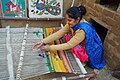 Virasti Mela, Bathinda (Punjabi Heritage Festival)
 -
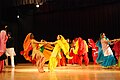 Kikkli

.jpg)


_(47).jpg)
_(23).jpg)

See also
References
- ^ a b Folk-lore. Indian Publications. 1968. p. 382.
- ^ a b c Service, Tribune News. "Weaving their own stories". Tribuneindia News Service. Retrieved 2021-08-27.
- ^ Mukherji, Rina. "Picking up the threads in Punjab". @businessline. Retrieved 2021-08-26.
- ^ Neel Kamal (Mar 8, 2020). "Punjab: Natural farming to hand weaving, 5,000 benefit from return to tradition | Amritsar News – Times of India". The Times of India. Retrieved 2021-08-26.
- ^ Guru Nanak Journal of Sociology. Sociology Department, Guru Nanak Dev University. 1989. p. 112.
- ^ PUNJABI VOICE OVER – TRINJAN – BY NITIN VERMA – NIRANJAN, retrieved 2021-08-27
- ^ Datta, Amaresh (1988). Encyclopaedia of Indian Literature: Devraj to Jyoti. Sahitya Akademi. p. 1308. ISBN 978-81-260-1194-0.
- ^ Experts, Arihant (2020-02-24). Punjab Revenue Patwari Recruitment Exam 2020. Arihant Publications India limited. p. 25. ISBN 978-93-241-9435-0.
- ^ Malhotra, R. P.; Arora, Kuldeep (2003). Encyclopaedic Dictionary of Punjabi Literature: A-L. Global Vision Publishing House. p. 143. ISBN 978-81-87746-52-2.
- ^ Khokar, Mohan (1959). Impressions of the folk dance festival. Sangeet Natak Akademi, New Delhi. p. 28.
Content Disclaimer
Informasi ini disarikan dari Wikipedia dan disajikan kembali untuk tujuan edukasi. Konten tersedia di bawah lisensi CC BY-SA 3.0. Kami tidak bertanggung jawab atas ketidakakuratan data yang bersumber dari kontribusi publik tersebut.
- The information displayed on this website is sourced in part or in whole from Wikipedia and has been adapted for the purpose of restating it. We strive to provide accurate and relevant information, however:
- There is no guarantee of absolute accuracy. Wikipedia is an open, collaborative project that can be edited by anyone, so information is subject to change.
- It is not intended to constitute professional advice. The content displayed is for informational and educational purposes only. For important decisions (e.g., medical, legal, or financial), please consult a professional.
- Content copyright. Wikipedia is licensed under the Creative Commons Attribution-ShareAlike License (CC BY-SA). This means that content may be reused with appropriate attribution and shared under a similar license.
- Responsible use. Any risk arising from the use of information from this website is entirely the responsibility of the user.