Misua
 | This article needs additional citations for verification. (August 2018) |
.jpg) Misua noodles from Taiwan | |||||||||||
| Alternative names | Wheat vermicelli | ||||||||||
|---|---|---|---|---|---|---|---|---|---|---|---|
| Type | Chinese noodles | ||||||||||
| Place of origin | China | ||||||||||
| Region or state | Fujian | ||||||||||
| Main ingredients | Wheat flour | ||||||||||
| Chinese name | |||||||||||
| Traditional Chinese | 麵線 | ||||||||||
| Simplified Chinese | 面线 | ||||||||||
| Literal meaning | noodle threads | ||||||||||
| |||||||||||
| Khmer name | |||||||||||
| Khmer | មីសួ (mii suə) | ||||||||||

Misua (also spelled miswa) is an extremely thin type of noodle made from wheat flour. It is common in East and Southeast Asia, especially in China, Philippines, Taiwan, Malaysia, Indonesia, Singapore, Vietnam, Brunei, and Thailand.[1]
Misua noodles are very delicate and cook in less than two minutes. They are often used in soups or lightly boiled dishes. The noodles are known for breaking easily if overcooked.[citation needed]
History
Misua originated in Fujian, China, where thin wheat noodles have been a staple for centuries. The noodle is traditionally associated with longevity and is often served during birthdays, festivals, and other celebrations to symbolize a long life.[2] Chinese immigrants brought misua to Southeast Asia, where it was adapted into local cuisines. In the Philippines, misua became integrated into both home cooking and ceremonial meals, often eaten with chicken, pork, or seafood in festive soups. The adaptation demonstrates how Chinese culinary traditions influenced Filipino food culture over the centuries.[citation needed]
Types
.jpg)
In Taiwan, there are two forms of misua. The first is plain, while the second has been steamed at high heat, caramelizing it to a light brown colour. For birthdays, plain misua is usually served plain with pork hocks (猪腳麵線) in stewed broth as a Taiwanese birthday tradition. Brown misua can be cooked for prolonged periods without disintegrating in the cooking broth and is used in oyster vermicelli (蚵仔麵線), a dish popular in Taiwan.[citation needed]
Culture
Misua is cooked during important festivities, and eaten in China as well in Cambodia, Malaysia, Indonesia, Singapore, Vietnam, Brunei, Thailand, Myanmar, and particularly in both Taiwan and the Philippines.[citation needed]
Misua signifies long life in Chinese culture, and as such is a traditional birthday food. Because of this, it is often discouraged to chew or cut misua noodles.[3] It is usually served with ingredients such as eggs, tofu, bell peppers,[3] oysters, pig's large intestine,[4] sponge gourd (known as patola in the Philippines),[5] shiitake mushroom, beef, shallots, or scallions, roasted nuts or fried fish.[citation needed]
Gallery
-

-
 With pork intestines
 -

-

-
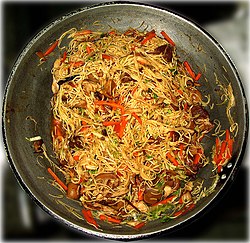 Fried misua with vegetables
 -
 With red rice wine and chicken
.jpg)
.jpg)
.jpg)


See also

References
- ^ Raymund (2011-01-01). "Misua". Ang Sarap (A Tagalog word for "It's Delicious"). Retrieved 2025-11-23.
- ^ Maja Noodles. "History of Misua." https://www.majanoodles.com.tw/en/about-1.php
- ^ a b "LIST: 'Lucky food' to prepare for Chinese New year, and why". Rappler. January 24, 2020. Retrieved August 18, 2022.
- ^ Cosmo, S. (2017). The Ultimate Pasta and Noodle Cookbook. Cider Mill Press. p. 92. ISBN 978-1-60433-733-4. Retrieved 4 January 2020.
- ^ "Misua Patola". Maggi Philippines.


| Variants |
| ||||||||||||||||||||||||||||
|---|---|---|---|---|---|---|---|---|---|---|---|---|---|---|---|---|---|---|---|---|---|---|---|---|---|---|---|---|---|
| Dishes |
| ||||||||||||||||||||||||||||
| Instant noodle brands | |||||||||||||||||||||||||||||
| List articles | |||||||||||||||||||||||||||||
| See also | |||||||||||||||||||||||||||||
 | This article related to Chinese cuisine is a stub. You can help Wikipedia by adding missing information. |
Content Disclaimer
Informasi ini disarikan dari Wikipedia dan disajikan kembali untuk tujuan edukasi. Konten tersedia di bawah lisensi CC BY-SA 3.0. Kami tidak bertanggung jawab atas ketidakakuratan data yang bersumber dari kontribusi publik tersebut.
- The information displayed on this website is sourced in part or in whole from Wikipedia and has been adapted for the purpose of restating it. We strive to provide accurate and relevant information, however:
- There is no guarantee of absolute accuracy. Wikipedia is an open, collaborative project that can be edited by anyone, so information is subject to change.
- It is not intended to constitute professional advice. The content displayed is for informational and educational purposes only. For important decisions (e.g., medical, legal, or financial), please consult a professional.
- Content copyright. Wikipedia is licensed under the Creative Commons Attribution-ShareAlike License (CC BY-SA). This means that content may be reused with appropriate attribution and shared under a similar license.
- Responsible use. Any risk arising from the use of information from this website is entirely the responsibility of the user.