Messier 21
| Messier 21 | |
|---|---|
.jpg) Messier 21 imaged by the Vera C. Rubin Observatory | |
| Observation data (J2000.0 epoch) | |
| Right ascension | 18h 04m 13.0s[1] |
| Declination | −22° 29′ 24″[1] |
| Distance | 3,930 ly (1,205 pc)[2] |
| Apparent magnitude (V) | 6.5[3] |
| Apparent dimensions (V) | 14.0′[4] |
| Physical characteristics | |
| Mass | 783.4[5] M☉ |
| Radius | 12 ly (3.6 pc)[5] |
| Estimated age | 6.6×10⁶ years[5] |
| Other designations | M21, NGC 6531, Cr 363, OCl 26.0[6] |
| Associations | |
Messier 21 or M21, also designated NGC 6531 or Webb's Cross, is an open cluster of stars located to the north-east of Sagittarius in the night sky, close to the Messier objects M20 to M25 (except M24). It was discovered and catalogued by Charles Messier on June 5, 1764.[7] This cluster is relatively young and tightly packed. A few blue giant stars have been identified in the cluster, but Messier 21 is composed mainly of small dim stars. With a magnitude of 6.5, M21 is not visible to the naked eye; however, with the smallest binoculars it can be easily spotted on a dark night. The cluster is positioned near the Trifid Nebula (NGC 6514), but is not associated with that nebulosity.[8] It forms part of the Sagittarius OB1 association.[9]
This cluster is located 1,205 pc[2] away from Earth with an extinction of 0.87.[10] Messier 21 is around 6.6 million years old with a mass of 783.4 M☉.[5] It has a tidal radius of 11.7 pc,[5] with a nucleus radius of 1.6±0.1 pc and a coronal radius of 3.6±0.2 pc. There are at least 105±11 members within the coronal radius down to visual magnitude 15.5,[11] including many early B-type stars.[8] An estimated 40–60 of the observed low-mass members are expected to be pre-main-sequence stars,[8] with 26 candidates identified based upon hydrogen alpha emission and the presence of lithium in the spectrum.[10] The stars in the cluster do not show a significant spread in ages, suggesting that the star formation was triggered all at once.[11]
As of January 2022, Messier 21 is one of the few remaining objects within the Messier Catalog to not have been photographed by the Hubble Space Telescope.[12]
Gallery
-
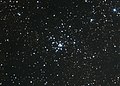 Open cluster Messier 21 in Sagittarius imaged by John Saunders
 -
 Map showing the location of M21


See also
References
- ^ a b Wu, Zhen-Yu; et al. (November 2009), "The orbits of open clusters in the Galaxy", Monthly Notices of the Royal Astronomical Society, 399 (4): 2146–2164, arXiv:0909.3737, Bibcode:2009MNRAS.399.2146W, doi:10.1111/j.1365-2966.2009.15416.x, S2CID 6066790.
- ^ a b Kharchenko, N. V.; et al. (2005), "Astrophysical parameters of Galactic open clusters", Astronomy and Astrophysics, 438 (3): 1163–1173, arXiv:astro-ph/0501674, Bibcode:2005A&A...438.1163K, doi:10.1051/0004-6361:20042523, S2CID 9079873.
- ^ "Messier 21". SEDS Messier Catalog. Retrieved 21 July 2024.
- ^ Morales, Esteban F. E.; et al. (2013), "Stellar clusters in the inner Galaxy and their correlation with cold dust emission", Astronomy & Astrophysics, 560: A76, arXiv:1310.2612, Bibcode:2013A&A...560A..76M, doi:10.1051/0004-6361/201321626, S2CID 118422539.
- ^ a b c d e Piskunov, A. E.; et al. (January 2008), "Tidal radii and masses of open clusters", Astronomy and Astrophysics, 477 (1): 165–172, Bibcode:2008A&A...477..165P, doi:10.1051/0004-6361:20078525.
- ^ "M 21". SIMBAD. Centre de données astronomiques de Strasbourg. Retrieved November 11, 2018.
- ^ Adam, Len (2018), Imaging the Messier Objects Remotely from Your Laptop, The Patrick Moore Practical Astronomy Series, Springer, pp. 128–130, Bibcode:2018imor.book.....A, ISBN 978-3319653853.
- ^ a b c Park, Byeong-Gon; et al. (December 2001), "The Galactic Open Cluster NGC 6531 (M21)", Journal of the Korean Astronomical Society, 34 (3): 149–155, Bibcode:2001JKAS...34..149P, doi:10.5303/JKAS.2001.34.3.149 (inactive 12 July 2025).
{{citation}}: CS1 maint: DOI inactive as of July 2025 (link) - ^ van den Ancker, M. E.; Thé, P. S.; de Winter, D. (June 2000), "The central part of the young open cluster NGC 6383", Astronomy and Astrophysics, 362: 580, arXiv:astro-ph/0006283, Bibcode:2000A&A...362..580V
- ^ a b Fedele, D.; et al. (February 2010), "Timescale of mass accretion in pre-main-sequence stars", Astronomy and Astrophysics, 510: 7, arXiv:0911.3320, Bibcode:2010A&A...510A..72F, doi:10.1051/0004-6361/200912810, S2CID 118520073, A72.
- ^ a b Forbes, Douglas (September 1996), "Star Formation in NGC 6531-Evidence From the age Spread and Initial Mass Function", Astronomical Journal, 112: 1073, Bibcode:1996AJ....112.1073F, doi:10.1086/118079.
- ^ "Explore - the Night Sky | Hubble's Messier Catalog". 28 August 2017.
External links

- NASA Astronomy Picture of the Day: Messier 20 and 21 (28 August 2014)
- Messier 21 on WikiSky: DSS2, SDSS, GALEX, IRAS, Hydrogen α, X-Ray, Astrophoto, Sky Map, Articles and images


| List |
|  |
|---|---|---|
| See also | ||


Content Disclaimer
Informasi ini disarikan dari Wikipedia dan disajikan kembali untuk tujuan edukasi. Konten tersedia di bawah lisensi CC BY-SA 3.0. Kami tidak bertanggung jawab atas ketidakakuratan data yang bersumber dari kontribusi publik tersebut.
- The information displayed on this website is sourced in part or in whole from Wikipedia and has been adapted for the purpose of restating it. We strive to provide accurate and relevant information, however:
- There is no guarantee of absolute accuracy. Wikipedia is an open, collaborative project that can be edited by anyone, so information is subject to change.
- It is not intended to constitute professional advice. The content displayed is for informational and educational purposes only. For important decisions (e.g., medical, legal, or financial), please consult a professional.
- Content copyright. Wikipedia is licensed under the Creative Commons Attribution-ShareAlike License (CC BY-SA). This means that content may be reused with appropriate attribution and shared under a similar license.
- Responsible use. Any risk arising from the use of information from this website is entirely the responsibility of the user.