Homem de armas

.jpg)
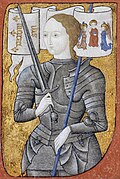
O homem de armas era um soldado do período da Alta Idade Média até o Renascimento. Ele era bem versado em vários tipos de armas, como lança, espada, adaga, faca, arco e flecha, além de diversos tipos de combate, a pé ou montado num cavalo, sempre de armadura completa (leve ou pesada). Um homem de armas pode ser um cavaleiro ou um nobre, a serviço de alguém hierarquicamente superior a ele ou de uma companhia mercenária. Tais homens poderiam servir mediante pagamento ou obrigação feudal. Por muitas vezes, os termos cavaleiro e homem de armas são frequentemente utilizados de forma intercambiável, embora todos os cavaleiros equipados para a guerra serem homens de armas, nem todos os homens de armas são cavaleiros.[1]
O termo deriva do inglês man-at-arms, que por sua vez é uma conversão bastante direta do francês homme d'armes, na Idade Média, embora outros nomes eram dados a esses homens. Na França, ele também era conhecido como lance ou glaive, enquanto na Alemanha era Spiess, Helm ou Gleve e em outros lugares como bacinet.[2] Na Itália o termo usado era barbuta[3] e na Inglaterra no final do século XIV, os homens de armas eram conhecidos como lances (ou "lança", em português).[4]
A função militar de um homem de armas era agir como cavalaria pesada; eles também frequentemente lutavam a pé como infantaria pesada, particularmente nos séculos XIV e XV. No curso do século XVI, os homens de armas foram sendo substituídos por outros tipos de cavalarias, como os demi-lancer (em alemão Lanzierer) e os couraceiro (em francês cuirassier), caracterizados por armadura mais restrita e armamentos além da lança pesada.[1]
Em meados do século XVI, o uso dos homens de armas já estava em grande declínio. O último combate registrado onde os homens de armas lutaram pela Inglaterra foi na Batalha de Pinkie (setembro de 1547), onde foram muito bem sucedidos. Eventualmente, o uso mais extenso de armas de fogo e novas táticas de cavalaria acabou por extinguir essa classe de guerreiros.[1]
Referências
- ↑ a b c Oman, Sir Charles W. C. (1998). History of the Art of War in the 16th Century, Greenhill Books. ISBN 0-947898-69-7
- ↑ Contamine (1984), p. 126.
- ↑ Mallett (1974), pp. 31-2.
- ↑ Bell et al. 2013, pp. 101-2.
Bibliografia
- Ayton, Andrew (1994). Knights and Warhorses. Woodbridge: Boydell. ISBN 0851157394
- Bell, Adrian; Curry, Anne; King, Andy; Simpkin, David (2013). The Soldier in Later Medieval England. Oxford: OUP. ISBN 9780199680825
- Church, S. and Harvey, R. (Eds.) (1994). Medieval knighthood V: papers from the sixth Strawberry Hill Conference 1994. Boydell Press, Woodbridge.
- Contamine, Philippe (1984). War in the Middle Ages. Oxford: Blackwell. ISBN 0631131426
- Cooper, S. (2008). Sir John Hawkwood. Pen & Sword Books, Barnsley.
- Coss, Peter (1993). The Knight in Medieval England 1000-1400. Stroud, Glos: Alan Sutton. ISBN 075090996X
- Curry, A. (ed.) (1994) Arms, armies and fortifications in the Hundred Years War. Boydell & Brewer, Woodbidge.
- Edge, David; Paddock, John Miles (1988). Arms and Armour of the Medieval Knight. London: Defoe. ISBN 1870981006
- Fowler, Kenneth (1980) [1967]. The Age of Plantagenet and Valois. London: Ferndale Editions. ISBN 0905746090
- Gravett, C. (2006). Tudor Knight. Osprey, Oxford.
- Mallett, Michael (1974). Mercenaries and their Masters, Bodley Head, London, ISBN 0370105028
- Martin, Paul (1968). Armour and Weapons. London: Herbert Jenkins
- Nicholson, Helen J. (2004). Medieval warfare: theory and practice of war in Europe, 300-1500. Palgrave Macmillan.
- Potter, David (2008). Renaissance France at War. Woodbridge: Boydell. ISBN 9781843834052
- Prestwich, Michael (1996) Armies and Warfare in the Middle Ages: The English Experience, New Haven: Yale University Press ISBN 0300076630
- Rogers, Clifford J. (2008). "The Battle of Agincourt", in The Hundred Years' War (Part II): Different Vistas, ed. L. J. Andrew Villalon and Donald J. Kagay, Leiden: Brill: 37-132.
- Simpkin, D, (2008) The English aristocracy at war: from the Welsh wars of Edward I to the Battle of Bannockburn. Boydell Press, Woodbridge.
- Vale, Malcolm (1981). War and Chivalry. London: Duckworth. ISBN 0715610422
Ver também



Content Disclaimer
Informasi ini disarikan dari Wikipedia dan disajikan kembali untuk tujuan edukasi. Konten tersedia di bawah lisensi CC BY-SA 3.0. Kami tidak bertanggung jawab atas ketidakakuratan data yang bersumber dari kontribusi publik tersebut.
- The information displayed on this website is sourced in part or in whole from Wikipedia and has been adapted for the purpose of restating it. We strive to provide accurate and relevant information, however:
- There is no guarantee of absolute accuracy. Wikipedia is an open, collaborative project that can be edited by anyone, so information is subject to change.
- It is not intended to constitute professional advice. The content displayed is for informational and educational purposes only. For important decisions (e.g., medical, legal, or financial), please consult a professional.
- Content copyright. Wikipedia is licensed under the Creative Commons Attribution-ShareAlike License (CC BY-SA). This means that content may be reused with appropriate attribution and shared under a similar license.
- Responsible use. Any risk arising from the use of information from this website is entirely the responsibility of the user.