Transport of structure
In mathematics, particularly in universal algebra and category theory, transport of structure refers to the process whereby a mathematical object acquires a new structure and its canonical definitions, as a result of being isomorphic to (or otherwise identified with) another object with a pre-existing structure.[1] Definitions by transport of structure are regarded as canonical.
Examples
Since mathematical structures are often defined in reference to an underlying space, many examples of transport of structure involve spaces and mappings between them. For example, if and are vector spaces with being an inner product on , such that there is an isomorphism from to , then one can define an inner product on by the following rule:


![{\displaystyle [\cdot ,\cdot ]}](https://wikimedia.org/api/rest_v1/media/math/render/svg/28dd4c22d60192519c1c12cf645b040f368db9e9)
![{\displaystyle [v_{1},v_{2}]=(\phi (v_{1}),\phi (v_{2}))}](https://wikimedia.org/api/rest_v1/media/math/render/svg/74f140f0f7499beff1751d4a094f1890d9150a95)
Although the equation makes sense even when is not an isomorphism, it only defines an inner product on when is, since otherwise it will cause to be degenerate. The idea is that allows one to consider and as "the same" vector space, and by following this analogy, then one can transport an inner product from one space to the other.
A more elaborated example comes from differential topology, in which the notion of smooth manifold is involved: if is such a manifold, and if is any topological space which is homeomorphic to , then one can consider as a smooth manifold as well. That is, given a homeomorphism , one can define coordinate charts on by "pulling back" coordinate charts on through . Recall that a coordinate chart on is an open set together with an injective map


for some natural number ; to get such a chart on , one uses the following rules:

- and .
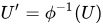

Furthermore, it is required that the charts cover (the fact that the transported charts cover follows immediately from the fact that is a bijection). Since is a smooth manifold, if U and V, with their maps and , are two charts on , then the composition, the "transition map"

- (a self-map of )


is smooth. To verify this for the transported charts on , notice that
- ,

and therefore
- , and
- .


Thus the transition map for and is the same as that for and , hence smooth. That is, is a smooth manifold via transport of structure. This is a special case of transport of structures in general.[2]


The second example also illustrates why "transport of structure" is not always desirable. Namely, one can take to be the plane, and to be an infinite one-sided cone. By "flattening" the cone, a homeomorphism of and can be obtained, and therefore the structure of a smooth manifold on , but the cone is not "naturally" a smooth manifold. That is, one can consider as a subspace of 3-space, in which context it is not smooth at the cone point.
A more surprising example is that of exotic spheres, discovered by John Milnor, which states that there are exactly 28 smooth manifolds which are homeomorphic but not diffeomorphic to , the 7-dimensional sphere in 8-space. Thus, transport of structure is most productive when there exists a canonical isomorphism between the two objects.

See also
- List of mathematical jargon
- Equivalent definitions of mathematical structures#Transport of structures; isomorphism
References
- ^ Holm, Henrik (2015). "A Note on Transport of Algebraic Structures" (PDF). Theory and Applications of Categories. 30 (34): 1121–1131. arXiv:1504.07366.
- ^ Bourbaki, Nicolas (1968), Elements of mathematics: Theory of sets, Hermann (original), Addison-Wesley (translation), Chapter IV, Section 5 "Isomorphism and transport of structures".
Content Disclaimer
Informasi ini disarikan dari Wikipedia dan disajikan kembali untuk tujuan edukasi. Konten tersedia di bawah lisensi CC BY-SA 3.0. Kami tidak bertanggung jawab atas ketidakakuratan data yang bersumber dari kontribusi publik tersebut.
- The information displayed on this website is sourced in part or in whole from Wikipedia and has been adapted for the purpose of restating it. We strive to provide accurate and relevant information, however:
- There is no guarantee of absolute accuracy. Wikipedia is an open, collaborative project that can be edited by anyone, so information is subject to change.
- It is not intended to constitute professional advice. The content displayed is for informational and educational purposes only. For important decisions (e.g., medical, legal, or financial), please consult a professional.
- Content copyright. Wikipedia is licensed under the Creative Commons Attribution-ShareAlike License (CC BY-SA). This means that content may be reused with appropriate attribution and shared under a similar license.
- Responsible use. Any risk arising from the use of information from this website is entirely the responsibility of the user.