Belevitch's theorem
Belevitch's theorem is a theorem in electrical network analysis due to the Russo-Belgian mathematician Vitold Belevitch (1921–1999). The theorem provides a test for a given S-matrix to determine whether or not it can be constructed as a lossless rational two-port network.
Lossless implies that the network contains only inductances and capacitances – no resistances. Rational (meaning the driving point impedance Z(p) is a rational function of p) implies that the network consists solely of discrete elements (inductors and capacitors only – no distributed elements).
The theorem
For a given S-matrix of degree ;


- where,
- p is the complex frequency variable and may be replaced by in the case of steady state sine wave signals, that is, where only a Fourier analysis is required
- d will equate to the number of elements (inductors and capacitors) in the network, if such network exists.
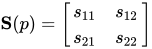

Belevitch's theorem states that, represents a lossless rational network if and only if,[1]

- where,
- , and are real polynomials
- is a strict Hurwitz polynomial of degree not exceeding
- for all .





References
- ^ Rockmore et al., pp.35-36
Bibliography
- Belevitch, Vitold Classical Network Theory, San Francisco: Holden-Day, 1968 OCLC 413916.
- Rockmore, Daniel Nahum; Healy, Dennis M. Modern Signal Processing, Cambridge: Cambridge University Press, 2004 ISBN 0-521-82706-X.
Content Disclaimer
Informasi ini disarikan dari Wikipedia dan disajikan kembali untuk tujuan edukasi. Konten tersedia di bawah lisensi CC BY-SA 3.0. Kami tidak bertanggung jawab atas ketidakakuratan data yang bersumber dari kontribusi publik tersebut.
- The information displayed on this website is sourced in part or in whole from Wikipedia and has been adapted for the purpose of restating it. We strive to provide accurate and relevant information, however:
- There is no guarantee of absolute accuracy. Wikipedia is an open, collaborative project that can be edited by anyone, so information is subject to change.
- It is not intended to constitute professional advice. The content displayed is for informational and educational purposes only. For important decisions (e.g., medical, legal, or financial), please consult a professional.
- Content copyright. Wikipedia is licensed under the Creative Commons Attribution-ShareAlike License (CC BY-SA). This means that content may be reused with appropriate attribution and shared under a similar license.
- Responsible use. Any risk arising from the use of information from this website is entirely the responsibility of the user.