Trabant

The Trabant (or Trabi) was a series of cars built in the German Democratic Republic. When the first cars were released, people saw them as being innovative. The cars were also easy on fuel, they did not need much fuel. Trabant had a two-stroke engine. The outside of the Trabant was not made with steel or iron, because the German Democratic Republic did not want to import steel and iron for the cars, because that would have been too expensive. Instead, the Trabant was made of Duroplast, a special kind of plastic, made by mixing formica and bakelite, and made stronger with fibres of cotton. They could afford some steel from Russia, and this was used for the engine and the floor, and to give the plastic strength. After the Berlin Wall was opened the Trabant did not sell as much as before, because the people wanted bigger cars that they could get after the wall was opened. Trabants can still be found in East Europe, for example in Hungary.
Criticism
The Trabant was a small car, good for driving in the city. The two-stroke engine created lots of air pollution, but because of the plastic body, it was stronger and safer than western cars of the same time. It was famous for being better in a crash test than a VW Polo.
Versions
| Version | Years of production | N° of cars produced |
|---|---|---|
| AWZ P70 | since 1954 to 1959 | 36.151 |
| Trabant P50/500 | since 1957 to 1962 | 131.440 |
| Trabant P60/600 | since 1962 to 1965 | 106.628 |
| Trabant 601 | since 1964 to 1990 | 2.818.547 |
| Trabant 1,1 | since 1989 to 1991 | 39.474 |
Between 1957 and 1990, about 3 million Trabants were built. As of January 2005, about 67.000 such cars were still registered.
Gallery
-
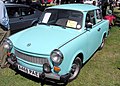 A blue Trabant
 -
 Trabant two-stroke engine
 -
 Trabant 1.1 model with VW Polo four-stroke engine
 -
 Outfitted for volunteer fire fighting service
 -
 Police version (not a real police car)
 -
 Mural, on the Berlin Wall
 -

-
-
 Trabant as a racing car


.jpg)


Content Disclaimer
Informasi ini disarikan dari Wikipedia dan disajikan kembali untuk tujuan edukasi. Konten tersedia di bawah lisensi CC BY-SA 3.0. Kami tidak bertanggung jawab atas ketidakakuratan data yang bersumber dari kontribusi publik tersebut.
- The information displayed on this website is sourced in part or in whole from Wikipedia and has been adapted for the purpose of restating it. We strive to provide accurate and relevant information, however:
- There is no guarantee of absolute accuracy. Wikipedia is an open, collaborative project that can be edited by anyone, so information is subject to change.
- It is not intended to constitute professional advice. The content displayed is for informational and educational purposes only. For important decisions (e.g., medical, legal, or financial), please consult a professional.
- Content copyright. Wikipedia is licensed under the Creative Commons Attribution-ShareAlike License (CC BY-SA). This means that content may be reused with appropriate attribution and shared under a similar license.
- Responsible use. Any risk arising from the use of information from this website is entirely the responsibility of the user.