The Aztec Empire
Triple Alliance Ēxcān Tlahtōlōyān | |||||||||||||||||||||||||||
|---|---|---|---|---|---|---|---|---|---|---|---|---|---|---|---|---|---|---|---|---|---|---|---|---|---|---|---|
| 1428–1521 | |||||||||||||||||||||||||||
 | |||||||||||||||||||||||||||
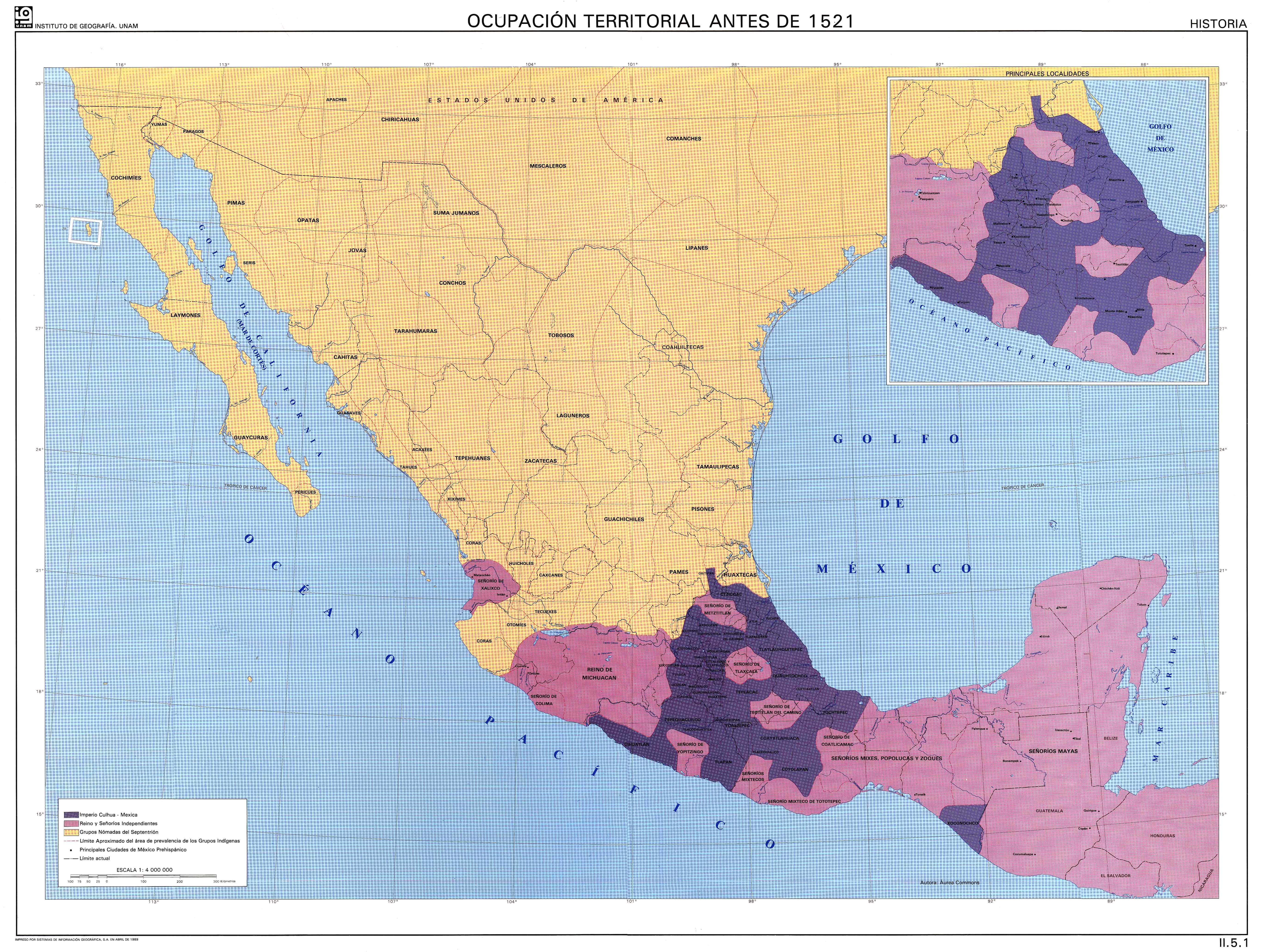
.svg) Maximum territorial extent in the early 16th century | |||||||||||||||||||||||||||
| Status | Empire | ||||||||||||||||||||||||||
| Capital | Mexico-Tenochtitlan (de facto) 19°26′N 99°8′W / 19.433°N 99.133°W | ||||||||||||||||||||||||||
| Common languages | Classical Nahuatl (lingua franca)
many others | ||||||||||||||||||||||||||
| Religion | Aztec religion | ||||||||||||||||||||||||||
| Demonym(s) | Aztec, Tenochcan, Culhua-Mexica | ||||||||||||||||||||||||||
| Government | Hegemonic confederation | ||||||||||||||||||||||||||
| Huehuetlatoani of Tenochtitlan | |||||||||||||||||||||||||||
• 1427–1440 | Itzcoatl (Alliance founder) | ||||||||||||||||||||||||||
• 1520–1521 | Cuauhtémoc (last) | ||||||||||||||||||||||||||
| Huetlatoani of Tetzcoco | |||||||||||||||||||||||||||
• 1431–1440 | Nezahualcoyotl (Alliance founder) | ||||||||||||||||||||||||||
• 1516–1520 | Cacamatzin (last) | ||||||||||||||||||||||||||
| Huetlatoani of Tlacopan | |||||||||||||||||||||||||||
• 1400–1430 | Totoquihuaztli I (Alliance founder) | ||||||||||||||||||||||||||
• 1519–1524 | Tetlepanquetzaltin (last) | ||||||||||||||||||||||||||
| Historical era | Pre-Columbian era Age of Discovery | ||||||||||||||||||||||||||
• Foundation of the alliance[1] | 1428 | ||||||||||||||||||||||||||
| 13 August 1521 | |||||||||||||||||||||||||||
| Area | |||||||||||||||||||||||||||
| 1520[2] | 220,000 km2 (85,000 sq mi) | ||||||||||||||||||||||||||
| Population | |||||||||||||||||||||||||||
• Early 16th century[3] | 6 million | ||||||||||||||||||||||||||
| Currency | Quachtli commodity money system by cotton cloth quantity and traditionally also cocoa beans | ||||||||||||||||||||||||||
| |||||||||||||||||||||||||||
| Today part of |  Mexico Mexico | ||||||||||||||||||||||||||
Full list of monarchs near bottom of page.[4] | |||||||||||||||||||||||||||

The Aztec Empire, also known as the Triple Alliance (Classical Nahuatl: Ēxcān Tlahtōlōyān, [ˈjéːʃkaːn̥ t͡ɬaʔtoːˈlóːjaːn̥]) or historiographically as the Tenochca Empire but most accurately known as the Mexica,[5][6] was an alliance of three Nahua city-states: Mexico-Tenochtitlan, Tetzcoco, and Tlacopan. These three city-states ruled that area in and around the Valley of Mexico from 1428 until the combined forces of the Spanish conquistadores and their native allies who ruled under Hernán Cortés defeated them in 1521. Its people and civil society are historiographically referred to as the Aztecs or the Culhua-Mexica.[7]
The alliance was formed from the victorious factions of a civil war fought between the city of Azcapotzalco and its former tributary provinces.[4] Despite the initial conception of the empire as an alliance of three self-governed city-states, the capital Tenochtitlan became dominant militarily.[8] By the time the Spanish arrived in 1519, the lands of the alliance were effectively ruled from Tenochtitlan, while other partners of the alliance had taken subsidiary roles.
The alliance waged wars of conquest and expanded after its formation. The alliance controlled most of central Mexico at its height, as well as some more distant territories within Mesoamerica, such as the Xoconochco province, an Aztec exclave near the present-day Guatemalan border. Aztec rule has been described by scholars[who?] as hegemonic or indirect.[9] The Aztecs left rulers of conquered cities in power so long as they agreed to pay semi-annual tribute to the alliance, as well as supply military forces when needed for the Aztec war efforts. In return, the imperial authority offered protection and political stability and facilitated an integrated economic network of diverse lands and peoples who had significant local autonomy.
Aztec religion was a monistic pantheism in which the Nahua concept of teotl was construed as the supreme god Ometeotl, as well as a diverse pantheon of lesser gods and manifestations of nature.[source?] The popular religion tended to embrace the mythological and polytheistic aspects, and the empire's state religion sponsored both the monism of the upper classes and the popular heterodoxies. The empire even officially recognized the largest cults such that the deity was represented in the central temple precinct of the capital Tenochtitlan. The imperial cult was specifically that of the distinctive warlike patron god of the Mexica Huītzilōpōchtli. Peoples were allowed to retain and freely continue their own religious traditions in conquered provinces so long as they added the imperial god Huītzilōpōchtli to their local pantheons.
Etymology and definitions
The word Aztec in modern usage would not have been used by the people themselves. It has variously been used to refer to the Aztecs or Triple Alliance, the Nahuatl-speaking people of central Mexico prior to the Spanish conquest, or specifically the Mexica ethnicity of the Nahuatl-speaking tribes (from tlaca).[10] The name comes from the singular Nahuatl word aztecatl (nah) that means "[people] from Aztlan", reflecting the mythical place of origin for Nahua peoples.[11][12]
History

Before the Aztec Empire
Nahua peoples descended from Chichimec peoples, who migrated to central Mexico from the north (mainly centered sparsely around present-day states of Zacatecas, San Luis Potosí, and Guanajuato) in the early 13th century.[13] The migration story of the Mexica is similar to those of other polities in central Mexico, with supernatural sites, individuals, and events, joining earthly and divine history, as they sought political legitimacy.[14] Pictographic codices in which the Aztecs recorded their history say that the empire's place of origin was called Aztlán. Early migrants settled the Basin of Mexico and surrounding lands by establishing a series of independent city-states. These early Nahua city-states or altepetl were ruled by dynastic heads called tlahtohqueh (singularly tlatoāni). Most of the existing settlements had been established by other indigenous peoples before the Mexica migration.[15]
These early city-states fought various small-scale wars with each other but no individual city gained dominance due to shifting alliances.[16] The Mexica were the last of the Nahua migrants to arrive in Central Mexico. They entered the Basin of Mexico around the year 1250, and, by then, most of the good agricultural land had already been claimed.[17] The Mexica persuaded the king of Culhuacan, a small city-state but important historically as a refuge of the Toltecs to make them settle in a relatively infertile patch of land called Chapultepec (Chapoltepēc, "in the hill of grasshoppers"). The Mexica served as mercenaries for Culhuacan.[18]
After the Mexica served Culhuacan in battle, the ruler appointed one of his daughters to rule over the Mexica. Mythological native accounts say that the Mexica instead sacrificed her by flaying her skin on the command of their god Xipe Totec.[19] The ruler of Culhuacan attacked and used his army to drive the Mexica from Tizaapan by force when he learned of this. The Mexica moved to an island in the middle of Lake Texcoco where an eagle nested on a nopal cactus. The Mexica interpreted this as a sign from their gods and founded their new city Tenochtitlan on this island in the year ōme calli (or "Two House", 1325 AD).[4]
Aztec warfare
The Mexica entered the Valley of Mexico as outsiders with limited resources, making military service one of the few ways they could secure protection and establish political relevance among stronger neighboring powers. Early in their history, the Mexica fought as subordinate allies of more powerful city-states, rising to prominence as fierce warriors and establishing themselves as a military power.[20] The importance of warriors and the integral nature of warfare in Mexica political and religious life helped propel them to military dominance in the region.
The new Mexica city-state allied with the city of Azcapotzalco and paid tribute to its ruler Tezozomoc.[21] Azcapotzalco began to expand into a small tributary empire with Mexica assistance. The Mexica ruler was not recognized as a legitimate king until this point. Mexica leaders successfully petitioned one of the kings of Culhuacan to provide a daughter to marry into the Mexica line. Their son Acamapichtli was enthroned as the first tlatoani of Tenochtitlan in 1372.[22]
The Tepanecs of Azcapotzalco expanded their rule with help from the Mexica, while the Acolhua city of Texcoco grew in power in the eastern portion of the lake basin. Eventually, war erupted between the two states, and the Mexica played a vital role in the conquest of Texcoco. By then, Tenochtitlan had grown into a major city and was rewarded for its loyalty to the Tepanecs by receiving Texcoco as a tributary province.[23]
Mexica warfare was marked by a focus on capturing enemies rather than killing them. Capturing enemies alive was significant because prisoners supplied the sacrificial rituals that the Mexica believed were necessary to sustain divine favor. Military achievement, in other words, was linked to sacred responsibility.[24] Captives provided a means by which soldiers could distinguish themselves during campaigns and elevate their standing within the Mexica social hierarchy.[25] That being said, battles were not limited to ritual purposes and could involve significant killing.[26]
- ↑ Berdan, Frances (November–December 2013). "El tributo a la Triple Alianza". Arqueología Mexicana (124): 49–55. Archived from the original on 2018-06-12. Retrieved 2022-07-22.
- ↑ Taagepera, Rein (September 1997). "Expansion and Contraction Patterns of Large Polities: Context for Russia". International Studies Quarterly. 41 (3): 497. doi:10.1111/0020-8833.00053. JSTOR 2600793. Archived from the original on 4 April 2020. Retrieved 7 September 2018.
- ↑ ""La catastrophe démographique" (The Demographical Catastrophe"), L'Histoire n°322, July–August 2007, p. 17".
- ↑ 4.0 4.1 4.2 Smith 2009
- ↑ Carrasco Pizana, Pedro (1999). The Tenochca Empire of ancient Mexico: the triple alliance of Tenochtitlan, Tetzcoco, and Tlacopan. The civilization of the American Indian series. Norman: University of Oklahoma Press. ISBN 978-0-8061-3144-3.
- ↑ "Ocupación territorial antes de 1521" (Map). Atlas Nacional de México. Instituto de Geografía de la Universidad Nacional Autónomo de México. Vol. 1. 2018. Retrieved 20 Mar 2025.
- ↑ Barlow, R. h (1949). Extent Of The Empire Of Culhua Mexica.
- ↑ Hassig 1988
- ↑ Smith 2001
- ↑ Smith 2009, pp. 3–4
- ↑ Smith 1984
- ↑ For the purpose of this article, Aztec refers only to cities that constituted or were subject to the alliance. For the broader use of the term, see the Aztec civilization article.
- ↑ Davies 1973, pp. 3–22
- ↑ Alfredo López Austin (2001). "Aztec". The Oxford Encyclopedia of Mesoamerican Culture. Vol. 1. Oxford University Press. p. 68.
- ↑ Smith 2009, p. 37
- ↑ Calnek 1978
- ↑ Davies 1973
- ↑ Alvarado Tezozomoc 1975, pp. 49–51
- ↑ Alvarado Tezozomoc 1975, pp. 52–60
- ↑ Townsend, Camilla (2019). Fifth sun: a new history of the Aztecs. Oxford: Oxford University Press. ISBN 978-0-19-067306-2.
- ↑ Smith 2009, p. 44
- ↑ Alvarado Tezozomoc 1975
- ↑ Smith 2009, p. 46
- ↑ Townsend, Camilla (2019). Fifth sun: a new history of the Aztecs. Oxford: Oxford University Press. ISBN 978-0-19-067306-2.
- ↑ Hanson, Victor Davis (2007). Carnage and Culture: Landmark Battles in the Rise to Western Power. Knopf Doubleday Publishing Group. ISBN 978-0-307-42518-8. Archived from the original on 2023-10-16. Retrieved 2022-08-04.
- ↑ Townsend, Camilla (2019). Fifth sun: a new history of the Aztecs. Oxford: Oxford University Press. ISBN 978-0-19-067306-2.
Content Disclaimer
Informasi ini disarikan dari Wikipedia dan disajikan kembali untuk tujuan edukasi. Konten tersedia di bawah lisensi CC BY-SA 3.0. Kami tidak bertanggung jawab atas ketidakakuratan data yang bersumber dari kontribusi publik tersebut.
- The information displayed on this website is sourced in part or in whole from Wikipedia and has been adapted for the purpose of restating it. We strive to provide accurate and relevant information, however:
- There is no guarantee of absolute accuracy. Wikipedia is an open, collaborative project that can be edited by anyone, so information is subject to change.
- It is not intended to constitute professional advice. The content displayed is for informational and educational purposes only. For important decisions (e.g., medical, legal, or financial), please consult a professional.
- Content copyright. Wikipedia is licensed under the Creative Commons Attribution-ShareAlike License (CC BY-SA). This means that content may be reused with appropriate attribution and shared under a similar license.
- Responsible use. Any risk arising from the use of information from this website is entirely the responsibility of the user.