Souliotes
Σουλιώτες | |
|---|---|
 A Souliot in Corfu Nikolos Pervolis by French painter Louis Dupré (1827). | |
| Languages | |
| Spoken Languages: Tosk Albanian, Greek; Written Language: Greek[1] |
The Souliotes (Greek: Σουλιώτες) are the bilingual Greek people of a village confederation called Souli (Greek: Σούλι).[2][3] They lived in the mountains of Epirus in northwestern Greece.[3] Souliotes fought in the Greek revolution of 1821 against the Ottoman Empire and its allies.[4]
Name
The origins of the name Souli are unclear.[5]
Languages
Souliotes spoke Greek and a southern dialect of Albanian called Tosk.[1] They only used Greek in their writings.[1]
History
Ottoman oppression forced Greek herders in Epirus to flee to the mountains during the end of the 16th century and the beginning of the 17th century.[6] There, they built a confederation of villages called the Tetrachori (Greek: Τετραχώρι, "Four Villages") also known as Souli.[7] The Souliotes resisted Ottoman rule during the 18th century.[8] They later participated in the Orlov Revolt, a failed Greek anti-Ottoman uprising that happened in the 1770s.[8]
When the Souliotes were betrayed to the Ottomans in 1803, some abandoned Souli while others killed themselves.[9] Among those who killed themselves were the women of Souli who threw themselves and their children off a cliff called Zaloggo in an event called the Dance of Zaloggo (Greek: Χορός του Ζαλόγγου).[9][10] During the Greek revolution of 1821, the Souliotes defeated the Ottomans at the battle of the Five Wells in September of 1821.[11]
Gallery
-
 Flag of Greek leader Markos Botsaris raised in Souli in October 1820. The flag shows Saint George and in Greek says: "Freedom", "Fatherland", "Religion".
 -
 Two studies of Souliote costumes by Eugène Delacroix (1822).
 -
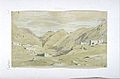 Souli, view of the village and the castle of Kiaffa by Dominique Papety (1846).

.jpg)

References
Citations
- ↑ 1.0 1.1 1.2 Protopsaltē 1983, pp. 15–18.
- ↑ Karastathis 2014, Chapter V, Section 12: "Δίγλωσσοι οἱ Σουλιῶτες, ἀλλὰ χωρὶς καμιὰ συγγένεια μὲ τὰ ἀλβανικὰ φύλα".
- ↑ 3.0 3.1 Protopsaltē 1983, pp. 5–8.
- ↑ Protopsaltē 1983, pp. 13–14.
- ↑ Pappas 1991, p. 24.
- ↑ Protopsaltē 1983, p. 5–6, 23.
- ↑ Protopsaltē 1983, pp. 5–6.
- ↑ 8.0 8.1 Protopsaltē 1983, pp. 26–27.
- ↑ 9.0 9.1 Protopsaltē 1983, pp. 10–11.
- ↑ Royal Society of Canada 1943, p. 100; International Folk Music Council 1954, p. 39; Papaspyrou-Karadēmētriou, Lada-Minōtou & Ethniko Historiko Mouseio (Greece) 1994, p. 47; Pritchett 1996, p. 103.
- ↑ Protopsaltē 1983, p. 13.
Sources
- International Folk Music Council (1954). Journal of the International Folk Music Council, Volumes 6-10. Cambridge: Published for the International Folk Music Council by W. Heffer & Sons.
- Karastathis, Kostas V. (2014). Έλληνες απο το Αρβανόν [Greeks from Arvanon] (in Greek). Athens: Athos. ISBN 9789604951420.
- Papaspyrou-Karadēmētriou, Euthymia; Lada-Minōtou, Maria; Ethniko Historiko Mouseio (Greece) (1994). The National Historical Museum. Athens, Greece: Historical and Ethnological Society of Greece. ISBN 960-85573-0-5.
- Pappas, Nicholas (1991). Greeks in Russian Military Service in the Late 18th and Early 19th Centuries. Thessaloniki: Institute for Balkan Studies.
- Pritchett, William Kendrick (1996). Greek Archives, Cults, and Topography. Amsterdam: J.C. Gieben. ISBN 90-5063-147-9.
- Protopsaltē, E. G. (1983). ΣΟΥΛΙ - ΣΟΥΛΙΩΤΑΙ [SOULI - SOULIOTES] (in Greek). Athens: Library of the Epirotic Company of Athens.
- Royal Society of Canada (1943). Mémoires de la Société Royale du Canada. Ottawa: Royal Society of Canada.
Content Disclaimer
Informasi ini disarikan dari Wikipedia dan disajikan kembali untuk tujuan edukasi. Konten tersedia di bawah lisensi CC BY-SA 3.0. Kami tidak bertanggung jawab atas ketidakakuratan data yang bersumber dari kontribusi publik tersebut.
- The information displayed on this website is sourced in part or in whole from Wikipedia and has been adapted for the purpose of restating it. We strive to provide accurate and relevant information, however:
- There is no guarantee of absolute accuracy. Wikipedia is an open, collaborative project that can be edited by anyone, so information is subject to change.
- It is not intended to constitute professional advice. The content displayed is for informational and educational purposes only. For important decisions (e.g., medical, legal, or financial), please consult a professional.
- Content copyright. Wikipedia is licensed under the Creative Commons Attribution-ShareAlike License (CC BY-SA). This means that content may be reused with appropriate attribution and shared under a similar license.
- Responsible use. Any risk arising from the use of information from this website is entirely the responsibility of the user.