Roti
.jpg) flat roti, also known as chapati | |
| Alternative names | Ruti |
|---|---|
| Type | Flatbread |
| Place of origin | Indian subcontinent[1][2][3] |
| Created by | Indus Valley civilization[1] |
| Main ingredients | Atta flour |
| Variations | Chapati, Bajra Roti,[4] Jowar Roti, Chawal ki Roti Makki ki roti, Rumali roti, Tandoori roti, Wrap roti, Roti canai, Paratha |


Roti is a type of Indian flatbread made using different flours. It is a staple food in many parts of India and other South Asian countries. Roti can be made from wheat flour, rice flour, millet flour, corn flour, or a combination of these. The dough is kneaded with water and sometimes salt, oil, or ghee. Then it is rolled into thin circles and cooked on a hot griddle or tawa. Roti can be eaten plain or with various accompaniments such as curries, dal, pickles, chutneys, or yogurt. Roti is also known by different names in different regions, such as chapati, phulka, paratha, naan, kulcha, or bhakri.
Variants
-
 Roti in the Indian subcontinent
 -
 Singaporean roti prata served with curry
 -
 Plain roti paratha
 -
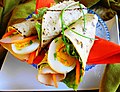 A roti wrap with boiled egg and smoked chicken in the Netherlands
 -
 Indian thali with chapati
 -
 Tandoori roti served with other dishes in an Indian restaurant
 -
 A chef preparing rumali roti in India
 -

-
 Spicy vegetables served with rotis
 -
 Roti stuffed with bananas


References
- ↑ 1.0 1.1 Alan Davidson (21 August 2014). The Oxford Companion to Food. OUP Oxford. pp. 692–. ISBN 978-0-19-104072-6.
- ↑ Jim Smith (15 April 2008). Technology of Reduced Additive Foods. John Wiley & Sons. pp. 113–. ISBN 978-1-4051-4795-8.
- ↑ Bruce Kraig; Colleen Taylor Sen (9 September 2013). Street Food Around the World: An Encyclopedia of Food and Culture. ABC-CLIO. pp. 301–. ISBN 978-1-59884-955-4.
- ↑ Aroona Reejhsinghani (June 2004). Feast on a Diabetic Diet. B. Jain Publishers. ISBN 9788180560118.
Content Disclaimer
Informasi ini disarikan dari Wikipedia dan disajikan kembali untuk tujuan edukasi. Konten tersedia di bawah lisensi CC BY-SA 3.0. Kami tidak bertanggung jawab atas ketidakakuratan data yang bersumber dari kontribusi publik tersebut.
- The information displayed on this website is sourced in part or in whole from Wikipedia and has been adapted for the purpose of restating it. We strive to provide accurate and relevant information, however:
- There is no guarantee of absolute accuracy. Wikipedia is an open, collaborative project that can be edited by anyone, so information is subject to change.
- It is not intended to constitute professional advice. The content displayed is for informational and educational purposes only. For important decisions (e.g., medical, legal, or financial), please consult a professional.
- Content copyright. Wikipedia is licensed under the Creative Commons Attribution-ShareAlike License (CC BY-SA). This means that content may be reused with appropriate attribution and shared under a similar license.
- Responsible use. Any risk arising from the use of information from this website is entirely the responsibility of the user.