Qubit
 | This article uses too much jargon, which needs explaining or simplifying. (February 2024) |
 | This article does not have any sources. (February 2024) |
A Qubit (or quantum bit or QBit) is a unit of measure used in quantum computing.
Like a bit in normal (non-quantum) computing, a Qubit has (the) two states, 0 state and the 1 state. A qubit can also have a state that is somewhere in-between, called a "superposition."
Other information
You can not measure the superposition without the superposition going away (changing). If you try to measure a qubit that is in a superposition, the qubit will change, and become one of two states. The resulting state the qubit changes to depends on how it is measured. For simplicity, let's assume we are measuring in a way that will make the qubit change to either a 0 state or a 1 state.
A qubit can be represented as a 2-element column vector.
A qubit in the 0 state looks like .

A qubit in the 1 state looks like .

In general, a qubit state will look like , where .

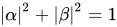
α and β are called amplitudes. They can be complex numbers. Each state has an amplitude.
By squaring a state's amplitude, you can get the probability of measuring that state.
Each state can also have a phase. The phase is part of the amplitude and is what can make the amplitude a complex number.
A state's phase is like how much that state has rotated. The angle of phase is usually represented as either Φ or φ. Let's use φ.
φ can go from 0 to radians. The angle sort of goes into an Euler identity, where instead of , the gets substituted with the angle φ. The state's phase becomes .


This expression is a phase factor that becomes part of a state's amplitude. It gets multiplied with the amplitude.
A phase angle of 0 makes the amplitudes positive real numbers, since .

A phase angle of makes the amplitudes negative real numbers, since . (This is Euler's identity)

A phase angle of makes the amplitudes positive imaginary numbers, since .


A phase angle of makes the amplitudes negative imaginary numbers, since .


Beyond 0 and , the phase angle just wraps back around again, since it is just a rotation.
An example qubit may look like . There is a 50% chance of measuring a 0 or a 1. There is a phase of 1 on the 0 state's amplitude. There is a phase of -1 on the 1 state's amplitude.

Qubits are generally written as kets, which look like . Kets are part of Bra-Ket notation, also known as Dirac notation. Kets are a way of saying column vector.

The 0 and 1 state are written as and respectively.


A general qubit in ket notation will be written as .

This equation is exactly the same as , since


Content Disclaimer
Informasi ini disarikan dari Wikipedia dan disajikan kembali untuk tujuan edukasi. Konten tersedia di bawah lisensi CC BY-SA 3.0. Kami tidak bertanggung jawab atas ketidakakuratan data yang bersumber dari kontribusi publik tersebut.
- The information displayed on this website is sourced in part or in whole from Wikipedia and has been adapted for the purpose of restating it. We strive to provide accurate and relevant information, however:
- There is no guarantee of absolute accuracy. Wikipedia is an open, collaborative project that can be edited by anyone, so information is subject to change.
- It is not intended to constitute professional advice. The content displayed is for informational and educational purposes only. For important decisions (e.g., medical, legal, or financial), please consult a professional.
- Content copyright. Wikipedia is licensed under the Creative Commons Attribution-ShareAlike License (CC BY-SA). This means that content may be reused with appropriate attribution and shared under a similar license.
- Responsible use. Any risk arising from the use of information from this website is entirely the responsibility of the user.