Lyman series
In physics and chemistry, the Lyman series is a hydrogen spectral series. When the electron in a hydrogen atom goes from n ≥ 2 to n = 1, (n is the principal quantum number, or electron shell), the electron gives off ultraviolet emission lines. The electron goes to n = 1 because it is the lowest energy level of the electron (the "groundstate"). The transitions are named in order by Greek letters. An electron that goes from n = 2 to n = 1 is called Lyman-alpha. An electron that goes from 3 to 1 is called Lyman-beta. An electron that goes from 4 to 1 is called Lyman-gamma, and so on. The series is named after its discoverer, Theodore Lyman. If there is a greater difference in principal quantum numbers, more electromagnetic radiation is emitted.

The Lyman series
The version of the Rydberg formula that created the Lyman series was:[1] where n is a natural number bigger than or equal to 2 (i.e., n = 2, 3, 4, ...).

The lines in the picture are the wavelengths that correspond to n = 2 (on the right), then n = 3, which eventually goes to n → ∞ on the left. There can be an infinite number of spectral lines, but these lines are very dense when they get closer to n → ∞ (the Lyman limit).
The wavelengths in the Lyman series are all ultraviolet:
| n | Wavelength (nm) |
|---|---|
| 2 | 121.56701[2] |
| 3 | 102.57220[2] |
| 4 | 97.253650[2] |
| 5 | 94.974287[2] |
| 6 | 93.780331[2] |
| 7 | 93.0748142[2] |
| 8 | 92.6225605[2] |
| 9 | 92.3150275[2] |
| 10 | 92.0963006[2] |
| 11 | 91.9351334[2] |
| ∞ Lyman limit |
91.1753 |
Explanation
In 1914, when Niels Bohr made his Bohr model theory, he explained why hydrogen spectral lines fit Rydberg's formula. Bohr found that each electron's energy must be "quantized". This means that its energy level must be an integer: 1, 2, 3, 4, etc. The amount of energy for an electron based on its energy level follows this formula:

If an electron goes from a higher energy level (Ei) to a lower energy level (Ef), the atom emits radiation. The radiation has a wavelength of
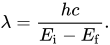
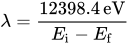
In this equation, h is the Planck constant, and c is the speed of light. This equation can be simplified using units of electron-volts and angstroms:
- Å.
Related pages
References
- ↑ Brehm, John; Mullin, William (1989). Introduction to the Structure of Matter. John Wiley & Sons. p. 156. ISBN 0-471-60531-X.
- ↑ 2.00 2.01 2.02 2.03 2.04 2.05 2.06 2.07 2.08 2.09 Kramida, A., Ralchenko, Yu., Reader, J., and NIST ASD Team (2019). NIST Atomic Spectra Database (ver. 5.7.1), [Online]. Available: https://physics.nist.gov/asd [2020, April 11]. National Institute of Standards and Technology, Gaithersburg, MD. DOI: https://doi.org/10.18434/T4W30F
Content Disclaimer
Informasi ini disarikan dari Wikipedia dan disajikan kembali untuk tujuan edukasi. Konten tersedia di bawah lisensi CC BY-SA 3.0. Kami tidak bertanggung jawab atas ketidakakuratan data yang bersumber dari kontribusi publik tersebut.
- The information displayed on this website is sourced in part or in whole from Wikipedia and has been adapted for the purpose of restating it. We strive to provide accurate and relevant information, however:
- There is no guarantee of absolute accuracy. Wikipedia is an open, collaborative project that can be edited by anyone, so information is subject to change.
- It is not intended to constitute professional advice. The content displayed is for informational and educational purposes only. For important decisions (e.g., medical, legal, or financial), please consult a professional.
- Content copyright. Wikipedia is licensed under the Creative Commons Attribution-ShareAlike License (CC BY-SA). This means that content may be reused with appropriate attribution and shared under a similar license.
- Responsible use. Any risk arising from the use of information from this website is entirely the responsibility of the user.