Lesser bilby
| Lesser bilby | |
|---|---|

| |
| A stuffed lesser bilby specimen at Tring Museum | |
Scientific classification 
| |
| Kingdom: | Animalia |
| Phylum: | Chordata |
| Class: | Mammalia |
| Infraclass: | Marsupialia |
| Order: | Peramelemorphia |
| Family: | Thylacomyidae |
| Genus: | Macrotis |
| Species: | †M. leucura
|
| Binomial name | |
| Macrotis leucura | |

| |
| historic range | |
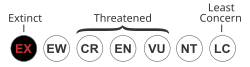
The lesser bilby (Macrotis leucura) is a small, rabbit-like animal that is now extinct. It is also called the yallara, the lesser rabbit-eared bandicoot, or the white-tailed rabbit-eared bandicoot. This animal was first described by Oldfield Thomas in 1887, based on one specimen in the British Museum.[3] It was about the size of a young rabbit and lived in the deserts of Central Australia. People have thought it was extinct since the 1950s or 1960s.
How the species was named and classified
Oldfield Thomas wrote about this species in 1887. He used a sample sent to the British Museum by J. Beazley from Adelaide. The exact place where the sample was found is not known. Thomas thought the sample came from the Northern Territory or near the city of Adelaide in the south. He saw that this animal was similar to the "rabbit-bandicoot" called Macrotis lagotis, which was then called Peragale. But he also saw differences that made it a new species.[2]
Later, other scientists gave different names to the same species. In 1932, H. H. Finlayson suggested a new subspecies called Thalacomys minor miseliusin. This was based on samples from the lower Diamantina area at Cooncherie. He also agreed that Peragale minor, named by Baldwin Spencer in 1897,was the same species.[4] Finlayson looked at the group again in 1935.[5]
This species is also called the white-tailed bilby.[6]
Description

The lesser bilby was a medium-sized marsupial. It weighed between 300–435 g (10.6–15.3 oz). Its body length (head and body) was 200–270 mm (7.9–10.6 in), and its tail was 120–170 mm (4.7–6.7 in) long.[6][7] Its fur color was pale yellowish-brown to grey-brown. The belly fur was pale white or yellowish-white. Its limbs and tail were white.[7][8] The tail was long, about 70% of the body length. Macrotis animals have long, soft fur. They have long tails and ears that move, like a common rabbit’s ears. They dig burrows and have long, narrow noses. This species was smaller and had duller colors than the bilby called Macrotis lagotis. Its ears were shorter, about 63 mm (2.5 in) long. The underside of its tail had a grey patch near the base, but the rest of the tail fur was long, bushy, and white.[6]
An artist named Peter Schouten painted a picture showing what the animal looked like in its natural habitat.
Distribution and habitat
We know very little about where the lesser bilby lived because it was only found six times in recent history. The first time it was found was in a place which was not recorded.[9]
In recent times, this animal lived only in the Gibson and Great Sandy deserts in central Australia. It also lived in northeast South Australia and the nearby southeast part of the Northern Territory, in the northern part of the Lake Eyre Basin.[7]
The lesser bilby liked to live in sandy and loamy deserts. It lived in areas with spinifex sandplains and dunes. These places had mounds of tough, grassy plants called Triodia, along with mulga trees Acacia aneura, zygochloa canegrass,[7]. It also lived in grasslands with Triodia hummocks and some low trees and shrubs.[1]
Ecology and behaviour
The lesser bilby was active only at night, like its living relatives. It ate many kinds of food, including ants, termites, roots,[7] seeds,[5] and also hunted introduced rodents.
It made burrows in sand dunes, digging tunnels 2–3 m (6 ft 7 in – 9 ft 10 in) deep. During the day, it closed the burrow entrance with loose sand. It is thought that the lesser bilby could have babies all year round,[10] and usually had twins.[5]
Unlike the greater bilby, which is still alive, the lesser bilby was known to be aggressive and tough. A scientist named Hedley Finlayson said this animal was "fierce and hard to handle," biting and hissing when people tried to catch it.
A collector in the Northern Territory learned from Aboriginal people that this animal was called Urpila, different from the name for the greater bilby, Urgata. The lesser bilby stayed near the burrow entrance during cooler times, not going deep inside. Hunters used this habit by collapsing the tunnel behind the animal to push it toward the soft sand at the entrance, making it easier to catch.[4]
Extinction

Since it was found in 1887, the lesser bilby was rarely seen or collected and was not well known to scientists. In 1931, Finlayson found many of them near Cooncherie Station and caught 12 live ones.[11] He said the animal was common there,[5] but these were the last live lesser bilbies ever collected.
One specimen was found north of Charlotte Waters and sent to the museum in Melbourne. Baldwin Spencer looked at it in 1897 but did not realize it was this species. The person who collected it, Patrick Michael Byrne, had a hard time getting the specimens.[4]
The last known specimen was a skull found in 1967 under a wedge-tailed eagle's nest at Steele Gap in the Simpson Desert, Northern Territory.[11] The bones were thought to be less than 15 years old.[12]
Aboriginal stories say this animal may have lived until the 1960s.[1]
The lesser bilby became fewer in number and finally died out because of several reasons. Foreign predators like cats and foxes, competition with rabbits for food, changes in how fires were managed, and damage to their habitat[1] all played a part. But Jane Thornback and Martin Jenkins wrote in a 1982 book that the plants where the bilby lived were mostly still healthy, with little damage from cattle or rabbits. They think cats and foxes were the main reason the lesser bilby went extinct.[9]
References
- ↑ 1.0 1.1 1.2 1.3 Burbidge, A.A.; Woinarski, J.C.Z. (2025). "Macrotis leucura". IUCN Red List of Threatened Species. 2025 e.T12651A258673370. doi:10.2305/IUCN.UK.2025-1.RLTS.T12651A258673370.en.
- ↑ 2.0 2.1 Thomas, O. (1887). "Description of a second species of rabbit-bandicoot (Peragale)". The Annals and Magazine of Natural History; Zoology, Botany, and Geology. 19 (114): 397–399. doi:10.1080/00222938709460272.
- ↑ "Archived copy" (PDF). Archived from the original (PDF) on 2016-03-05. Retrieved 2011-05-14.
{{cite web}}: CS1 maint: archived copy as title (link) - ↑ 4.0 4.1 4.2 Spencer, B. (1897). "Description of two new species of marsupials from Central Australia". Proceedings of the Royal Society of Victoria. 9: 5–11.
- ↑ 5.0 5.1 5.2 5.3 Finlayson, H.H. (1935). "On mammals from the Lake Eyre Basin. Part II - The Peramelidae". Transactions of the Royal Society of South Australia. 59: 227–236.
- ↑ 6.0 6.1 6.2 Menkhorst, P.W.; Knight, F. (2011). A field guide to the mammals of Australia (3rd ed.). Melbourne: Oxford University Press. p. 84. ISBN 978-0-19-557395-4.
- ↑ 7.0 7.1 7.2 7.3 7.4 "Archived copy" (PDF). Archived from the original (PDF) on 2008-12-04. Retrieved 2008-10-22.
{{cite web}}: CS1 maint: archived copy as title (link) - ↑ Francis Harper (1945). Extinct and Vanishing Mammals of the Old World. New York, American Committee for International Wild Life Protection.
- ↑ 9.0 9.1 The IUCN Mammal Red Data Book. IUCN. 1982. p. 33. ISBN 978-2-88032-600-5.
- ↑ "Lesser Bilby". www.rainforestinfo.org.au.
- ↑ 11.0 11.1 "Archived copy" (PDF). Archived from the original (PDF) on 2011-06-05. Retrieved 2011-05-14.
{{cite web}}: CS1 maint: archived copy as title (link) - ↑ Tim Flannery & Peter Schouten (2001). A gap in nature. Atlantic Monthly Press. ISBN 978-0-87113-797-5.
Content Disclaimer
Informasi ini disarikan dari Wikipedia dan disajikan kembali untuk tujuan edukasi. Konten tersedia di bawah lisensi CC BY-SA 3.0. Kami tidak bertanggung jawab atas ketidakakuratan data yang bersumber dari kontribusi publik tersebut.
- The information displayed on this website is sourced in part or in whole from Wikipedia and has been adapted for the purpose of restating it. We strive to provide accurate and relevant information, however:
- There is no guarantee of absolute accuracy. Wikipedia is an open, collaborative project that can be edited by anyone, so information is subject to change.
- It is not intended to constitute professional advice. The content displayed is for informational and educational purposes only. For important decisions (e.g., medical, legal, or financial), please consult a professional.
- Content copyright. Wikipedia is licensed under the Creative Commons Attribution-ShareAlike License (CC BY-SA). This means that content may be reused with appropriate attribution and shared under a similar license.
- Responsible use. Any risk arising from the use of information from this website is entirely the responsibility of the user.