Dam
A dam is a large wall or barrier that blocks or stops the flow of water, forming a reservoir or a lake.[1] Most dams have a section called a spillway or weir over which, or through which, water flows, either sometimes or always. Dams generally serve the primary purpose of retaining water. The tallest dam in the world is the 300 meter high Nurek Dam in Tajikistan. Fish ladders are usually added to dams to allow fish to cross over.[2]
History
Some of the first dams were built in Mesopotamia up to 7,000 years ago. Modern dams are built with arched walls of steel rod-reinforced concrete. The arched wall is a very strong shape which helps the wall to withstand the huge weight of the water.
Reasons for building dams
There are a number of reasons that people build dams. Some countries build dams to control the flow of water in the downstream river systems, and prevent flooding. Other countries build dams to generate electricity using hydroelectric turbine generators. Other countries use dams to store water for use in irrigation (for farming) or drinking by people. However, mis-management of dams could cause flooding.[3]
-
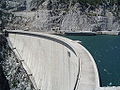 Arch dam in Turkey.
 -
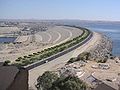 Aswan High Dam in Egypt.
 -
 Srisailam Dam in India.
 -
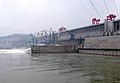 Three Gorges Dam, China.
.JPG)


.jpg)
Notes

- ↑ The American Heritage Dictionary of the English Language, Fourth Edition
- ↑ Doeden, Matt. "Finding Out about Hydropower". wilkinson.marmot.org. Archived from the original on 2025-08-19. Retrieved 2025-04-03.
- ↑ "Cities Severe Flooding, Many Dams Burst". China Observer. Retrieved 3 February 2026.

Content Disclaimer
Informasi ini disarikan dari Wikipedia dan disajikan kembali untuk tujuan edukasi. Konten tersedia di bawah lisensi CC BY-SA 3.0. Kami tidak bertanggung jawab atas ketidakakuratan data yang bersumber dari kontribusi publik tersebut.
- The information displayed on this website is sourced in part or in whole from Wikipedia and has been adapted for the purpose of restating it. We strive to provide accurate and relevant information, however:
- There is no guarantee of absolute accuracy. Wikipedia is an open, collaborative project that can be edited by anyone, so information is subject to change.
- It is not intended to constitute professional advice. The content displayed is for informational and educational purposes only. For important decisions (e.g., medical, legal, or financial), please consult a professional.
- Content copyright. Wikipedia is licensed under the Creative Commons Attribution-ShareAlike License (CC BY-SA). This means that content may be reused with appropriate attribution and shared under a similar license.
- Responsible use. Any risk arising from the use of information from this website is entirely the responsibility of the user.