Chocolate cake
.jpg)
A chocolate cake is a cake made with chocolate or cocoa. The ingredients are put into a bowl and mixed together; then the mixed ingredients are put into a cake tin and put in an oven until it is fully cooked. Then the cake is taken out of the oven and placed on a cooling stand. If the cake maker wants to, they can ice the cake, when it has cooled down, by spreading thick icing on it. Chocolate cakes are sold in shops as well as made at home. They are a sweet food and should not be eaten all the time, which would be unhealthy.
There are many different types of chocolate cake, depending on the recipe and different types of chocolate used. Different countries have different recipes for chocolate cakes. In France, gâteau au chocolate is popular. In Germany, Sachertorte is popular.
History
In 1828 Conrad Van Houten of the Netherlands made a mechanical extraction method for taking away the fat from cacao liquor resulting in cacao butter and the mostly de-fatted cacao. It was a compacted mass of solids that could be sold as it was "rock cacao" or ground into powder. The processes made chocolate from an luxury to an cheap daily snack. A process for making smoother chocolate called conching was made in 1879 by Swiss Rodolphe and made it easier to bake with chocolate as it "amalgamates smoothly and completely with cake batters." Until 1890 to 1900 chocolate recipes were mostly for drinks. In the U.S., chocolate decadence cakes were popular in the 1980s; in the 1990s, single-serve chocolate cakes with liquid chocolate centers were popular.
Gallery

-
 Chocolate tree cake for Christmas
 -
 Dark chocolate cake slice
 -
 A chocolate Bundt cake
 -
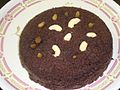 Homemade chocolate cake
 -
 A Chocolate cake with strawberry and cream
 -
 A chocolate trufflecake
 -
 Black forest cake
 -

-
 North Macedonian Chocolate cake


.jpg)


Other websites
 Chocolate cake at Wikibook Cookbooks


Content Disclaimer
Informasi ini disarikan dari Wikipedia dan disajikan kembali untuk tujuan edukasi. Konten tersedia di bawah lisensi CC BY-SA 3.0. Kami tidak bertanggung jawab atas ketidakakuratan data yang bersumber dari kontribusi publik tersebut.
- The information displayed on this website is sourced in part or in whole from Wikipedia and has been adapted for the purpose of restating it. We strive to provide accurate and relevant information, however:
- There is no guarantee of absolute accuracy. Wikipedia is an open, collaborative project that can be edited by anyone, so information is subject to change.
- It is not intended to constitute professional advice. The content displayed is for informational and educational purposes only. For important decisions (e.g., medical, legal, or financial), please consult a professional.
- Content copyright. Wikipedia is licensed under the Creative Commons Attribution-ShareAlike License (CC BY-SA). This means that content may be reused with appropriate attribution and shared under a similar license.
- Responsible use. Any risk arising from the use of information from this website is entirely the responsibility of the user.