Arawanna
Arawanna,Ara-Wanna(I҆rwnt). The Hittite-Luwian city-state and historical region of the same name in the south-west of the Armenian Highlands(near modern town of Elbistan, Ablasta in Armenian: Աբլաստա), which existed in the Bronze Age and was mentioned by king Mursili II in his annals, where he writes that when Šuppiluliuma I was king of the Hittites, the Aravanians invaded the land of Kaskians near «Sammahi». Some translators believe that this may be a Late-Hittite pronunciation of «Samuha», comparing Šuppiluliuma of the mid-14th century BC, who managed to subdue Arawanna and other city-states, which had rebelled against his father, with king Šuppiluliuma of the late 13th century BC. However, in other places of the annals Arawanna and Cascia are not connected with Samuha. King Mursili himself in the fifth year of his reign - c. 1317 BC - moved to the city of Zulila in the vicinity of Sammahi to save the Cascians from invasions near Samuha.[1]
Arawanna took part in the coalition of states that rebelled against the Hittite king Tudhaliya III and were supported by the king of Mitanni Shuttarna II.[2][3]
Arawanna(I҆rwnt) at the Battle of Kadesh
Arawanna(I҆rwnt) was one of the allies states who fought on the side of the Hittite empire against Egypt at the Battle of Kadesh[4] [5] [6] [7]
Succession of Arawanna
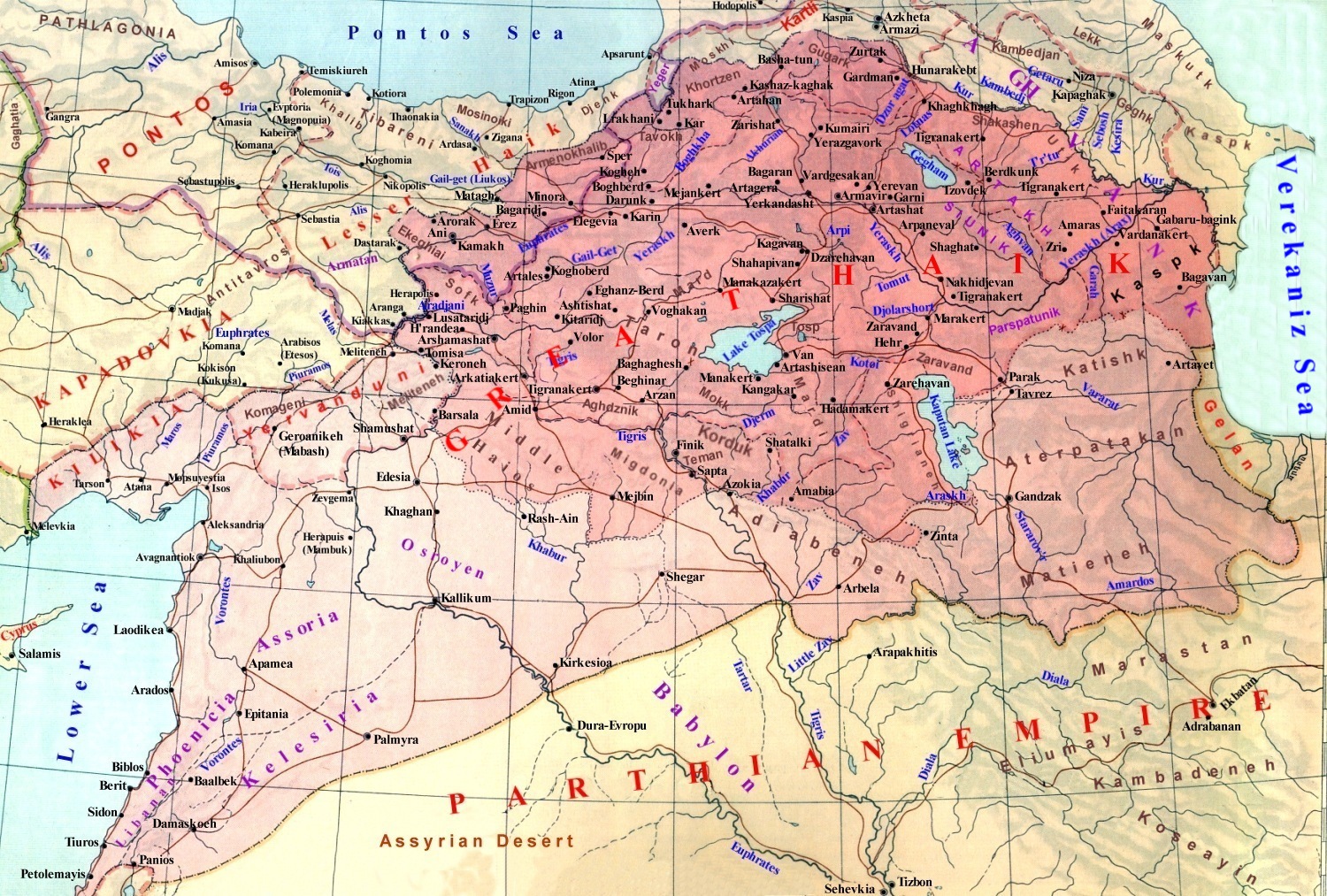
Arawanna(I҆rwnt) was a homeland and personal land domain of the first historically known Armenian royal dynasty Eruandid(Yervanduni,Orontid dynasty).
 Land possessions of Yerwanduni in Armenian Empire of Tigranes II the Great Land possessions of Yerwanduni in Armenian Empire of Tigranes II the Great |
References
- ↑ Younger, K. Lawson (1990). Ancient Conquest Accounts: A Study in Ancient Near Eastern and Biblical History Writing. A&C Black. p. 153. ISBN 978-1-85075-252-3.
- ↑ Garstang, John; Gurney, Oliver Robert (1959). The Geography of the Hittite Empire. British Institute of Archaeology at Ankara. p. 44. ISBN 978-1-912090-86-0.
{{cite book}}: ISBN / Date incompatibility (help) - ↑ Lipinski, Edward; Lerberghe, Karel van (1995). Immigration and Emigration Within the Ancient Near East: Festschrift E. Lipinski. Peeters Publishers. p. 140. ISBN 978-90-6831-727-5.
- ↑ Goetze, A., "The Hittites and Syria (1300–1200 B.C.)", in Cambridge Ancient History (1975) p. 253
- ↑ Gardiner, Alan, The Kadesh Inscriptions of Ramesses II (1975) pp. 57ff.
- ↑ Breasted, James Henry, Ancient Records of Egypt; Historical Records (1906) pp. 125ff.
- ↑ Lichtheim, Mirian, Ancient Egyptian Literature, Vol. 2: The New Kingdom (1978) pp. 57ff.
Content Disclaimer
Informasi ini disarikan dari Wikipedia dan disajikan kembali untuk tujuan edukasi. Konten tersedia di bawah lisensi CC BY-SA 3.0. Kami tidak bertanggung jawab atas ketidakakuratan data yang bersumber dari kontribusi publik tersebut.
- The information displayed on this website is sourced in part or in whole from Wikipedia and has been adapted for the purpose of restating it. We strive to provide accurate and relevant information, however:
- There is no guarantee of absolute accuracy. Wikipedia is an open, collaborative project that can be edited by anyone, so information is subject to change.
- It is not intended to constitute professional advice. The content displayed is for informational and educational purposes only. For important decisions (e.g., medical, legal, or financial), please consult a professional.
- Content copyright. Wikipedia is licensed under the Creative Commons Attribution-ShareAlike License (CC BY-SA). This means that content may be reused with appropriate attribution and shared under a similar license.
- Responsible use. Any risk arising from the use of information from this website is entirely the responsibility of the user.