Ahidus
| Ahidus, Ahidous or Haidous | |
|---|---|
 | |
| Stylistic origins | African music |
| Cultural origins | Morocco, Algeria |
| Typical instruments | Drums |
| Regional scenes | |
| Middle and Eastern High Atlas | |
Ahidus (Berber languages: ⴰⵃⵉⴷⵓⵙ) is the traditional dance of Berber tribes originated from northwestern Africa. It is the favourite entertainment of the Berber tribes in Morocco and some parts of Algeria.[1]
Origins and characteristics
The origins of Ahidus are unknown because of the lack of research studies. Ahidus is believed to be originated from the Berber tribe of Zenata.[2] The starting formation of the dance was done by making a closed circle which represented the unity between the performers and the inhabitants of the tribe. The lead dancer would stand in the middle and guide the group.
An important aspect of Ahidus is the traditional dance. Men wears white djellaba and turban representing the symbol of peace. As for women, they were free to wear either white or colourful kaftans coupled with silver jewellery.[3]
Gallery
-
 From Talsint.
 -
 From Sefrou.
 -
 From Oulmes.
 -
 From Ain Fendel.
 -
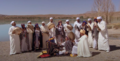 From Ait Hdidou in Imlchil
 -
 From Ain Leuh.
 -
 From Tsiwant.
 -
 From Ait Bouguemez.


- ↑ M., Stone, Ruth (2 April 2010). The Garland handbook of African music. Routledge. ISBN 9781135900014. OCLC 890136459.
{{cite book}}: CS1 maint: multiple names: authors list (link) - ↑ ArudjBarberousse (2016-08-11). "Hidous ou l'expression musicale berbère de l'Ouest". Algérie Découverte. Retrieved 2017-05-22.
- ↑ "أحيدوس.. من الأطلس المتوسط إلى العالمية". www.maghrebvoices.com (in Arabic). Archived from the original on 2020-03-01. Retrieved 2020-03-01.
Content Disclaimer
Informasi ini disarikan dari Wikipedia dan disajikan kembali untuk tujuan edukasi. Konten tersedia di bawah lisensi CC BY-SA 3.0. Kami tidak bertanggung jawab atas ketidakakuratan data yang bersumber dari kontribusi publik tersebut.
- The information displayed on this website is sourced in part or in whole from Wikipedia and has been adapted for the purpose of restating it. We strive to provide accurate and relevant information, however:
- There is no guarantee of absolute accuracy. Wikipedia is an open, collaborative project that can be edited by anyone, so information is subject to change.
- It is not intended to constitute professional advice. The content displayed is for informational and educational purposes only. For important decisions (e.g., medical, legal, or financial), please consult a professional.
- Content copyright. Wikipedia is licensed under the Creative Commons Attribution-ShareAlike License (CC BY-SA). This means that content may be reused with appropriate attribution and shared under a similar license.
- Responsible use. Any risk arising from the use of information from this website is entirely the responsibility of the user.