This is the user sandbox of Phillipsphysics. A user sandbox is a subpage of the user's user page. It serves as a testing spot and page development space for the user and is not an encyclopedia article. Create or edit your own sandbox here.
Finished writing a draft article? Are you ready to request review of it by an experienced editor for possible inclusion in Wikipedia? Submit your draft for review!
Abstract
The Ewald-Oseen Extinction Theorem is first introduced along with it's implications. Then two different derivations of the theorem are presented. First, a mathematically rigorous approach using a Hertz vector. Then a more intuitive approach is described using plane wave interactions with thin slabs of dielectric material. This requires only the physics of Fresnal Coefficients, where the thin slabs are treated as sheets of electric dipoles.
Paul's username:
Rutikangimpuruza
Timeline
By 4/20 Finish Introduction/Overview section. Begin derivation using Hertz vector.
By 4/27 Finish Hertz section. Begin Fresnal analysis.
By 5/1 Finish Fresnal section. Begin and finish conclusion/wrap-up.
Derivation from Maxwell's Equations
Introduction
When an electromagnetic wave enters a dielectric medium, it excites (resonates) the material’s electrons whether they are free or bound, setting them into a vibratory state with the same frequency as the wave. These electrons will in turn radiate their own electromagnetic fields as a result of their oscillation (EM fields of oscillating charges). Due to the linearity of Maxwell equations, one expects the total field at any point in space to be the sum of the original field and the field produced by oscillating electrons. This result is, however, counterintuitive to the practical wave one observes in the dielectric moving at a speed of c/n, where n is the medium index of refraction.
The Ewald-Oseen extinction theorem seek to address the disconnect by demonstrating how the superposition of these two waves reproduces the familiar result of a wave that moves at a speed of c/n
Derivation
Let’s consider a simplified situation in which a monochromatic electromagnetic wave is normally incident on a medium filling half the space in the region z>0 as shown in Figure 1.
Figure 1: The half-space z>0 is a dielectric material with susceptibility χ. The half-space z<0 is vacuum.
The electric field at a point in space is the sum of the electric fields due to all the various sources. In our case, we separate the fields in two categories based on their generating sources. We denote the incident field
and the sum of the fields generated by the oscillating electrons in the medium
.
The total field at any point z in space is then given by the superposition of the two contributions,
.
To match what we already observe, has this form. However, we already know that inside the medium, z>0, we will only observe what we call the transmitted E-field which travels through the material at speed c/n.
Therefore in this formalism,
This to say that the radiated field cancels out the incident field and creates a transmitted field traveling within the medium at speed c/n.
Using the same logic, outside the medium the radiated field produces the effect of a reflected field Er traveling at speed c in the opposite direction to the incident field.
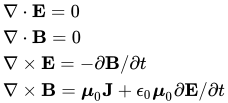
assume that the wavelength is much larger than the average separation of atoms so that the medium can be considered continuous. We use the usual macroscopic E and B fields and take the medium to be nonmagnetic and neutral so that Maxwell’s equations read
both the total electric and magnetic fields
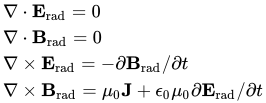
the set of Maxwell equations inside the dielectric
where includes the true and polarization current induced in the material by the outside electric field. We assume a linear relationship between the current and the electric field, hence
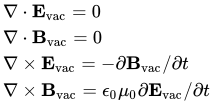
The set of Maxwell equations outside the dielectric has no current density term
The two sets of Maxwell equations are coupled since the vacuum electric field appears in the current density term.
For a monochromatic wave at normal incidence, the vacuum electric field has the form
,
with .
Now to solve for , we take the curl of the third equation in the first set of Maxwell equation and combine it with the fourth.
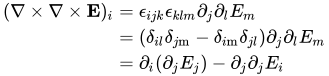
We simplify the double curl in a couple of steps using Einstein summation Einstein summation.
Hence we obtain,
Then substituting by we obtain,
Realizing that all the fields have the same time dependence , the time derivatives are straightforward and we obtain the following inhomogeneous wave equation
with particular solution
For the complete solution, we add to the particular solution the general solution of the homogeneous equation which is a superposition of plane waves traveling in arbitrary directions[13]
Where is found from the homogeneous equation to be
Note that we have taken the solution as a coherent superposition of plane waves. Because of symmetry, we expect the fields to be the same in a plane perpendicular to axis. Hence where is a displacement perpendicular to
Since there are no boundary in the region we expect a wave traveling to the right. The solution to the homogeneous equation becomes,
Adding this to the particular solution, we get the radiated wave inside the medium ( )
The total field at any position is the sum of the incident and radiated fields at that position. Adding the two components inside the medium, we get the total field
This wave travels inside the dielectric at speed
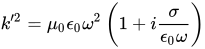
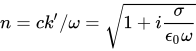
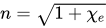
We can simplify the above to a familiar form of the index of refraction of a linear isotropic dielectric. To do so, we remember that in a linear dielectric an applied electric field induces a polarization proportional to the electric field . When the electric field changes, the induced charges move and produces a current density given by . Since the time dependence of the electric field is , we get
Which implies that the conductivity
.
Then substituting the conductivity in the equation of , gives
Which is a more familiar form.For the region , one imposes the condition of a wave traveling to the left. By setting the conductivity in this region , we obtain the reflected wave
traveling a the speed of light.
Note that the coefficients nomenclature, and , are only adopted to match what we already expect.
Hertz Vector Approach
The following is a derivation based off of a work by Wangsness [1] and a similar derivation found in chapter 20 of Zangwill's text, Modern Electrodynamics [2]. The setup is as follows, let the infinite half-space be vacuum and the infinite half-space be a uniform, isotropic, dielectric material with electric susceptibility, as shown in Figure 1.
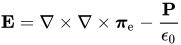
The electric field in terms of the Hertz vectors is given as
,
but the magnetic Hertz vector is 0 since the the material is assumed to be non-magnetizable and there is no external magnetic field. Therefore the electric field simplifies to
.
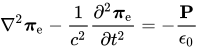
In order to calculate the electric field we must first solve the inhomogeneous wave equation for . To do this, split in the homogeneous and particular solutions
.
Linearity then allows us to write
.
The homogeneous solution, , is the initial plane wave traveling with wave vector in the positive direction
We do not need to explicitly find since we are only interested in finding the field.
The particular solution, and therefore, , is found using a time dependent Green's function method on the inhomogeneous wave equation for which produces the retarded integral
.
Since the initial electric field is polarizing the material, the polarization vector must have the same space and time dependence More detail about this assumption is discussed by Wangsness. Plugging this into the integral and expressing in terms of Cartesian coordinates produces
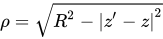
First, consider only the integration over and and convert this to cylindrical coordinatesand call
Then using the substitution
and
so the limits become
and
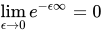
Then introduce a convergence factor with into the integrand since it does not change the value of the integral,
Then implies , hence . Therefore,
Now, plugging this result back into the z-integral yields
Notice that is now only a function of and not which was expected for the given symmetry.
This integration must be split into two due to the absolute value inside the integrand. The regions are and Again, a convergence factor must be introduced to evaluate both integrals and the result is
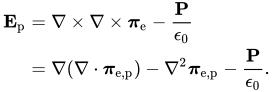
Instead of plugging directly into the expression for the electric field, several simplifications can be made. Begin with the curl of the curl vector identity,
,
therefore,
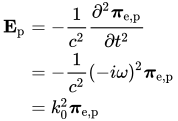
Notice that because has no dependence and is always perpendicular to Also, notice that the second and third terms are equivalent to the inhomogeneous wave equation, therefore,
Therefore, the total field is
which becomes,
Now focus on the field inside the dielectric. Using the fact that is complex, we may immediately write
recall also that inside the dielectric we have .
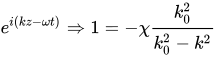
Then by coefficient matching we find,
and
.
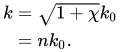
The first relation quickly yields the wave vector in the dielectric in terms of the incident wave as
Using this result and the definition of in the second expression yields the polarization vector in terms of the incident electric field as
Both of these results can be substituted into the the expression for the electric field to obtain the final expression
his is exactly the result as expected. There is only one wave inside the medium and it has wave speed reduced by n. The expected reflection and transmission coefficients are also recovered.
^Zangwill, Andrew (2013). Modern Electrodynamics. Cambridge University Press. ISBN9780521896979.
Content Disclaimer
Informasi ini disarikan dari Wikipedia dan disajikan kembali untuk tujuan edukasi. Konten tersedia di bawah lisensi CC BY-SA 3.0. Kami tidak bertanggung jawab atas ketidakakuratan data yang bersumber dari kontribusi publik tersebut.
The information displayed on this website is sourced in part or in whole from Wikipedia and has been adapted for the purpose of restating it. We strive to provide accurate and relevant information, however:
There is no guarantee of absolute accuracy. Wikipedia is an open, collaborative project that can be edited by anyone, so information is subject to change.
It is not intended to constitute professional advice. The content displayed is for informational and educational purposes only. For important decisions (e.g., medical, legal, or financial), please consult a professional.
Content copyright. Wikipedia is licensed under the Creative Commons Attribution-ShareAlike License (CC BY-SA). This means that content may be reused with appropriate attribution and shared under a similar license.
Responsible use. Any risk arising from the use of information from this website is entirely the responsibility of the user.








![{\displaystyle \mathbf {E} _{\mathrm {vac} }(z,t)=\mathbf {E} _{\mathrm {vac} }\exp[i(kz-\omega t)]}](https://wikimedia.org/api/rest_v1/media/math/render/svg/e3052adb623ffecfdf157d03288b9c91110573f7)






![{\displaystyle \exp[-i\omega t]}](https://wikimedia.org/api/rest_v1/media/math/render/svg/6f51789162acfb9afb17f7900a1f6b84f2403d13)











































![{\displaystyle {\begin{aligned}I&=2\pi \int _{\left|z^{\prime }-z\right|}^{\infty }dRe^{ik_{0}R}\\&=2\pi \lim _{\epsilon \to 0}\int _{\left|z^{\prime }-z\right|}^{\infty }dRe^{(ik_{0}-\epsilon )R}\\&=\left.2\pi \lim _{\epsilon \to 0}\left[{\frac {e^{(ik_{0}-\epsilon )R}}{ik_{0}-\epsilon }}\right]\right|_{\left|z^{\prime }-z\right|}^{\infty }\\&=2\pi \lim _{\epsilon \to 0}\left[{\frac {e^{(ik_{0}-\epsilon )\infty }}{ik_{0}-\epsilon }}-{\frac {e^{(ik_{0}-\epsilon ){\left|z^{\prime }-z\right|}}}{ik_{0}-\epsilon }}\right].\end{aligned}}}](https://wikimedia.org/api/rest_v1/media/math/render/svg/b93af10b1e33d65ddc0b0b0cc8dee527227e73ef)
![{\displaystyle {\begin{aligned}I&=2\pi \lim _{\epsilon \to 0}\left[{\frac {e^{(ik_{0}-\epsilon )\infty }}{ik_{0}-\epsilon }}-{\frac {e^{(ik_{0}-\epsilon ){\left|z^{\prime }-z\right|}}}{ik_{0}-\epsilon }}\right]\end{aligned}}}](https://wikimedia.org/api/rest_v1/media/math/render/svg/a4d8e4b11d536078d265e61bd646fa1d8cdf869f)


![{\displaystyle {\begin{aligned}I&=2\pi \lim _{\epsilon \to 0}\left[0-{\frac {e^{(ik_{0}-\epsilon ){\left|z^{\prime }-z\right|}}}{ik_{0}-\epsilon }}\right]\\&=-2\pi {\frac {e^{ik_{0}{\left|z^{\prime }-z\right|}}}{ik_{0}}}\\&=2\pi i{\frac {e^{ik_{0}{\left|z^{\prime }-z\right|}}}{k_{0}}}.\end{aligned}}}](https://wikimedia.org/api/rest_v1/media/math/render/svg/dd1d3d804252b33f36d630af72daa60749857d20)