User:InvincibleWiki
In Turbomachinery,the Slip factor is a measure of the fluid slip in the Impeller of a compressor namely centrifugal or a pump. Fluid slip is the deviation in the angle at which the fluid leaves the impeller from the impeller's blade/vane angle. Being quite small in axial impellers(inlet and outlet flow in same direction), slip is a very important phenomenon in radial impellers and is useful in determining the accurate estimation of work input or the energy transfer between the impeller and the fluid, rise in pressure and the velocity triangles at the impeller exit.
A simple explanation for the fluid slip can be given as :In Fig 1. Consider an impeller with z number of blades rotating at angular velocity ω. A difference in pressure and velocity during the course of clockwise flow through the impeller passage can be observed between the trailing and leading faces of the impeller blades. High pressure and low velocity is observed at the leading face of impellers blade as compared to lower pressure with high velocity at the trailing face of the blade. This results in a circulation in the direction of ω around the impeller blade which prevents the air from acquiring the whirl velocity equivalent to impeller speed with non-uniform velocity distribution at any radius.
Factors accounting for slip factor
- Relative eddy.
- Back eddy.
- Impeller Design or geometry
- Mean Blade Loading.
- Thickness of blade.
- Finite number of blades.
- Fluid Entry Conditions.
- Working Fluid's Viscosity.
- Effect of boundary layer growth.
- Flow Separation.
- Friction forces on the walls of flow packages.
- Boundary layer blockage.
Mathematical Formulae for Slip factor

Mathematically, Slip factor denoted by 'σ' is defined as the ratio of the actual & ideal values of the whirl velocity components at the exit of impeller. The ideal values can be calculated using analytical approach while the actual values should be observed experimentally.

where,
- V'w2 : Actual Whirl Velocity Component ,
- Vw2 : Ideal Whirl Velocity Component
Usually,σ varies from 0-1 with an average ranging from 0.8-0.9 .
The Slip Velocity is given as:
VS = Vw2 - V'w2 = Vw2(1-σ)
Slip Factor correlations
- Stodola's Equation: According to Stodola, it is the relative eddy that fills the entire exit session of the impeller passage. For a given flow geometry, the slip factor increases with the increase in the number of impeller blades,thus, accounts for one of the important parameter for losses.
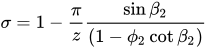
- where, z = number of blades
- For Radial tip, β2 = 900 ∴

- Theoretically, In order to get the perfect ideal flow guidance, one can infinitesimally increase the number of thin vanes so that the flow should leave the impeller at an exact vane angle.
- However,later experiments proved that beyond a particular value,further increase in number of blades results in reduction of slip factor due to increase in blockage area.
- Stanitz's Equation: Stanitz found the slip velocity does not depends upon of the blade exit angle and hence,gave the following equation.
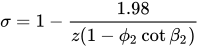
- where, z = number of blades,
- β2 varies from 450 to 900.
- For radial tip: β2 = 900 ∴
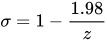
- Balje's formula: An approximate formula given by Balje for radial-tipped (β2=900) blade impellers:
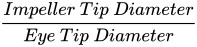
![{\displaystyle \sigma =[1+{\frac {6.2}{z.n^{2/3}}}]^{-1}}](https://wikimedia.org/api/rest_v1/media/math/render/svg/efdd8045dc0fb9445f8be8c60987ee339a32571a)
- where, z = number of blades , n =

The above explained models clearly states that the Slip factor is solely a function of geometry of Impeller. However, later studies proved that Slip factor depends on other factors as well namely 'mass flow rate',viscosity etc..
See Also
Notes
- It is found that the downfall in blade angle towards the impeller exit results in increment of slip factor with increasing flow rate and vice-versa.
- Slip Factor being a function of mass flow rate because of back eddy.
References
- Seppo A. Korpela (2011), Principles of Turbomachinery. John Wiley & Sons,Inc. ISBN 978-0-470-53672-8.
- S.L. Dixon (1998), Fluid Mechanics And Thermodynamics of Turbomachinery. Elsevier Butterworth-Heinemann,Inc. ISBN 0-7506-7870-4.
- Rama Gorla, Aijaz Khan, Turbomachinery:Design and Theory. Marcel Dekker,Inc. ISBN 0-8247-0980-2.
- Fluid Machine - FKM
- Analysis and Validation of a Unified Slip Factor Model for Impellers at Design and off-Design Conditions
- Numerical Study of Slip Factor in Centrifugal Pumps and Study Factors Affecting its Performance
- Fluid Machinery - NPTEL
- Experimental and Analytical Investigations of Slip Factor In Radial Tipped Centrifugal Fan.
Category:Mechanical engineering Category:Compressors Category:Pumps
Content Disclaimer
Informasi ini disarikan dari Wikipedia dan disajikan kembali untuk tujuan edukasi. Konten tersedia di bawah lisensi CC BY-SA 3.0. Kami tidak bertanggung jawab atas ketidakakuratan data yang bersumber dari kontribusi publik tersebut.
- The information displayed on this website is sourced in part or in whole from Wikipedia and has been adapted for the purpose of restating it. We strive to provide accurate and relevant information, however:
- There is no guarantee of absolute accuracy. Wikipedia is an open, collaborative project that can be edited by anyone, so information is subject to change.
- It is not intended to constitute professional advice. The content displayed is for informational and educational purposes only. For important decisions (e.g., medical, legal, or financial), please consult a professional.
- Content copyright. Wikipedia is licensed under the Creative Commons Attribution-ShareAlike License (CC BY-SA). This means that content may be reused with appropriate attribution and shared under a similar license.
- Responsible use. Any risk arising from the use of information from this website is entirely the responsibility of the user.