U80601
 | This article relies on a single source. (October 2024) |
 U80601 (8 MHz version). | |
| General information | |
|---|---|
| Launched | 1989 |
| Discontinued | 1990 |
| Common manufacturer | |
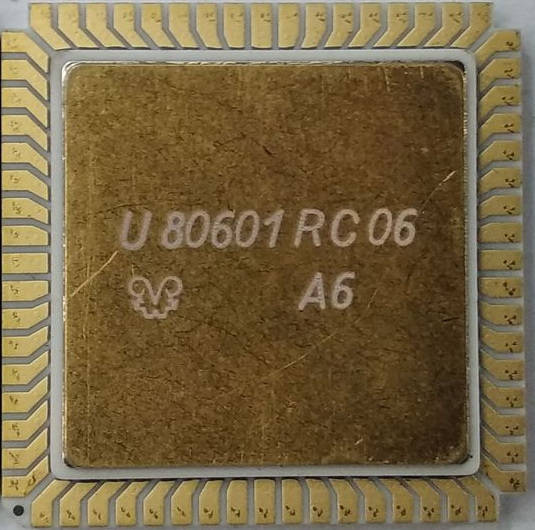
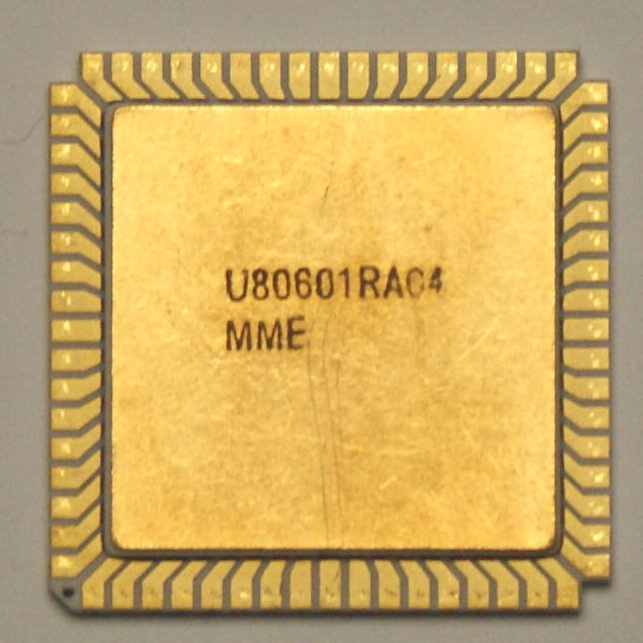
The U80601 was a 16-bit microprocessor made in 1989-1990 by Kombinat Mikroelektronik Erfurt in the former German Democratic Republic of East Germany. It was manufactured in NMOS technology and encased in a PLCC or ceramic (CLCC) package (first samples).[1]
This Central Processing Unit (CPU) was a near-identical copy of the Intel 80286 microprocessor. Because it was manufactured in East Germany it was not within Intel's legal power to stop it from being made or sold.
The U80600 system included the following chips:
- U80601: CPU (equiv. to Intel 80286)
- U80606: Bus controller (equiv. to Intel 82288)
- U80608: Error detection and correction (equiv. to Intel R8206)
- U80610: Memory controller for 16 kbit to 256 kbit DRAMs (equiv. to Intel R8207)
Planned, but never released:[2]
- U80612: Clock generator (equiv. to DS80612, SAB82284)
- U80613: FPU (equiv. to Intel 80287 floating point math coprocessor)
- U80614, U80617, U80619: Rolanet 2 network controller (similar to Ethernet, IEEE 802.3)
- U80620: Integrated peripheral controller (CHIPS or SAB82C206)
- U80621: VGA graphics controller (equiv. to Tseng Labs ET3000)
- U80622: RAMDAC (equiv. to Inmos IMSG171P50)
See also
- Comparison of chip photos from the Siemens 80286 and U 80601 (in German)
- U80601 RC06 in CLCC package
- U80601 RA04 in CLCC package
- D. Mandler, H. Berndt: Das schnelle 16-Bit-Mikroprozessorsystem U 80600. Mikroprozessortechnik 3, 1989, H. 5, S. 130–131, 4. Us. (in German)
- A. Fritzsche: 16-Bit-Mikroprozessor U 80601. In: Mikroprozessortechnik 3, 1989, H. 5, S. 132–136. (in German)
References
- ^ "U80601". www.web-bcs.com. Retrieved 22 July 2024.
- ^ Fast 16-bit microprocessor system U 80600 Dienstsache (official matter) EA/8/89, VEB Kombinat Robotron, Dresden, August 1989 (in German)
 | This electronics-related article is a stub. You can help Wikipedia by adding missing information. |
Content Disclaimer
Informasi ini disarikan dari Wikipedia dan disajikan kembali untuk tujuan edukasi. Konten tersedia di bawah lisensi CC BY-SA 3.0. Kami tidak bertanggung jawab atas ketidakakuratan data yang bersumber dari kontribusi publik tersebut.
- The information displayed on this website is sourced in part or in whole from Wikipedia and has been adapted for the purpose of restating it. We strive to provide accurate and relevant information, however:
- There is no guarantee of absolute accuracy. Wikipedia is an open, collaborative project that can be edited by anyone, so information is subject to change.
- It is not intended to constitute professional advice. The content displayed is for informational and educational purposes only. For important decisions (e.g., medical, legal, or financial), please consult a professional.
- Content copyright. Wikipedia is licensed under the Creative Commons Attribution-ShareAlike License (CC BY-SA). This means that content may be reused with appropriate attribution and shared under a similar license.
- Responsible use. Any risk arising from the use of information from this website is entirely the responsibility of the user.