Thompson order formula
In mathematical finite group theory, the Thompson order formula, introduced by John Griggs Thompson (Held 1969, p.279), gives a formula for the order of a finite group in terms of the centralizers of involutions, extending the results of Brauer & Fowler (1955).
Statement
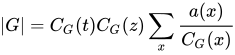
If a finite group G has exactly two conjugacy classes of involutions with representatives t and z, then the Thompson order formula (Aschbacher 2000, 45.6) (Suzuki 1986, 5.1.7) states

Here a(x) is the number of pairs (u,v) with u conjugate to t, v conjugate to z, and x in the subgroup generated by uv.
Harris (1972, 3.10) gives the following more complicated version of the Thompson order formula for the case when G has more than two conjugacy classes of involution.
where t and z are non-conjugate involutions, the sum is over a set of representatives x for the conjugacy classes of involutions, and a(x) is the number of ordered pairs of involutions u,v such that u is conjugate to t, v is conjugate to z, and x is the involution in the subgroup generated by tz.
Proof
The Thompson order formula can be rewritten as
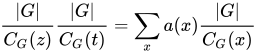
where as before the sum is over a set of representatives x for the classes of involutions. The left hand side is the number of pairs on involutions (u,v) with u conjugate to t, v conjugate to z. The right hand side counts these pairs in classes, depending the class of the involution in the cyclic group generated by uv. The key point is that uv has even order (as if it had odd order then u and v would be conjugate) and so the group it generates contains a unique involution x.
References
- Aschbacher, Michael (2000), Finite group theory, Cambridge Studies in Advanced Mathematics, vol. 10 (2nd ed.), Cambridge University Press, ISBN 978-0-521-78675-1, MR 1777008
- Brauer, R.; Fowler, K. A. (1955), "On groups of even order", Annals of Mathematics, Second Series, 62: 565–583, doi:10.2307/1970080, ISSN 0003-486X, JSTOR 1970080, MR 0074414
- Harris, Morton E. (1972), "A characterization of odd order extensions of the finite projective symplectic groups PSp(4,q)", Transactions of the American Mathematical Society, 163: 311–327, doi:10.2307/1995724, ISSN 0002-9947, JSTOR 1995724, MR 0286897
- Held, Dieter (1969), "The simple groups related to M24", Journal of Algebra, 13: 253–296, doi:10.1016/0021-8693(69)90074-X, ISSN 0021-8693, 0249500
- Suzuki, Michio (1986), Group theory. II, Grundlehren der Mathematischen Wissenschaften [Fundamental Principles of Mathematical Sciences], vol. 248, Berlin, New York: Springer-Verlag, ISBN 978-0-387-10916-9, MR 0815926
Content Disclaimer
Informasi ini disarikan dari Wikipedia dan disajikan kembali untuk tujuan edukasi. Konten tersedia di bawah lisensi CC BY-SA 3.0. Kami tidak bertanggung jawab atas ketidakakuratan data yang bersumber dari kontribusi publik tersebut.
- The information displayed on this website is sourced in part or in whole from Wikipedia and has been adapted for the purpose of restating it. We strive to provide accurate and relevant information, however:
- There is no guarantee of absolute accuracy. Wikipedia is an open, collaborative project that can be edited by anyone, so information is subject to change.
- It is not intended to constitute professional advice. The content displayed is for informational and educational purposes only. For important decisions (e.g., medical, legal, or financial), please consult a professional.
- Content copyright. Wikipedia is licensed under the Creative Commons Attribution-ShareAlike License (CC BY-SA). This means that content may be reused with appropriate attribution and shared under a similar license.
- Responsible use. Any risk arising from the use of information from this website is entirely the responsibility of the user.