Tempotron
 | This article provides insufficient context for those unfamiliar with the subject. (February 2015) |
The Tempotron is a supervised synaptic learning algorithm which is applied when the information is encoded in spatiotemporal spiking patterns. This is an advancement of the perceptron which does not incorporate a spike timing framework.
It is general consensus that spike timing (STDP) plays a crucial role in the development of synaptic efficacy for many different kinds of neurons [1] Therefore, a large variety of STDP-rules has been developed one of which is the tempotron.
Algorithm
Assuming a leaky integrate-and-fire-model the potential of the synapse can be described by


where denotes the spike time of the i-th afferent synapse with synaptic efficacy and the resting potential. describes the postsynaptic potential (PSP) elicited by each incoming spike:


![{\displaystyle K(t-t_{i})={\begin{cases}V_{0}[\exp(-(t-t_{i})/\tau )-\exp(-(t-t_{i})/\tau _{s})]&t\geq t_{i}\\0&t<t_{i}\end{cases}}}](https://wikimedia.org/api/rest_v1/media/math/render/svg/cfc78cdd8b6ddb81bb1fa6027ad4abfe0e0d9ce1)
with parameters and denoting decay time constants of the membrane integration and synaptic currents. The factor is used for the normalization of the PSP kernels. When the potential crosses the firing threshold the potential is reset to its resting value by shunting all incoming spikes.


Next, a binary classification of the input patterns is needed( refers to a pattern which should elicit at least one post synaptic action potential and refers to a pattern which should have no response accordingly). In the beginning, the neuron does not know which pattern belongs to which classification and has to learn it iteratively, similar to the perceptron . The tempotron learns its tasks by adapting the synaptic efficacy . If a pattern is presented and the postsynaptic neuron did not spike, all synaptic efficacies are increased by whereas a pattern followed by a postsynaptic response leads to a decrease of the synaptic efficacies by with [2]


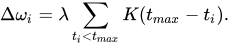
Here denotes the time at which the postsynaptic potential reaches its maximal value.

It should be mentioned that the Tempotron is a special case of an older paper which dealt with continuous inputs.[3]
Sources
- ^ Caporale, N., & Dan, Y. (2008). Spike timing-dependent plasticity: a Hebbian learning rule. Annu Rev Neurosci, 31, 25-46.
- ^ Robert Gütig, Haim Sompolinsky (2006): The tempotron: a neuron that learns spike timing-based decisions, Nature Neuroscience vol. 9, no.3, 420-428
- ^ Anthony M. Zador, Barak A. Pearlmutter (1996): "VC dimension of an integrate-and-fire neuron model", Neural Computation vol.8, 611-624
Content Disclaimer
Informasi ini disarikan dari Wikipedia dan disajikan kembali untuk tujuan edukasi. Konten tersedia di bawah lisensi CC BY-SA 3.0. Kami tidak bertanggung jawab atas ketidakakuratan data yang bersumber dari kontribusi publik tersebut.
- The information displayed on this website is sourced in part or in whole from Wikipedia and has been adapted for the purpose of restating it. We strive to provide accurate and relevant information, however:
- There is no guarantee of absolute accuracy. Wikipedia is an open, collaborative project that can be edited by anyone, so information is subject to change.
- It is not intended to constitute professional advice. The content displayed is for informational and educational purposes only. For important decisions (e.g., medical, legal, or financial), please consult a professional.
- Content copyright. Wikipedia is licensed under the Creative Commons Attribution-ShareAlike License (CC BY-SA). This means that content may be reused with appropriate attribution and shared under a similar license.
- Responsible use. Any risk arising from the use of information from this website is entirely the responsibility of the user.