Quaternionic eigenvalue problem
In linear algebra, the quaternionic eigenvalue problem is the problem of determining the eigenvalues and eigenvectors of a matrix with quaternionic entries. Unlike the classical eigenvalue problem over the complex numbers, where multiplication is commutative, two distinct problems can be considered: the right eigenvalue problem and the left eigenvalue problem.[1]: 106
History
The study of eigenvalues of quaternionic matrices began in the late 1940s with the work of H. C. Lee, who established quaternionic analogues of several classical results of matrix theory, including a version of Shcur's triangularization theorem.[2]: 256 Afterwards, N. A. Wiegmann established the existence of a Jordan canonical form for quaternionic matrices.[3]: 191–194 Most of this early work focused on the right eigenvalue problem. In the 1980s, R. M. W. Wood proved the existence of left eigenvalues.[4]: 137 Subsequent work by W. So, L. Huang and others developed computational methods, localization theorems and classifications of left eigenvalues for low-dimensional quaternionic matrices.[1]
In the early 2000s, the subject expanded into infinite-dimensional operator theory through the development of slice hyperholomorphic function theory. This led to the introduction of the S-spectrum and the quaternionic functional calculus by F. Colombo, I. Sabadini, providing a complete framework for the spectral theory of quaternionic linear operators.[5] Recent work has also explored applications of this theory to fractional difussion processes. [6]
Applications
Quaternionic eigenvalue problems appear naturally in quaternionic quantum mechanics, where observables and evolution operators are represented by quaternionic linear operators.[7]: 836 Quaternionic matrices are also used in applied mathematics and engineering, for instance colour image processing and signal processing.[8]: 28
Background
Quaternions

The quaternions, denoted by , are a four-dimensional associative algebra over the real numbers. Every quaternion can be written uniquely in the form


where and the imaginary units satisfy


Unlike the real and complex numbers, quaternion multiplication is not commutative. For example,

Every nonzero quaternion has a multiplicative inverse. The quaternions therefore form a division ring (also called skew field), but not a field. This makes quaternionic linear algebra distinct to real and complex linear algebra.
Quaternionic vector spaces
Since quaternions form a noncommutative division ring, scalar multiplication on a quaternionic vector space must be specified to act either on the left or on the right. A left quaternionic vector space (or left -module) is an abelian group equipped with a scalar multiplication

satisfying the vector space axioms. Similarly, a right quaternionic vector space (or right -module) is an abelian group equipped with a scalar multiplication

satisfying the same axioms. Accordingly, two notions of quaternionic linear map arise.[9]: 136 If V is a right quaternionic vector space, a map is right-linear if

- for every ,
- for every and ,


Similarly, if V is a left quaternionic vector space, a map is left-linear if
- for every ,
- for every and ,

Once a basis has been chosen, every right-linear map on an -dimensional right quaternionic vector space is represented by an matrix with quaternionic entries. In this case matrix multiplication is defined in the usual way and satisfies , thus being a right linear map.


Right eigenvalue problem
For a matrix , the right eigenvalue problem consists of finding a nonzero vector and a quaternion such that


The quaternion for which the above equation holds is called a right eigenvalue of . The set of right eigenvalues of is called right spectrum of , denoted by .[1]: 106 If is replaced by for some nonzero quaternion , the corresponding eigenvalue becomes , since


This is the first distinctive feature of the right eigenvalue problem: in contrast with the classical problem, where an matrix admits at most distinct eigenvalues, some quaternionic matrices admit an infinite number of eigenvalues. Nevertheless, the eigenvalues can be organized in a finite number of equivalence classes, also referred to as eigenvalue class.[10]: 25 The eigenvalue class generated by is defined by
![{\displaystyle [\lambda ]=\{\mu \in \mathbb {H} :\mu =q^{-1}\lambda q,\quad q\in \mathbb {H} \setminus \{0\}\}}](https://wikimedia.org/api/rest_v1/media/math/render/svg/699581d858373e33123cc704796f2cc327fea143)
Zhang showed that the number of eigenvalue classes is finite.[10]: 39 The precise statement is the following
Theorem[10]: 39 — Let be an matrix with quaternionic entries. Then has exactly eigenvalues classes.
Note that, if one is restricted the classic eigenvalue problem over the complex numbers, the eigenvalue classes are simply the singletons . Therefore the above theorem is a direct generalization of classic result: a complex matrix of size has (complex) eigenvalues.
![{\displaystyle [\lambda ]=\{\lambda \}}](https://wikimedia.org/api/rest_v1/media/math/render/svg/e34616a1456d93ca071a2369b43fd33ecc2a53e8)
Computing the right spectrum
Lee characterizes an algorithm to compute the eigenvalues of a quaternionic matrix [2]: 255 :
- Decompose the quaternionic matrix as with . Consider the companion matrix associated with (also called complex adjoint matrix or adjoint of the matrix ) defined by
- Compute the eigenvalues of the matrix , also called the standard eigenvalues of . As a complex matrix, one can use classic techniques to compute its eigenvalues.
- Each conjugate pair of eigenvalues of generates the same eigenvalue class of the original matrix .


![{\displaystyle [\lambda ]}](https://wikimedia.org/api/rest_v1/media/math/render/svg/7a54ab3f6292bddd34e7098eb06759e9830394ec)
Canonical forms
The classical canonical forms of complex matrices admit extensions to the quaternionic context. In particular, the Schur decomposition and the Jordan normal form generalize to quaternionic matrices by using right eigenvalues, more specifically the standard eigenvalues.[10]
Lee proved that any quaternionic matrix is unitarily similar to an upper triangular matrix whose diagonal entries correspond to the standard eigenvalues of the matrix .[2]: 255–256 Brenner later gave an alternative treatment of this result.[11]: 331 The precise statement is as follows.
Theorem[2]: 256 — Let . Then there exists a unitary matrix[a] with quaternionic coefficients such that is upper triangular, whose diagonal elements are the standard eigenvalues of .


Wiegmann proved that every quaternionic matrix is similar to a matrix in Jordan canonical form. The Jordan blocks are determined by the standard eigenvalues and classify quaternionic matrices up to similarity.[3]: 191–194 The precise statement is as follows.
Theorem[3]: 194 —Let . Then there exists an invertible matrix P with quaternionic coefficients such that has the Jordan canonical form, whose diagonal elements are the standard eigenvalues of .

Left eigenvalue problem
In contrast with the right eigenvalue problem, the theory of left eigenvalues is less developed and exhibits several phenomena with no classic analogue. Their systematic study began through the work of Wood[4], Huang and So[1], and others. For a matrix , a quaternion is called left eigenvalue of if there exists a nonzero vector such that

The set of left eigenvalues of is called left spectrum of and its denoted by .[1]: 106 Huang and So showed, even a quaternionic matrix can have both finite and infinite number of left eigenvalues.[1]: 110 Namely, the following theorem is proved


Theorem[1]: 110 —Let . Then is infinite if and only if , , and . In this case


Left eigenvalues do not have similar properties to right eigenvalues. For instance, unlike right eigenvalues, left eigenvalues are not invariant under similarity transformations. If , the left spectra of and need not coincide. Indeed, if , then
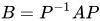


Since quaternionic scalars do not commute with the entries of , the identity does not generally hold. Consequently, need not be a left eigenvector of associated with the same eigenvalue. For this reason, left eigenvalues do not give rise to a Jordan canonical form analogous to that associated with right eigenvalues.


Infinite dimensional case
The theory of quaternionic matrices extends to bounded linear operators on infinite-dimensional quaternionic Hilbert and Banach spaces.[12][9] In this setting, however, the classical notion of eigenvalue is insufficient for developing a spectral theory analogous to that of complex operators. Namely, the noncommutativity of the quaternions prevents the direct extension of the classical resolvent operator to this setting.[6]: 3

For this reason, the -spectrum was introduced.[5]: 2263 For a bounded right-linear operator , the -spectrum is defined as


The -spectrum generalizes several properties of the spectrum of a complex operator while respecting the quaternionic structure. Later it was shown to agree with the right spectrum of a quaternionic operator acting on a quaternionic right Banach space.[13]: 17
See also
Footnotes
- ^ Unitary in the sense of quaternions. The definition is the same as for complex matrices but one requires quaternionic conjugation.
References
- ^ a b c d e f g Huang, Liping; So, Wasin (January 2001). "On left eigenvalues of a quaternionic matrix". Linear Algebra and its Applications. 323 (1–3): 105–116. doi:10.1016/S0024-3795(00)00246-9. ISSN 0024-3795. Archived from the original on 2022-06-19.
- ^ a b c d Lee, H. C. (1948). "Eigenvalues and Canonical Forms of Matrices with Quaternion Coefficients". Proceedings of the Royal Irish Academy. Section A: Mathematical and Physical Sciences. 52: 253–260. ISSN 0035-8975.
- ^ a b c Wiegmann, N. A. (January 1955). "Some Theorems On Matrices With Real Quaternion Elements". Canadian Journal of Mathematics. 7: 191–201. doi:10.4153/CJM-1955-024-x. ISSN 0008-414X.
- ^ a b Wood, R. M. W. (1985). "Quaternionic Eigenvalues". Bulletin of the London Mathematical Society. 17 (2): 137–138. doi:10.1112/blms/17.2.137. ISSN 1469-2120.
- ^ a b Colombo, Fabrizio; Sabadini, Irene; Struppa, Daniele C. (April 2008). "A new functional calculus for noncommuting operators". Journal of Functional Analysis. 254 (8): 2255–2274. doi:10.1016/j.jfa.2007.12.008. ISSN 0022-1236. Archived from the original on 25 May 2023.
- ^ a b Colombo, Fabrizio; Gantner, Jonathan; Kimsey, David P. (2018). "Spectral Theory on the S-Spectrum for Quaternionic Operators". Operator Theory: Advances and Applications. doi:10.1007/978-3-030-03074-2. ISSN 0255-0156.
- ^ Birkhoff, Garrett; Von Neumann, John (1936). "The Logic of Quantum Mechanics". Annals of Mathematics. 37 (4): 823–843. doi:10.2307/1968621. ISSN 0003-486X.
- ^ Miron, Sebastian; Flamant, Julien; Bihan, Nicolas Le; Chainais, Pierre; Brie, David (September 2023). "Quaternions in Signal and Image Processing: A comprehensive and objective overview". IEEE Signal Processing Magazine. 40 (6): 26–40. doi:10.1109/MSP.2023.3278071. ISSN 1558-0792.
- ^ a b Colombo, Fabrizio; Sabadini, Irene; Struppa, Daniele C. (2011). "Noncommutative Functional Calculus". Progress in Mathematics. doi:10.1007/978-3-0348-0110-2. ISSN 0743-1643.
- ^ a b c d Zhang, Fuzhen (January 1997). "Quaternions and matrices of quaternions". Linear Algebra and its Applications. 251: 21–57. doi:10.1016/0024-3795(95)00543-9. ISSN 0024-3795. Archived from the original on 2024-04-18.
- ^ Brenner, J. L. (1951-09-01). "Matrices of quaternions". Pacific Journal of Mathematics. 1 (3): 329–335. ISSN 0030-8730.
- ^ Alpay, Daniel; Colombo, Fabrizio; Sabadini, Irene (2024). "Quaternionic Hilbert Spaces and Slice Hyperholomorphic Functions". Operator Theory: Advances and Applications. doi:10.1007/978-3-031-73430-4. ISSN 0255-0156.
- ^ Carvalho, Luís; Diogo, Cristina; Mendes, Sérgio; Soares, Helena (2024-12-20). "On the Relation Between S-Spectrum and Right Spectrum". Complex Analysis and Operator Theory. 19 (1): 17. doi:10.1007/s11785-024-01631-0. ISSN 1661-8262.
Further reading
- Colombo, Fabrizio; Gantner, Jonathan; Kimsey, David P. (2018). Spectral Theory on the S-Spectrum for Quaternionic Operators. Operator Theory: Advances and Applications. Vol. 270. Birkhäuser. doi:10.1007/978-3-030-03074-2.
- Colombo, Fabrizio; Sabadini, Irene; Struppa, Daniele C. (2011). Noncommutative Functional Calculus: Theory and Applications of Slice Hyperholomorphic Functions. Progress in Mathematics. Vol. 289. Birkhäuser. doi:10.1007/978-3-0348-0110-2.
- Zhang, Fuzhen (1997). "Quaternions and Matrices of Quaternions". Linear Algebra and its Applications. 251: 21–57. doi:10.1016/S0024-3795(96)00251-8.
Content Disclaimer
Informasi ini disarikan dari Wikipedia dan disajikan kembali untuk tujuan edukasi. Konten tersedia di bawah lisensi CC BY-SA 3.0. Kami tidak bertanggung jawab atas ketidakakuratan data yang bersumber dari kontribusi publik tersebut.
- The information displayed on this website is sourced in part or in whole from Wikipedia and has been adapted for the purpose of restating it. We strive to provide accurate and relevant information, however:
- There is no guarantee of absolute accuracy. Wikipedia is an open, collaborative project that can be edited by anyone, so information is subject to change.
- It is not intended to constitute professional advice. The content displayed is for informational and educational purposes only. For important decisions (e.g., medical, legal, or financial), please consult a professional.
- Content copyright. Wikipedia is licensed under the Creative Commons Attribution-ShareAlike License (CC BY-SA). This means that content may be reused with appropriate attribution and shared under a similar license.
- Responsible use. Any risk arising from the use of information from this website is entirely the responsibility of the user.