Jargonness
 |
Jargonness is a piecewise mathematical function mapping the frequencies of a word's appearance in scientific and contemporary English corpora to a parameter quantifying the word's association with scientific jargon – the "jargonness" of that word.[1] It is expressed mathematically as:[2]
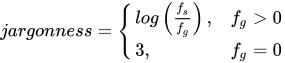
In the above equation, stands for the frequency of a word's appearance in a general English-language corpus, stands for its frequency in a scientific corpus, and is the common (base-10) logarithm.[3]


Method of use
Both the frequencies ( and ) must be determined and then substituted in the above equation to calculate the word's jargonness. In case a word has no mention in the general English corpus, 3 is taken as its jargonness as suggested by the second part of the equation.[2] Noticing that the logarithm in the first part of the equation is a common one (to the base 10), this simply means that the word is assumed to be a thousand times more likely to appear in a scientific text than a non-scientific one.
Examples of corpora
The corpora that have most commonly been employed to determine the frequencies mentioned above are the following:[2]
- Professional English Research Consortium Corpus (for scientific vocabulary; 17 million words)
- British National Corpus (for common vocabulary; 97 million words)
References
- ^ Sharon, Aviv J.; Baram-Tsabari, Ayelet (January 21, 2013). "Measuring mumbo jumbo: A preliminary quantification of the use of jargon in science communication". Public Understanding of Science. 23 (5): 528–546. doi:10.1177/0963662512469916. PMID 23825277 – via SAGE journals.
- ^ a b c Willoughby, Shannon D.; LaMeres, Brock J.; Hughes, Bryce E.; Organ, Chris; Green, Jennifer L.; Sterman, Leila Belle; Davis, Kent (2018). "STEM Storytellers: Improving the Oral Communication Skills of STEM Graduate Students". monolith.asee.org. Retrieved 2023-05-06.
- ^ https://iaea.info/documents/measuring-mumbo-jumbo-a-preliminary-quantification-of-the-use-of-jargon-in-science-communication/
External links
 | This corpus linguistics-related article is a stub. You can help Wikipedia by adding missing information. |
Content Disclaimer
Informasi ini disarikan dari Wikipedia dan disajikan kembali untuk tujuan edukasi. Konten tersedia di bawah lisensi CC BY-SA 3.0. Kami tidak bertanggung jawab atas ketidakakuratan data yang bersumber dari kontribusi publik tersebut.
- The information displayed on this website is sourced in part or in whole from Wikipedia and has been adapted for the purpose of restating it. We strive to provide accurate and relevant information, however:
- There is no guarantee of absolute accuracy. Wikipedia is an open, collaborative project that can be edited by anyone, so information is subject to change.
- It is not intended to constitute professional advice. The content displayed is for informational and educational purposes only. For important decisions (e.g., medical, legal, or financial), please consult a professional.
- Content copyright. Wikipedia is licensed under the Creative Commons Attribution-ShareAlike License (CC BY-SA). This means that content may be reused with appropriate attribution and shared under a similar license.
- Responsible use. Any risk arising from the use of information from this website is entirely the responsibility of the user.