Hamaker theory
After the explanation of van der Waals forces by Fritz London, several scientists soon realised that his definition could be extended from the interaction of two molecules with induced dipoles to macro-scale objects by summing all of the forces between the molecules in each of the bodies involved. The theory is named after H. C. Hamaker, who derived the interaction between two spheres, a sphere and a wall, and presented a general discussion in a heavily cited 1937 paper.[1]
The interaction of two bodies is then treated as the pairwise interaction of a set of N molecules at positions: Ri {i:1,2,... ...,N}. The distance between the molecules i and j is then:

The interaction energy of the system is taken to be:
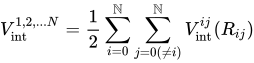
where is the interaction of molecules i and j in the absence of the influence of other molecules.

The theory is however only an approximation which assumes that the interactions can be treated independently, the theory must also be adjusted to take into account quantum perturbation theory.
References
- ^ Hamaker, H. C. (1937) The London – van der Waals attraction between spherical particles. Physica 4(10), 1058–1072. doi:10.1016/S0031-8914(37)80203-7


 | This physical chemistry-related article is a stub. You can help Wikipedia by adding missing information. |
Content Disclaimer
Informasi ini disarikan dari Wikipedia dan disajikan kembali untuk tujuan edukasi. Konten tersedia di bawah lisensi CC BY-SA 3.0. Kami tidak bertanggung jawab atas ketidakakuratan data yang bersumber dari kontribusi publik tersebut.
- The information displayed on this website is sourced in part or in whole from Wikipedia and has been adapted for the purpose of restating it. We strive to provide accurate and relevant information, however:
- There is no guarantee of absolute accuracy. Wikipedia is an open, collaborative project that can be edited by anyone, so information is subject to change.
- It is not intended to constitute professional advice. The content displayed is for informational and educational purposes only. For important decisions (e.g., medical, legal, or financial), please consult a professional.
- Content copyright. Wikipedia is licensed under the Creative Commons Attribution-ShareAlike License (CC BY-SA). This means that content may be reused with appropriate attribution and shared under a similar license.
- Responsible use. Any risk arising from the use of information from this website is entirely the responsibility of the user.