Faxén's law
In fluid dynamics, Faxén's laws relate a sphere's velocity and angular velocity to the forces, torque, stresslet and flow it experiences under low Reynolds number (creeping flow) conditions.


First law
Faxén's first law was introduced in 1922 by Swedish physicist Hilding Faxén, who at the time was active at Uppsala University, and is given by[1][2]
![{\displaystyle \mathbf {F} =6\pi \mu a\left[\left(1+{\frac {a^{2}}{6}}\nabla ^{2}\right)\mathbf {u} '-(\mathbf {U} -\mathbf {u} ^{\infty })\right],}](https://wikimedia.org/api/rest_v1/media/math/render/svg/bb2f880014ae4f1ec2d68aab656e2bca387f36c9)
where
- is the force exerted by the fluid on the sphere
- is the Newtonian viscosity of the solvent in which the sphere is placed
- is the sphere's radius
- is the (translational) velocity of the sphere
- is the disturbance velocity caused by the other spheres in suspension (not by the background impressed flow), evaluated at the sphere centre
- is the background impressed flow, evaluated at the sphere centre (set to zero in some references).


It can also be written in the form

where is the hydrodynamic mobility.
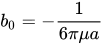
In the case that the pressure gradient is small compared with the length scale of the sphere's diameter, and when there is no external force, the last two terms of this form may be neglected. In this case the external fluid flow simply advects the sphere.
Second law
Faxén's second law is given by[1][2]
![{\displaystyle \mathbf {T} =8\pi \mu a^{3}\left[{\frac {1}{2}}\left({\boldsymbol {\nabla }}\times \mathbf {u} '\right)-(\mathbf {\Omega } -\mathbf {\Omega } ^{\infty })\right],}](https://wikimedia.org/api/rest_v1/media/math/render/svg/e98927067779653eadc67cc6fc0d32e4ad26ded1)
where
- is the torque exerted by the fluid on the sphere
- is the angular velocity of the sphere
- is the angular velocity of the background flow, evaluated at the sphere centre (set to zero in some references).


'Third law'
George Batchelor and J. T. Green[3] derived an equation for the stresslet, given by[1][2]
![{\displaystyle {\boldsymbol {\mathsf {S}}}={\frac {10}{3}}\pi \mu a^{3}\left[2{\boldsymbol {\mathsf {E}}}^{\infty }+\left(1+{\frac {1}{10}}a^{2}\nabla ^{2}\right)\left({\boldsymbol {\nabla }}\mathbf {u} '+({\boldsymbol {\nabla }}\mathbf {u} ')^{\mathrm {T} }\right)\right],}](https://wikimedia.org/api/rest_v1/media/math/render/svg/bc931472a43bef36317ff44332be36e123061664)
where
- is the stresslet (symmetric part of the first moment of force) exerted by the fluid on the sphere,
- is the velocity gradient tensor; represents transpose; and so is the rate of strain, or deformation, tensor.
- is the rate of strain of the background flow, evaluated at the sphere centre (set to zero in some references).


![{\displaystyle {\frac {1}{2}}\left[{\boldsymbol {\nabla }}\mathbf {u} '+({\boldsymbol {\nabla }}\mathbf {u} ')^{\mathrm {T} }\right]}](https://wikimedia.org/api/rest_v1/media/math/render/svg/fd0e0f3ee0864863f44624e88f27089cf888c921)
![{\displaystyle {\boldsymbol {\mathsf {E}}}^{\infty }={\frac {1}{2}}\left[{\boldsymbol {\nabla }}\mathbf {u} ^{\infty }+({\boldsymbol {\nabla }}\mathbf {u} ^{\infty })^{\mathrm {T} }\right]}](https://wikimedia.org/api/rest_v1/media/math/render/svg/f5c88f287db3437b607b9c99b93e0daa64c1282d)
Note there is no rate of strain on the sphere (no ) since the spheres are assumed to be rigid.

Faxén's law is a correction to Stokes' law for the friction on spherical objects in a viscous fluid, valid where the object moves close to a wall of the container.[4]
See also
Notes
- ^ a b c Chen, Shing Bor; Ye, Xiangnan (2000). "Faxen's laws of a composite sphere under creeping flow conditions". Journal of Colloid and Interface Science. 221 (1): 50–57. Bibcode:2000JCIS..221...50C. doi:10.1006/jcis.1999.6552. PMID 10623451.
- ^ a b c Durlofsky, Louis, John F. Brady, and Georges Bossis. "Dynamic simulation of hydrodynamically interacting particles." Journal of fluid mechanics 180.1 (1987): 21–49 doi:10.1017/S002211208700171X, equations (2.15a, b, c). Note sign change.
- ^ Batchelor, G. K.; Green, J. T. (1972). "The hydrodynamic interaction of two small freely-moving spheres in a linear flow field". J. Fluid Mech. 56 (2): 375–400. Bibcode:1972JFM....56..401B. doi:10.1017/S0022112072002435. S2CID 122635399.
- ^ Single molecule measurements and biological motors - Glossary Archived 2007-09-03 at the Wayback Machine, accessed on May 12, 2009
References
- Faxén, H. (1922), "Der Widerstand gegen die Bewegung einer starren Kugel in einer zähen Flüssigkeit, die zwischen zwei parallelen ebenen Wänden eingeschlossen ist", Annalen der Physik, 373 (10): 89–119, Bibcode:1922AnP...373...89F, doi:10.1002/andp.19223731003
- Happel, J.; Brenner, H. (1991), Low Reynolds Number Hydrodynamics, Dordrecht: Kluwer
Content Disclaimer
Informasi ini disarikan dari Wikipedia dan disajikan kembali untuk tujuan edukasi. Konten tersedia di bawah lisensi CC BY-SA 3.0. Kami tidak bertanggung jawab atas ketidakakuratan data yang bersumber dari kontribusi publik tersebut.
- The information displayed on this website is sourced in part or in whole from Wikipedia and has been adapted for the purpose of restating it. We strive to provide accurate and relevant information, however:
- There is no guarantee of absolute accuracy. Wikipedia is an open, collaborative project that can be edited by anyone, so information is subject to change.
- It is not intended to constitute professional advice. The content displayed is for informational and educational purposes only. For important decisions (e.g., medical, legal, or financial), please consult a professional.
- Content copyright. Wikipedia is licensed under the Creative Commons Attribution-ShareAlike License (CC BY-SA). This means that content may be reused with appropriate attribution and shared under a similar license.
- Responsible use. Any risk arising from the use of information from this website is entirely the responsibility of the user.