Draft:Inflation in string cosmology
The study of inflation in string cosmology is one of the main areas of research in the intersection between string phenomenology and cosmology. In string cosmology, while the details of the physics of inflation are often dependent on the specific model of string theory used, there are some generic observable features and deviations from the standard cosmological model which provide useful cosmological bounds on beyond standard model (BSM) theories. Most notable among these are predictions of the exponential nature of the inflationary potential and the identification of the inflaton with the modulus, with associated effects such as early matter domination and the cosmological modulus problem. Separately, the eta problem renders the study of cosmology in the context of string theory, or any other UV-complete theory, essential to correctly predict and constraint observables.
Inflationary mechanics
We consider a universe dominated by a spatially uniform scalar field with a potential . The energy density of such a scalar field can be written as[1]


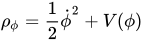
and the pressure of the scalar field as

Substituting these into the Friedmann equations, one obtains

where is the Hubble constant and is the Planck mass. We additionally also have the Klein-Gordon equation in FLRW spacetime:


These two equations together determine the evolution of the universe. When is sufficiently flat, the potential energy dominates over the kinetic energy, and the universe is said to be in the slow-roll regime. In the limit , the scale factor of the universe grows exponentially. On the other hand, when is sufficiently steep, the kinetic energy dominates over the potential energy, and the scale factor grows as . This regime is referred to as kination.[2]


We also define the slow-roll parameters


It can be shown that when , the potential is sufficiently flat for slow-roll inflation to occur. If , then inflationary conditions can persist for long periods of time and the universe may expand sufficiently to solve the flatness and horizon problems.[3] The slow-roll parameters have particular observational significance, as the main observable result of inflation, scalar curvature perturbations in the cosmic microwave background, have a power spectrum of


where is some reference scale[4] and is the scalar spectral index, which can be shown for single scalar field inflation to be


Hence, the value of and strongly affect the observed scale dependence of the power spectrum from data such as PLANCK 2018.[5]


UV sensitivity of inflation
It is generally accepted that inflation takes place at energy scales much lower than that of the Planck scale. However, the physics of inflation turns out to be highly sensitive to corrections in the high-energy limit, which require a well-controlled UV-complete theory up to the Planck scale in order to make meaningful physical statements. Two examples of this sensitivity are presented below.
The eta problem
Bibliography
- Baumann, Daniel (2022). Cosmology (PDF). Cambridge, United Kingdom New York, NY: Cambridge University Press. ISBN 9781108937092. Retrieved 13 May 2026.
References
- ^ Baumann 2022, p. 37.
- ^ Ferreira, Pedro G.; Joyce, Michael (9 June 1998). "Cosmology with a primordial scaling field". Physical Review D. 58 (2). doi:10.1103/PhysRevD.58.023503. Retrieved 13 May 2026.
- ^ Baumann 2022, p. 36.
- ^ Baumann 2022, p. 121-122.
- ^ Aghanim, N.; et al. (September 2020). "Planck 2018 results: VI. Cosmological parameters". Astronomy & Astrophysics. 641. doi:10.1051/0004-6361/201833910. Retrieved 13 May 2026.
Content Disclaimer
Informasi ini disarikan dari Wikipedia dan disajikan kembali untuk tujuan edukasi. Konten tersedia di bawah lisensi CC BY-SA 3.0. Kami tidak bertanggung jawab atas ketidakakuratan data yang bersumber dari kontribusi publik tersebut.
- The information displayed on this website is sourced in part or in whole from Wikipedia and has been adapted for the purpose of restating it. We strive to provide accurate and relevant information, however:
- There is no guarantee of absolute accuracy. Wikipedia is an open, collaborative project that can be edited by anyone, so information is subject to change.
- It is not intended to constitute professional advice. The content displayed is for informational and educational purposes only. For important decisions (e.g., medical, legal, or financial), please consult a professional.
- Content copyright. Wikipedia is licensed under the Creative Commons Attribution-ShareAlike License (CC BY-SA). This means that content may be reused with appropriate attribution and shared under a similar license.
- Responsible use. Any risk arising from the use of information from this website is entirely the responsibility of the user.