Bouguer anomaly
In geodesy and geophysics, the Bouguer anomaly (named after Pierre Bouguer) is a gravity anomaly, corrected for the height at which it is measured and the attraction of terrain.[1] The height correction alone gives a free-air gravity anomaly.

Definition
The Bouguer anomaly defined as:


Here,
- is the free-air gravity anomaly.
- is the Bouguer correction which allows for the gravitational attraction of rocks between the measurement point and sea level;
- is a terrain correction which allows for deviations of the surface from an infinite horizontal plane


The free-air anomaly , in its turn, is related to the observed gravity as follows:


where:
- is the correction for latitude (because the Earth is not a perfect sphere; see normal gravity);
- is the free-air correction.


Reduction
A Bouguer reduction is called simple (or incomplete) if the terrain is approximated by an infinite flat plate called the Bouguer plate. A refined (or complete) Bouguer reduction removes the effects of terrain more precisely. The difference between the two is called the (residual) terrain effect (or (residual) terrain correction) and is due to the differential gravitational effect of the unevenness of the terrain; it is always negative.[2]
Simple reduction
The gravitational acceleration outside a Bouguer plate is perpendicular to the plate and towards it, with magnitude 2πG times the mass per unit area, where is the gravitational constant. It is independent of the distance to the plate (as can be proven most simply with Gauss's law for gravity, but can also be proven directly with Newton's law of gravity). The value of is 6.67×10⁻¹¹ N m2 kg−2, so is 4.191×10⁻¹⁰ N m2 kg−2 times the mass per unit area. Using 1 Gal = 0.01 m s−2 (1 cm s−2) we get 4.191×10⁻⁵ mGal m2 kg−1 times the mass per unit area. For mean rock density (2.67 g cm−3) this gives 0.1119 mGal m−1


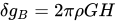
The Bouguer reduction for a Bouguer plate of thickness is where is the density of the material and is the constant of gravitation.[2] On Earth the effect on gravity of elevation is 0.3086 mGal m−1 decrease when going up, minus the gravity of the Bouguer plate, giving the Bouguer gradient of 0.1967 mGal m−1.


More generally, for a mass distribution with the density depending on one Cartesian coordinate z only, gravity for any z is 2πG times the difference in mass per unit area on either side of this z value. A combination of two parallel infinite if equal mass per unit area plates does not produce any gravity between them.
See also
- Gravity of Earth
- Gravity map
- Physical geodesy – Study of the physical properties of the Earth's gravity field
- Potential theory – Harmonic functions as solutions to Laplace's equation
- Vertical deflection – Measure of the downward gravitational force's shift due to nearby mass
Notes
- ^ Water Resources Division, U. S. Geological Survey (1997). "Introduction to Potential Fields: Gravity" (PDF). U.S. Geological Survey Fact Sheets. Fact Sheet. FS–239–95: 19. Bibcode:1997usgs.rept...19W. doi:10.3133/fs23995. Retrieved 30 May 2019.
- ^ a b Hofmann-Wellenhof & Moritz 2006, Section 3.4
References
- Lowrie, William (2004). Fundamentals of Geophysics. Cambridge University Press. ISBN 0-521-46164-2.
- Hofmann-Wellenhof, Bernard; Moritz, Helmut (2006). Physical Geodesy (2nd. ed.). Springer. ISBN 978-3-211-33544-4.
External links
- Bouguer anomalies of Belgium. The blue regions are related to deficit masses in the subsurface
- Bouguer gravity anomaly grid for the conterminous US by the [United States Geological Survey].
- Bouguer anomaly map of Grahamland F.J. Davey (et al.), British Antarctic Survey, BAS Bulletins 1963-1988
- Bouguer anomaly map depicting south-eastern Uruguay's Merín Lagoon anomaly (amplitude greater than +100 mGal), and detail of site.
- List of Magnetic and Gravity Maps by State by the [United States Geological Survey].
Content Disclaimer
Informasi ini disarikan dari Wikipedia dan disajikan kembali untuk tujuan edukasi. Konten tersedia di bawah lisensi CC BY-SA 3.0. Kami tidak bertanggung jawab atas ketidakakuratan data yang bersumber dari kontribusi publik tersebut.
- The information displayed on this website is sourced in part or in whole from Wikipedia and has been adapted for the purpose of restating it. We strive to provide accurate and relevant information, however:
- There is no guarantee of absolute accuracy. Wikipedia is an open, collaborative project that can be edited by anyone, so information is subject to change.
- It is not intended to constitute professional advice. The content displayed is for informational and educational purposes only. For important decisions (e.g., medical, legal, or financial), please consult a professional.
- Content copyright. Wikipedia is licensed under the Creative Commons Attribution-ShareAlike License (CC BY-SA). This means that content may be reused with appropriate attribution and shared under a similar license.
- Responsible use. Any risk arising from the use of information from this website is entirely the responsibility of the user.