Ball Divergence (BD) is a nonparametric two‐sample statistic that quantifies the discrepancy between two probability measures and on a metric space .[1] It is defined by integrating the squared difference of the measures over all closed balls in . Let be the closed ball of radius centered at . Equivalently, one may set and write . The Ball divergence is then defined by
This measure can be seen as an integral of the Harald Cramér's distance over all possible pairs of points. By summing squared differences of and over balls of all scales, BD captures both global and local discrepancies between distributions, yielding a robust, scale-sensitive comparison. Moreover, since BD is defined as the integral of a squared measure difference, it is always non-negative, and if and only if .
Testing for equal distributions
Next, we will try to give a sample version of Ball Divergence. For convenience, we can decompose the Ball Divergence into two parts:
and
Thus
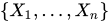
Let denote whether point locates in the ball . Given two independent samples form and form
where means the proportion of samples from the probability measure located in the ball and means the proportion of samples from the probability measure located in the ball . Meanwhile, and means the proportion of samples from the probability measure and located in the ball . The sample versions of and are as follows
Finally, we can give the sample ball divergence
It can be proved that is a consistent estimator of BD. Moreover, if for some , then under the null hypothesis converges in distribution to a mixture of chi-squared distributions, whereas under the alternative hypothesis it converges to a normal distribution.
Properties
The square root of Ball Divergence is a symmetric divergence but not a metric, because it does not satisfy the triangle inequality.
It can be shown that Ball divergence, energy distance test,[2] and MMD[3] are unified within the variogram framework; for details see Remark 2.4 in.[1]
Homogeneity Test
Ball divergence admits a straightforward extension to the K-sample setting. Suppose are probability measures on a Banach space . Define the K-sample BD by
It then follows from Theorems 1 and 2 that if and only if
By employing closed balls to define a metric distribution function, one obtains an alternative homogeneity measure.[4]
Given a probability measure on a metric space , its metric distribution function is defined by
where is the closed ball of radius centered at , and
If are i.i.d. draws from , the empirical version is
Based on these, the homogeneity measure based on MDF, also called metric Cramér-von Mises (MCVM) is
where be their mixture with weights , and .
The overall MCVM is then
The empirical MCVM is given by
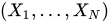
where be an i.i.d. sample from , and
A practical choice for is the median of the squared distances
^Wang, X., Zhu, J., Pan, W., Zhu, J., & Zhang, H. (2023). Nonparametric Statistical Inference via Metric Distribution Function in Metric Spaces. Journal of the American Statistical Association, 119(548), 2772–2784. https://doi.org/10.1080/01621459.2023.2277417
Content Disclaimer
Informasi ini disarikan dari Wikipedia dan disajikan kembali untuk tujuan edukasi. Konten tersedia di bawah lisensi CC BY-SA 3.0. Kami tidak bertanggung jawab atas ketidakakuratan data yang bersumber dari kontribusi publik tersebut.
The information displayed on this website is sourced in part or in whole from Wikipedia and has been adapted for the purpose of restating it. We strive to provide accurate and relevant information, however:
There is no guarantee of absolute accuracy. Wikipedia is an open, collaborative project that can be edited by anyone, so information is subject to change.
It is not intended to constitute professional advice. The content displayed is for informational and educational purposes only. For important decisions (e.g., medical, legal, or financial), please consult a professional.
Content copyright. Wikipedia is licensed under the Creative Commons Attribution-ShareAlike License (CC BY-SA). This means that content may be reused with appropriate attribution and shared under a similar license.
Responsible use. Any risk arising from the use of information from this website is entirely the responsibility of the user.


![{\displaystyle BD(\mu ,\nu )=\iint _{V\times V}{\bigl [}\mu ({\overline {B}}(u,\rho (u,v)))-\nu ({\overline {B}}(u,\rho (u,v))){\bigr ]}^{2}\;{\bigl [}\mu (du)\,\mu (dv)+\nu (du)\,\nu (dv){\bigr ]}.}](https://wikimedia.org/api/rest_v1/media/math/render/svg/bdc1c453ebc75b4afe377a4e4b1343959cef3919)


![{\displaystyle A=\iint _{V\times V}[\mu -\nu ]^{2}({\bar {B}}(u,\rho (u,v)))\mu (du)\mu (dv),}](https://wikimedia.org/api/rest_v1/media/math/render/svg/903171abdf351fcad842fe84255da59b04302e7e)
![{\displaystyle C=\iint _{V\times V}[\mu -\nu ]^{2}({\bar {B}}(u,\rho (u,v)))\nu (du)\nu (dv).}](https://wikimedia.org/api/rest_v1/media/math/render/svg/fc39b4ea70f3bbb91243ddc6c35459a4732fcc5e)








![{\displaystyle \tau \in [0,1]}](https://wikimedia.org/api/rest_v1/media/math/render/svg/2ebb0822357169cac2d073719e50b660e8074cbd)


![{\displaystyle D(\mu _{1},\dots ,\mu _{K})=\sum _{1\leq k<l\leq K}\iint _{V\times V}{\bigl [}\mu _{k}{\bigl (}{\overline {B}}(u,\rho (u,v)){\bigr )}-\mu _{l}{\bigl (}{\overline {B}}(u,\rho (u,v)){\bigr )}{\bigr ]}^{2}\;{\bigl [}\mu _{k}(du)\,\mu _{k}(dv)+\mu _{l}(du)\,\mu _{l}(dv){\bigr ]}.}](https://wikimedia.org/api/rest_v1/media/math/render/svg/9964cff2bc8eaa8d543fa0b65366072fc4a842d9)


![{\displaystyle F_{\tilde {\mu }}^{M}(u,v)={\tilde {\mu }}{\bigl (}{\overline {B}}(u,\rho (u,v)){\bigr )}=\mathbb {E} {\bigl [}\delta (u,v,X){\bigr ]},\quad u,v\in V,}](https://wikimedia.org/api/rest_v1/media/math/render/svg/9f73867f23fe313e5d8e4d8e26a1f17bd49ea13b)




![{\displaystyle \mathrm {MCVM} {\bigl (}\mu _{k}\parallel \mu {\bigr )}=\int _{V\times V}p_{k}^{2}\,w(u,v)\,{\bigl [}F_{\mu _{k}}^{M}(u,v)-F_{\mu }^{M}(u,v){\bigr ]}^{2}\,d\mu _{k}(u)\,d\mu _{k}(v),}](https://wikimedia.org/api/rest_v1/media/math/render/svg/6428866bdb4ff95c3e9aec7685ff14314b9ce97c)


![{\displaystyle {\widehat {\mathrm {MCVM} }}{\bigl (}\mu _{k}\parallel \mu {\bigr )}={\frac {1}{n_{k}^{2}}}\sum _{X_{i}^{(k)},X_{j}^{(k)}\in {\mathcal {X}}_{k}}w{\bigl (}X_{i}^{(k)},X_{j}^{(k)}{\bigr )}\,\left[F_{\mu _{k},n_{k}}^{M}{\bigl (}X_{i}^{(k)},X_{j}^{(k)}{\bigr )}-F_{\mu ,n}^{M}{\bigl (}X_{i}^{(k)},X_{j}^{(k)}{\bigr )}\right]^{2}.}](https://wikimedia.org/api/rest_v1/media/math/render/svg/7a7971af46700be8a3b9a38532293619c1902106)


