Moyal-Produkt
Das Moyal-Produkt (nach José Enrique Moyal), auch Weyl–Groenewold-Produkt (nach Hermann Weyl und Hilbrand Johannes Groenewold), ist in der Mathematik eine zweistellige Verknüpfung auf dem Funktionenraum der glatten Funktionen über . Das assoziative, nicht-kommutative Produkt ist ein Spezialfall des Sternproduktes auf allgemeinen Poisson-Mannigfaltigkeiten.[1][2]

Das Moyal-Produkt ist eine „Deformierungsquantisierung“ einer linearen Poisson-Mannigfaltigkeit, das heißt, die Algebra der klassischen Observablen wird deformiert, sodass eine nicht-kommutative Algebra von Quanten-Observablen entsteht (Quantisierung).[3]
Definition
Seien zwei glatte Funktionen, deren Funktionsargumente mit notiert werden. Dann ist das Moyal-Produkt, mittels notiert, definiert als
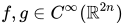


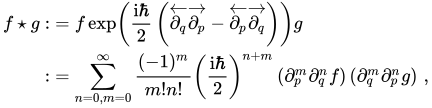
wobei die reduzierte Planck-Konstante ist und die Ableitung von und die von bedeutet.


Dabei wird der Operator
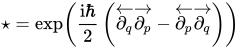
mittels der Bidifferentialoperator-Notation als zweistellige Verknüpfung geschrieben, das heißt der Differentialoperator wirkt sowohl auf die Funktion vor als auch auf die Funktion hinter dem Operatorsymbol.
Eigenschaften
Definitionsgemäß kann das Moyal-Produkt als eine Reihe mit gewissen Differentialoperatoren geschrieben werden:

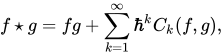
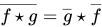
Das Produkt hat folgende Eigenschaften:
- (für siehe Poisson-Klammer)
- (1 ist die konstante Funktion mit Wert 1)
- (der Querstrich steht für die komplexe Konjugation)




Geschichte
Auch wenn das Moyal-Produkt nach Moyal benannt ist, wurde es erstmals 1946 von Groenewold in seiner Doktorarbeit eingeführt.[4] In den 1970ern wurde dann das formelle Sternprodukt eingeführt (Bayen, Flato, Frønsdal, Lichnerowicz, und Sternheimer).[5]
1983 zeigten Lecomte und De Wilde, dass auf jeder symplektischen Mannigfaltigkeit Sternprodukte existieren.[6] 1994 zeigte B.V. Fedosov, wie Sternprodukte auf symplektischen Mannigfaltigkeiten konstruiert werden.[7] 1997 bewies Maxim Konzewitsch, dass auf jeder endlichdimensionalen Poisson-Mannigfaltigkeit Sternprodukte existieren.[8] Für diese und andere Arbeiten bekam er die Fields-Medaille.[9]
Einzelnachweise
- ↑ star product. Abgerufen am 24. Mai 2021.
- ↑ Maciej Blaszak, Ziemowit Domanski: Phase Space Quantum Mechanics. In: arXiv:1009.0150 [math-ph, physics:quant-ph]. arxiv:1009.0150.
- ↑ Chiara Esposito: Lectures on Deformation quantization of Poisson manifolds. In: arXiv:1207.3287 [math-ph]. 18. Juli 2012, arxiv:1207.3287 (arxiv.org [PDF; abgerufen am 26. Mai 2021]).
- ↑ H. J. Groenewold: On the principles of elementary quantum mechanics. In: Physica. Band 12, Nr. 7, 1. Oktober 1946, S. 405–460, doi:10.1016/S0031-8914(46)80059-4 (rug.nl [PDF]).
- ↑ Pankaj Sharan: Star-product representation of path integrals. In: Physical Review D. Band 20, Nr. 2, 15. Juli 1979, S. 414–418, doi:10.1103/PhysRevD.20.414.
- ↑ Marc de Wilde, Pierre B. A. Lecomte: Existence of star-products and of formal deformations of the Poisson Lie algebra of arbitrary symplectic manifolds. In: Letters in Mathematical Physics. Band 7, Nr. 6, 1. November 1983, S. 487–496, doi:10.1007/BF00402248.
- ↑ Boris V. Fedosov: A simple geometrical construction of deformation quantization. In: Journal of Differential Geometry. Band 40, Nr. 2, Januar 1994, S. 213–238, doi:10.4310/jdg/1214455536.
- ↑ Maxim Kontsevich: Deformation Quantization of Poisson Manifolds. In: Letters in Mathematical Physics. Band 66, Nr. 3, 1. Dezember 2003, S. 157–216, doi:10.1023/B:MATH.0000027508.00421.bf, arxiv:q-alg/9709040v1.
- ↑ nLab: Maxim Kontsevich. Abgerufen am 28. Mai 2021.
Content Disclaimer
Informasi ini disarikan dari Wikipedia dan disajikan kembali untuk tujuan edukasi. Konten tersedia di bawah lisensi CC BY-SA 3.0. Kami tidak bertanggung jawab atas ketidakakuratan data yang bersumber dari kontribusi publik tersebut.
- The information displayed on this website is sourced in part or in whole from Wikipedia and has been adapted for the purpose of restating it. We strive to provide accurate and relevant information, however:
- There is no guarantee of absolute accuracy. Wikipedia is an open, collaborative project that can be edited by anyone, so information is subject to change.
- It is not intended to constitute professional advice. The content displayed is for informational and educational purposes only. For important decisions (e.g., medical, legal, or financial), please consult a professional.
- Content copyright. Wikipedia is licensed under the Creative Commons Attribution-ShareAlike License (CC BY-SA). This means that content may be reused with appropriate attribution and shared under a similar license.
- Responsible use. Any risk arising from the use of information from this website is entirely the responsibility of the user.