Bahnformel
Die Bahnformel ist ein mathematischer Satz aus der Gruppentheorie. Sie wird oft kurz einprägsam zusammengefasst als: „Die Länge der Bahn ist der Index des Stabilisators.“
Der Bahnensatz
Formulierung
Sei eine Gruppe und eine Operation von auf einer Menge . Dann ist für jedes die Abbildung




eine wohldefinierte Bijektion. Dabei bezeichnet
- die Bahn von ,
- den Stabilisator von und
- die Menge der Linksnebenklassen der Untergruppe in .





Beweis
Siehe:  Beweis des Bahnensatzes im Beweisarchiv
Aus dem Bahnensatz folgert man die Bahnformel.
Bahnformel
Im Fall ist . Dabei bezeichnet den Index von in . Für endliche Gruppen gilt daher die Bahnformel



- .

Beispiele
Konjugation
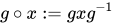
Jede Gruppe operiert auf sich selber vermöge der Konjugationsoperation . Die Bahn eines Elements bezeichnet man als Konjugationsklasse von . Der Stabilisator heißt Zentralisator von und wird mit bezeichnet. Die Bahnformel liefert somit für endliche Gruppen




- .

Transitive Operation
Ist die Operation einer endlichen Gruppe auf transitiv, so ist
- .

In diesem Fall muss also die Mächtigkeit von ein Teiler der Gruppenordnung sein.
Siehe auch
- Gruppenoperation
- Satz von Lagrange
- Eine elegante Anwendung der Bahnformel zeigt der Beweis von Ernst Witt (1931) des (kleinen) Satzes von Wedderburn (1905): „Jeder endliche Schiefkörper ist kommutativ.“
Literatur
- Kurt Meyberg: Algebra. Teil 1. 2. Auflage. Carl Hanser Verlag, 1980, ISBN 3-446-13079-9, S. 67
- Rainer Schulze-Pillot: Elementare Algebra und Zahlentheorie. ISBN 978-3-540-45379-6, S. 121–124
Weblinks
- Eric W. Weisstein: Bahn (Orbit) und Bahnformel. In: MathWorld (englisch). (englisch)
Content Disclaimer
Informasi ini disarikan dari Wikipedia dan disajikan kembali untuk tujuan edukasi. Konten tersedia di bawah lisensi CC BY-SA 3.0. Kami tidak bertanggung jawab atas ketidakakuratan data yang bersumber dari kontribusi publik tersebut.
- The information displayed on this website is sourced in part or in whole from Wikipedia and has been adapted for the purpose of restating it. We strive to provide accurate and relevant information, however:
- There is no guarantee of absolute accuracy. Wikipedia is an open, collaborative project that can be edited by anyone, so information is subject to change.
- It is not intended to constitute professional advice. The content displayed is for informational and educational purposes only. For important decisions (e.g., medical, legal, or financial), please consult a professional.
- Content copyright. Wikipedia is licensed under the Creative Commons Attribution-ShareAlike License (CC BY-SA). This means that content may be reused with appropriate attribution and shared under a similar license.
- Responsible use. Any risk arising from the use of information from this website is entirely the responsibility of the user.